Department of Oral and Maxillofacial Surgery, Haukeland University Hospital, Bergen, Norway.
Department of Clinical Dentistry, University of Bergen, Bergen, Norway.
BMC Oral Health. 2024 Nov 19;24(1):1406. doi: 10.1186/s12903-024-05170-0.
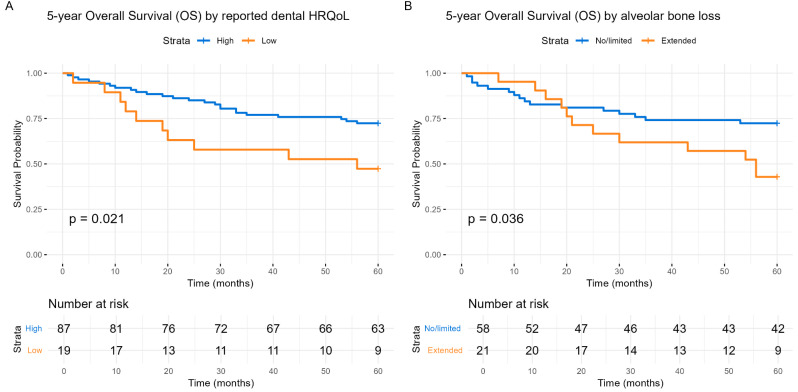
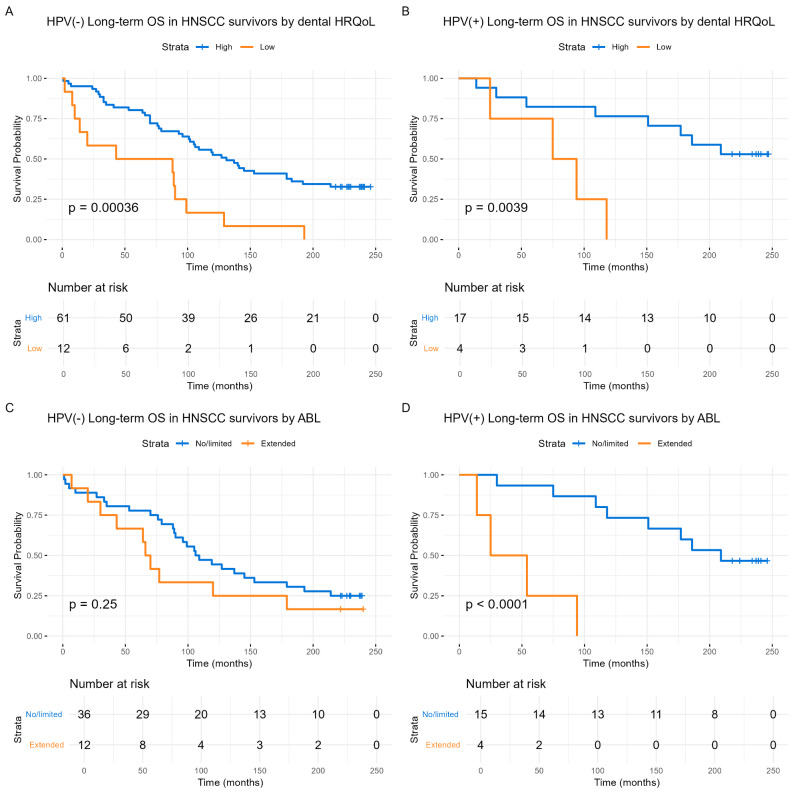
Our aim was to investigate oral health in newly diagnosed head and neck squamous cell carcinoma (HNSCC) patients in relation to long-term survival. We assessed whether the level of alveolar bone loss due to periodontitis at diagnosis, measured from orthopantomogram (OPG), and reported dental health-related quality of life (HRQoL) scores obtained at diagnosis contain prognostic information for HNSCC patients.
A total of 79 patients from a consecutive cohort of 106 diagnosed with HNSCC between November 2002 and June 2005 were included. All patients reported dental HRQoL, OPG-determined alveolar bone loss were measured in 79 patients at diagnosis. Reduced alveolar bone loss (≥ 4 mm) from cement-enamel junction on at least two molars or premolars registered both horizontally and vertically served as indicator of periodontal disease.
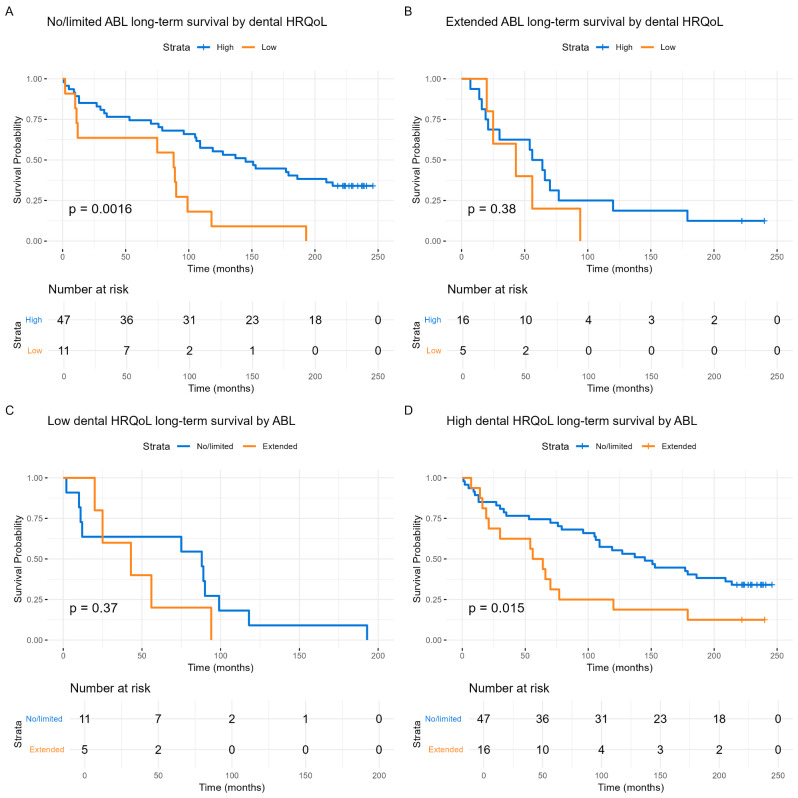
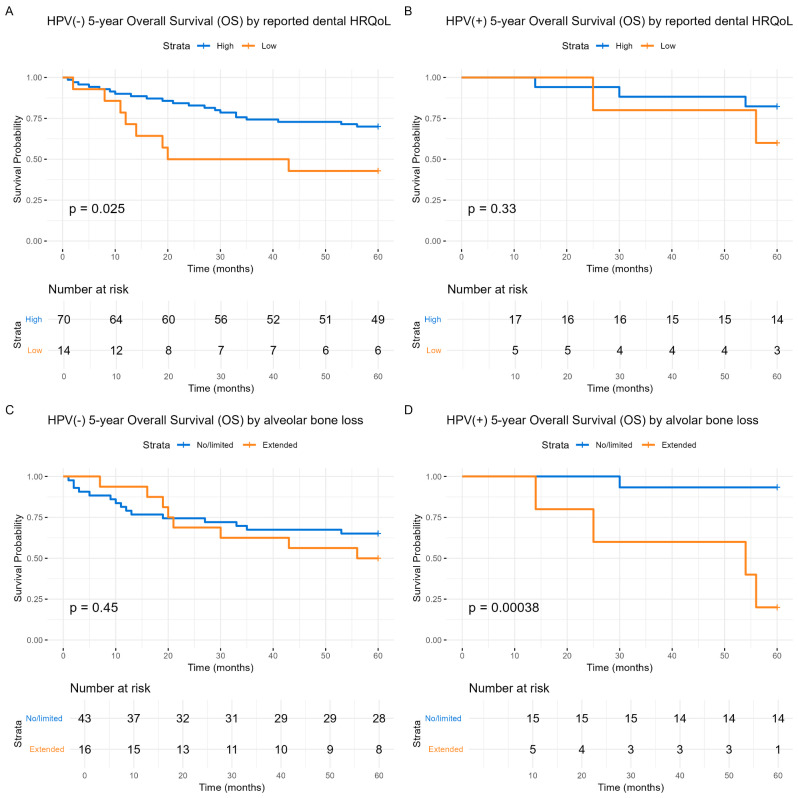
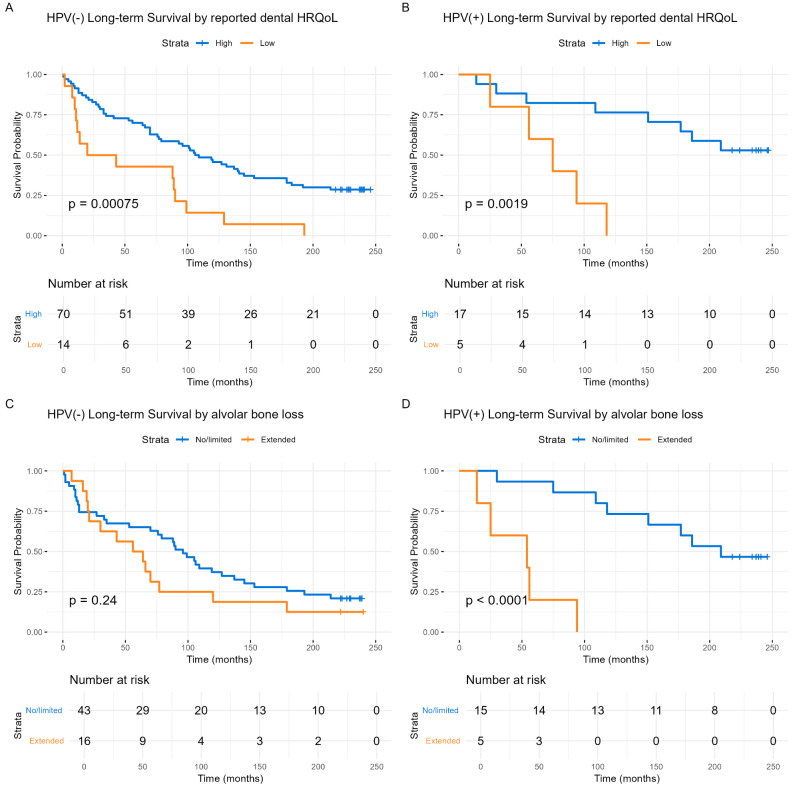
With alveolar bone loss, we determined increased mortality by univariate analysis (RR = 2.28, CI: 1.22-4.28, p = 0.01) and a strong trend by multivariate analyses adjusted for standard clinical information (RR = 1.95, CI: 0.98-3.87, p = 0.056). Reported lowered dental HRQoL scores predicted long-term survival in both univariate (RR = 3.58, CI: 1.99-6.45, p < 0.001) and multivariate adjusted for standard clinical information (RR = 2.17, CI: 1.17-4.01, p = 0.014). When analyzed with Cox regression, including alveolar bone loss and dental HRQoL, both factors, adjusted by clinical variables, were significant predictors of long-term survival: dental HRQoL (p = 0.007) and present alveolar bone loss (p = 0.034). Non-HNSCC disease-specific long-term survival predicted was also predicted when alveolar bone loss and dental HRQoL were analyzed simultaneously and adjusted for standard clinical information.
The degree of alveolar bone loss, as determined by OPG, and dental HRQoL both obtained at the time of HNSCC diagnosis, predicted long-term survival. When analyzed simultaneously, both factors remained significant in both univariate and multivariate analyses, adjusted by pertinent clinical variables, highlighting their unique prognostic value.
本研究旨在调查新诊断的头颈部鳞状细胞癌(HNSCC)患者的口腔健康状况与长期生存的关系。我们评估了在诊断时,牙周炎导致的牙槽骨丧失程度(通过全口曲面断层片 [OPG] 测量)和在诊断时报告的口腔健康相关生活质量(HRQoL)评分是否包含 HNSCC 患者的预后信息。
我们纳入了 2002 年 11 月至 2005 年 6 月期间连续确诊的 106 例 HNSCC 患者中的 79 例。所有患者均报告了口腔 HRQoL,在诊断时对 79 例患者进行了 OPG 确定的牙槽骨丧失测量。至少两个磨牙或前磨牙的牙骨质-釉质界处的牙槽骨丧失增加(≥4mm)被认为是牙周病的指标。
通过单因素分析,我们确定牙槽骨丢失与死亡率增加相关(RR=2.28,95%CI:1.22-4.28,p=0.01),通过调整标准临床信息的多因素分析也显示出明显的趋势(RR=1.95,95%CI:0.98-3.87,p=0.056)。报告的口腔 HRQoL 评分降低在单因素(RR=3.58,95%CI:1.99-6.45,p<0.001)和调整标准临床信息的多因素分析中(RR=2.17,95%CI:1.17-4.01,p=0.014)均预测了长期生存。当使用 Cox 回归分析同时包括牙槽骨丢失和口腔 HRQoL 时,在调整了临床变量后,这两个因素均为长期生存的显著预测因素:口腔 HRQoL(p=0.007)和当前的牙槽骨丢失(p=0.034)。当同时分析并调整标准临床信息时,非 HNSCC 疾病特异性长期生存也可以预测。
通过 OPG 确定的牙槽骨丧失程度和 HNSCC 诊断时获得的口腔 HRQoL 均可预测长期生存。当同时进行分析并在调整相关临床变量后,这两个因素在单因素和多因素分析中均保持显著,突出了它们独特的预后价值。