Commander, Dental Corps, United States Navy; Associate Professor, Uniformed Services University of the Health Sciences Postgraduate Dental College; Chair, Department of Orofacial Pain, Naval Postgraduate Dental School, Naval Medical Leader and Professional Development Command.
Deputy Chair, Department of Health Professions Education, Uniformed Services University of the Health Sciences.
MedEdPORTAL. 2024 Nov 19;20:11467. doi: 10.15766/mep_2374-8265.11467. eCollection 2024.
Temporomandibular disorders (TMDs) are common musculoskeletal pain conditions that can significantly impact daily activities such as eating, talking, breathing, intimacy, and expressing emotion. TMDs are often complex and multifactorial, and many patients experience overlapping pain conditions, sleep difficulties, and mental health challenges. The National Academies of Sciences, Engineering and Medicine (NASEM) has called for improved TMD education and training for health professionals, as current training opportunities are limited.
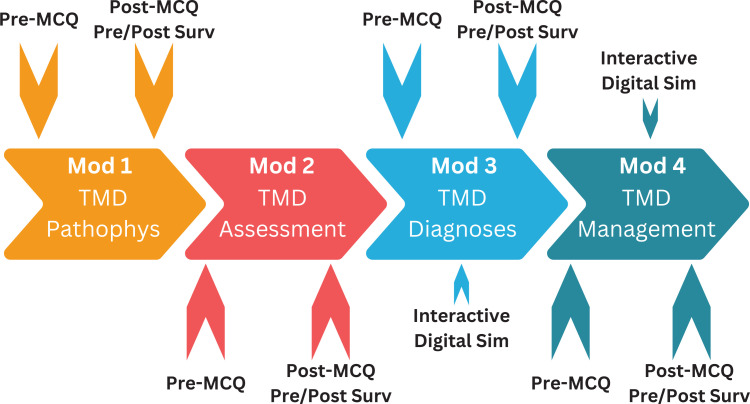
To prepare health professionals to care for patients who have a TMD, we designed a 5-hour, interactive, module-based curriculum aligned with the 2020 NASEM recommendations. The four-part module set addresses TMD physiology and pathophysiology, assessment, diagnosis, and management. Instructional methods are founded on the Cognitive Theory of Multimedia Learning and include engaging videos, clinical evaluation and education tools, and interactive digital simulation scenarios.
Thirty learners from diverse health professional backgrounds (medicine, dentistry, physician assistant, nursing, physical therapy) participated. Multiple-choice question assessments and pre/post retrospective survey scores demonstrated enhanced knowledge ( = 2.9 vs. = 4.2, < .001) and perceived competence ( = 1.9 vs. = 3.4, < .001), respectively. Encouragingly, all participants indicated applicability to their clinical practice.
Our modules offer educators and clinicians a valuable resource to improve TMD knowledge and facilitate best practices. Supplementary resources included in the curriculum are conducive to clinical implementation, fostering improved clinician assessment and patient education.
颞下颌关节紊乱病(TMDs)是常见的肌肉骨骼疼痛疾病,会严重影响日常活动,如进食、说话、呼吸、亲密和表达情感。TMDs 通常较为复杂且具有多因素性,许多患者同时存在多种疼痛状况、睡眠困难和心理健康挑战。美国国家科学院、工程院和医学院(NASEM)呼吁为健康专业人员提供更好的 TMD 教育和培训,因为目前的培训机会有限。
为了让健康专业人员能够照顾患有 TMD 的患者,我们设计了一个 5 小时的互动式、基于模块的课程,与 2020 年 NASEM 的建议保持一致。该四部分模块集涵盖了 TMD 的生理学和病理生理学、评估、诊断和管理。教学方法基于多媒体学习的认知理论,包括引人入胜的视频、临床评估和教育工具以及互动数字模拟场景。
来自不同健康专业背景(医学、牙科、医师助理、护理、物理治疗)的 30 名学习者参与了该课程。多项选择题评估和预/后回顾性调查评分表明,知识水平有所提高( = 2.9 对 = 4.2, <.001),感知能力也有所提高( = 1.9 对 = 3.4, <.001)。令人鼓舞的是,所有参与者都表示这些模块适用于他们的临床实践。
我们的模块为教育者和临床医生提供了宝贵的资源,可用于提高 TMD 知识水平,并促进最佳实践。课程中包含的补充资源有利于临床实施,有助于提高临床医生的评估和患者教育水平。