
利用分子信号从轮烷中实现葫芦[6]脲的变构释放。
Allosteric release of cucurbit[6]uril from a rotaxane using a molecular signal.
作者信息
Závodná Aneta, Janovský Petr, Kolařík Václav, Ward Jas S, Prucková Zdeňka, Rouchal Michal, Rissanen Kari, Vícha Robert
机构信息
Department of Chemistry, Faculty of Technology, Tomas Bata University in Zlín Vavrečkova 5669 760 01 Zlín Czech Republic
Department of Chemistry, University of Jyväskylä P.O. Box 35, Survontie 9 B 40014 Jyväskylä Finland.
出版信息
Chem Sci. 2024 Nov 5;16(1):83-89. doi: 10.1039/d4sc03970j. eCollection 2024 Dec 18.
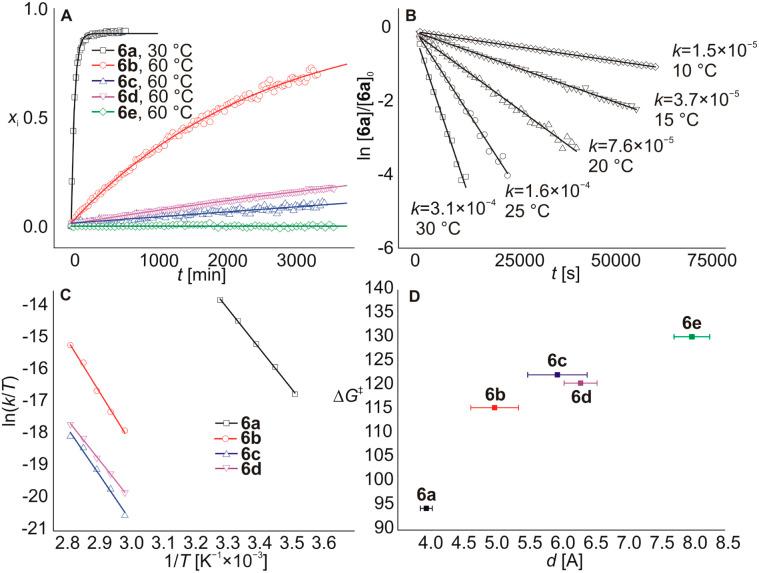
Rotaxanes can be regarded as storage systems for their wheel components, which broadens their application potential as a complement to the supramolecular systems that retain a mechanically interlocked structure. However, utilising rotaxanes in this way requires a method to release the wheel while preserving the integrity of all molecular constituents. Herein, we present simple rotaxanes based on cucurbit[6]uril (CB6), with an axis equipped with an additional binding motif that enables the binding of another macrocycle, cucurbit[7]uril (CB7). We demonstrate that the driving force behind the wheel dethreading originates from the binding of the signalling macrocycle to the allosteric site, leading to an increase in the system's strain. Consequently, the CB6 wheel leaves the rotaxane station overcoming the mechanical barrier. Portal-portal repulsive interactions between the two cucurbituril units play a crucial role in this process. Thus, the repulsive strength and the related rate of slipping off can be finely tuned by the length of the allosteric binding motif. Finally, we show that the CB6 wheel can be utilised within complexes with other guests in the mixture once released from the rotaxane.
轮烷可被视为其轮状组件的存储系统,这拓宽了它们作为对保持机械互锁结构的超分子系统的补充的应用潜力。然而,以这种方式使用轮烷需要一种在保持所有分子成分完整性的同时释放轮状组件的方法。在此,我们展示了基于葫芦[6]脲(CB6)的简单轮烷,其轴上配备了一个额外的结合基序,能够与另一种大环分子葫芦[7]脲(CB7)结合。我们证明,轮状组件脱扣背后的驱动力源于信号大环与变构位点的结合,导致系统应变增加。因此,CB6轮状组件克服机械障碍离开轮烷站点。两个葫芦脲单元之间的门户-门户排斥相互作用在此过程中起关键作用。因此,排斥强度和相关的滑脱速率可以通过变构结合基序的长度进行精细调节。最后,我们表明,一旦从轮烷中释放出来,CB6轮状组件可以与混合物中的其他客体一起用于复合物中。



 Zotero 插件