Wei Yilin, Ma Zixu, Liu Beibei, Yang Jialin, Wu Dan, Zhang Yongsheng, Zhang Yuexing, Xu Chunbao Charles, Nie Renfeng
National Key Laboratory of Biobased Transportation Fuel Technology, School of Chemical Engineering, Henan Center for Outstanding Overseas Scientists, Zhengzhou University Zhengzhou 450001 China
College of Chemistry and Chemical Engineering, Dezhou University Dezhou 253023 P. R. China
Chem Sci. 2024 Nov 13;15(48):20338-20345. doi: 10.1039/d4sc05885b. eCollection 2024 Dec 11.
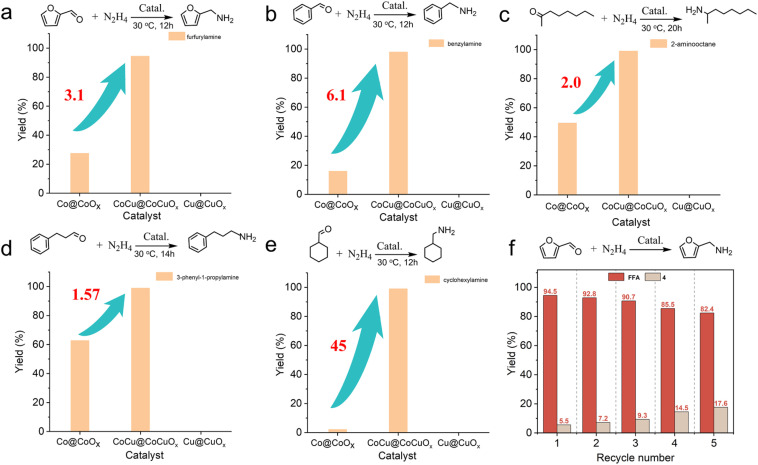
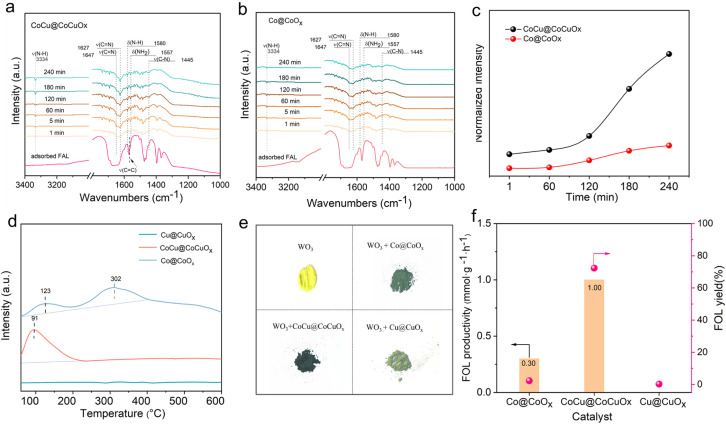
The synthesis of primary amines from renewable biomass and its derivatives through reductive amination has garnered significant attention. How to construct efficient non-noble-metal catalysts that enable low-temperature catalysis still remains challenging. Herein, we report a Cu-doped Co@CoO heterostructure catalyst that features structural Co-CoCuO bifunctional sites, which enable room temperature reductive amination of various aldehydes with 1.57-45 times higher efficiency than Co@CoO , outperforming many reported non-noble and even noble metal catalysts. Experiments and DFT calculations indicate that Cu doping leads to a phase transition of Co from hcp to fcc, while electrons are transferred from Cu to Co, forming a dual active site with electron-rich Co closely interacting with CoCuO . These electron-rich Co sites demonstrate excellent activity in the activation and dissociation of hydrogen, while the CuO component facilitates hydrogen spillover at the CoCuO interface, thus resulting in a highly efficient cooperative effect for the furfural (FAL) reductive amination. This work provides general guidance for the rational design of high-performance reductive amination catalysts for biomass upgrading.
通过还原胺化反应从可再生生物质及其衍生物合成伯胺已引起广泛关注。如何构建能够实现低温催化的高效非贵金属催化剂仍然具有挑战性。在此,我们报道了一种Cu掺杂的Co@CoO异质结构催化剂,其具有结构性Co-CoCuO双功能位点,能够在室温下对各种醛进行还原胺化反应,效率比Co@CoO高1.57至45倍,优于许多已报道的非贵金属甚至贵金属催化剂。实验和DFT计算表明,Cu掺杂导致Co从hcp相转变为fcc相,同时电子从Cu转移到Co,形成了富电子的Co与CoCuO紧密相互作用的双活性位点。这些富电子的Co位点在氢的活化和解离方面表现出优异的活性,而CuO组分促进了氢在CoCuO界面的溢流,从而对糠醛(FAL)还原胺化产生了高效的协同效应。这项工作为生物质升级的高性能还原胺化催化剂的合理设计提供了通用指导。