Broitman Adam W, Kahana Michael J
University of Pennsylvania.
bioRxiv. 2024 Nov 9:2024.11.07.622553. doi: 10.1101/2024.11.07.622553.
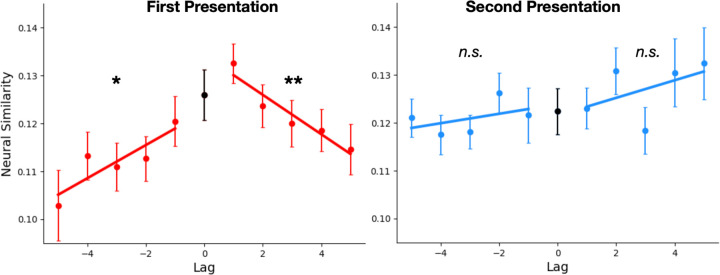
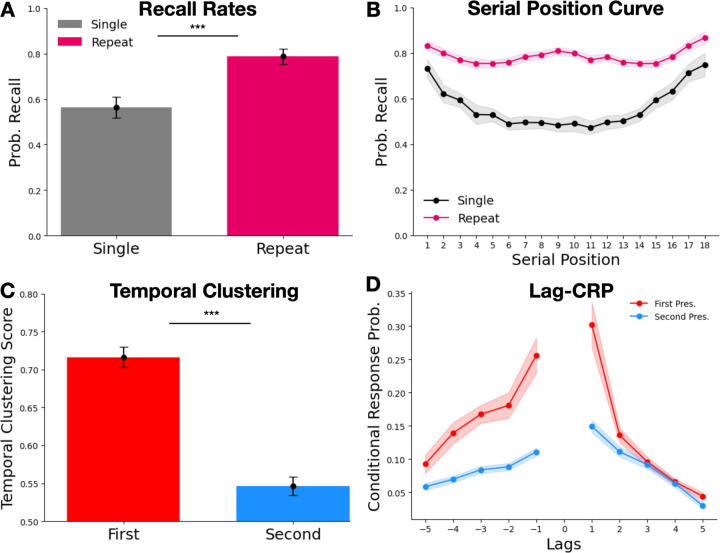
Episodic recollection involves retrieving context information bound to specific events. However, autobiographical memory largely comprises recurrent, similar experiences that become integrated into joint representations. In the current study, we extracted a neural signature of temporal context from scalp electroencephalography (EEG) to investigate whether recalling a recurring event accompanies the reinstatement of one or multiple instances of its occurrence. We asked 52 young adults to study and recall lists of words that included both once-presented and repeated items. Participants recalled repeated items in association with neighboring list items from each occurrence, but with stronger clustering around the repetition's initial occurrence. Furthermore, multivariate spectral EEG analyses revealed that neural activity from just prior to the recall of these words resembled patterns of activity observed near the item's first occurrence, but not its second. Together, these results suggest that the initial occurrence of an event carries stronger temporal context associations than later repetitions.
情景回忆涉及检索与特定事件相关的背景信息。然而,自传体记忆很大程度上由反复出现的类似经历组成,这些经历会整合到联合表征中。在当前的研究中,我们从头皮脑电图(EEG)中提取了时间背景的神经特征,以调查回忆一个反复出现的事件是否伴随着对其一次或多次出现实例的恢复。我们让52名年轻人学习并回忆包含单次呈现和重复项目的单词列表。参与者回忆重复项目时会与每次出现时相邻的列表项目相关联,但在重复首次出现时周围的聚类更强。此外,多变量频谱脑电图分析表明,就在这些单词被回忆之前的神经活动类似于在项目首次出现时观察到的活动模式,而不是第二次出现时的模式。总之,这些结果表明,事件的首次出现比后来的重复具有更强的时间背景关联。