Gao Chao, Ding Hai-Tao, Li Kang, Cao Hai-Yan, Wang Ning, Gu Zeng-Tian, Wang Qing, Sun Mei-Ling, Chen Xiu-Lan, Chen Yin, Zhang Yu-Zhong, Fu Hui-Hui, Li Chun-Yang
State Key Laboratory of Microbial Technology, Marine Biotechnology Research Center, Shandong University, Qingdao, China.
MOE Key Laboratory of Evolution and Marine Biodiversity, Frontiers Science Center for Deep Ocean Multispheres and Earth System & College of Marine Life Sciences, Ocean University of China, Qingdao, China.
mBio. 2025 Jan 8;16(1):e0191424. doi: 10.1128/mbio.01914-24. Epub 2024 Nov 22.
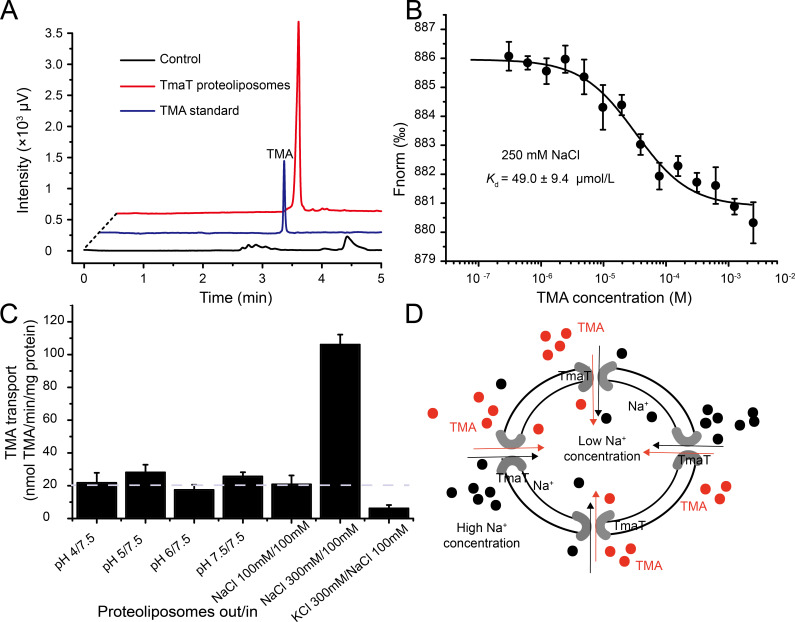
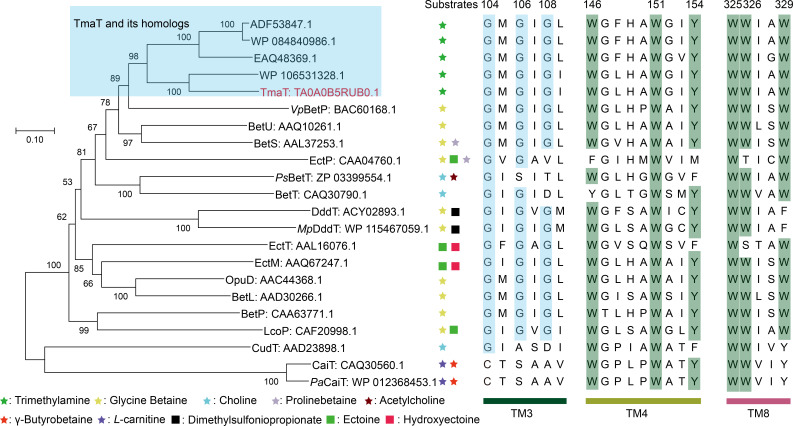
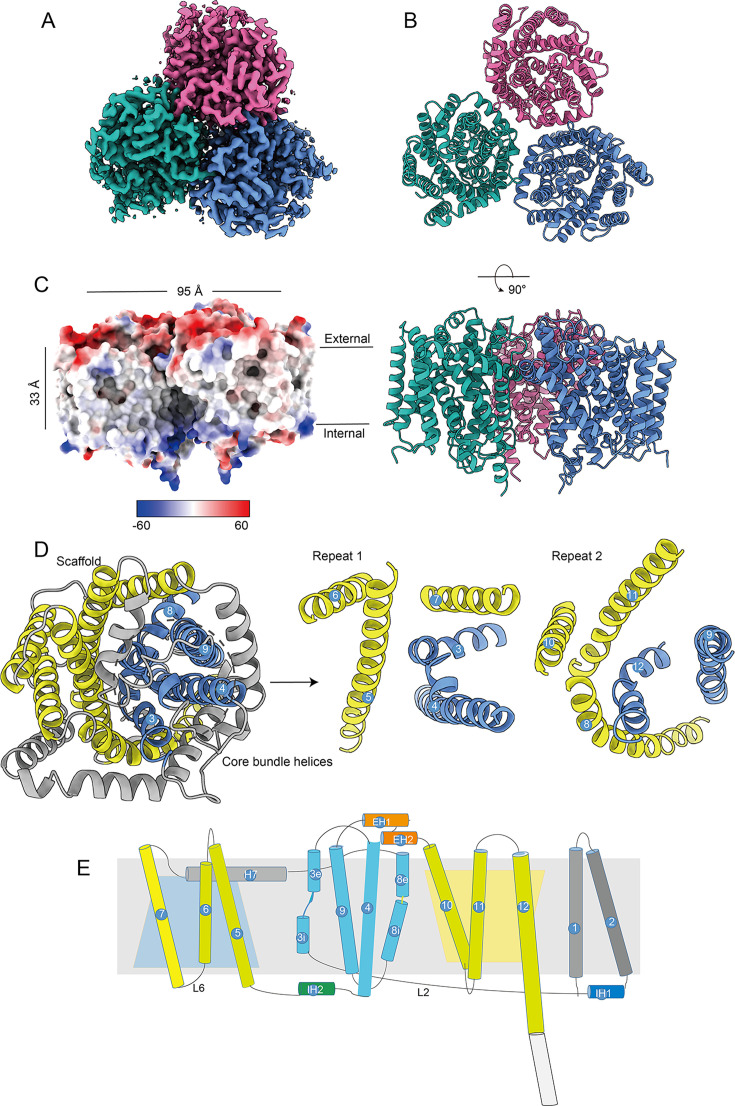
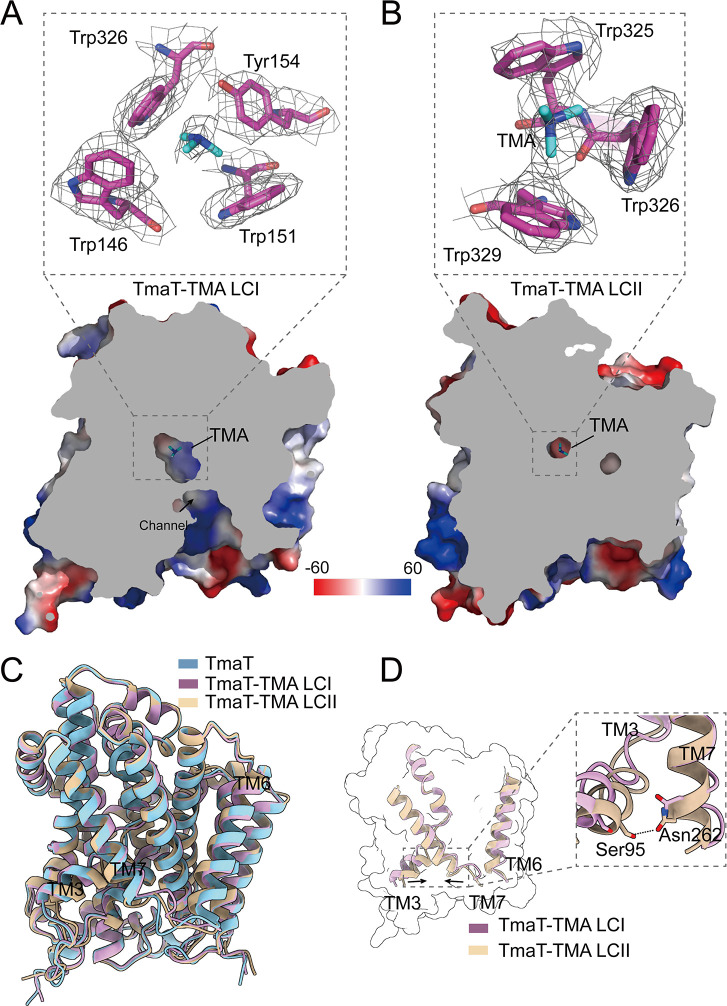
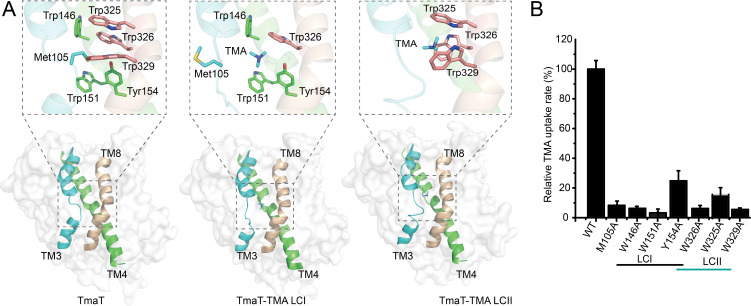
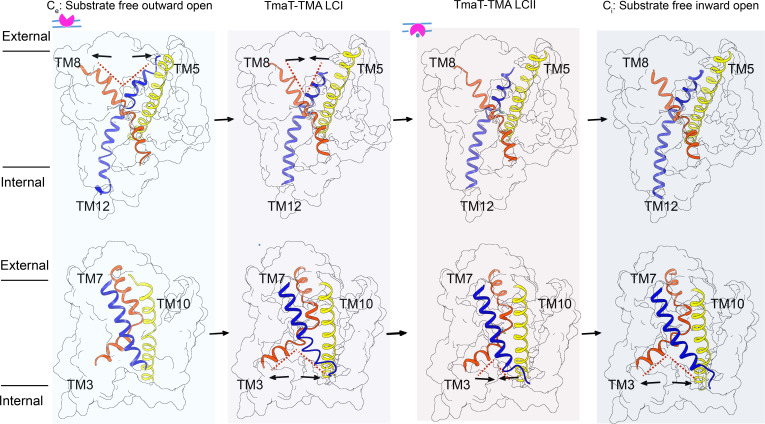
Trimethylamine (TMA), a simple trace biogenic amine resulting from the decomposition of proteins and other macromolecules, is ubiquitous in nature. It is found in the human gut as well as in various terrestrial and marine ecosystems. While the role of TMA in promoting cardiovascular diseases and depolarizing olfactory sensory neurons in humans has only recently been explored, many microbes are well known for their ability to utilize TMA as a carbon, nitrogen, and energy source. Here, we report the first structure of a TMA transporter, TmaT, originally identified from a marine bacterium. TmaT is a member of the betaine-choline-carnitine transporter family, and we show that TmaT is an Na/TMA symporter, which possessed high specificity and binding affinity toward TMA. Furthermore, the structures of TmaT and two TmaT-TMA complexes were solved by cryo-EM. TmaT forms a homotrimer structure in solution. Each TmaT monomer has 12 transmembrane helices, and the TMA transport channel is formed by a four-helix bundle. TMA can move between different aromatic boxes, which provides the structural basis of TmaT importing TMA. When TMA is bound in location I, residues Trp146, Trp151, Tyr154, and Trp326 form an aromatic box to accommodate TMA. Moreover, Met105 also plays an important role in the binding of TMA. When TMA is transferred to location II, it is bound in the aromatic box formed by Trp325, Trp326, and Trp329. Based on our results, we proposed the TMA transport mechanism by TmaT. This study provides novel insights into TMA transport across biological membranes.
The volatile trimethylamine (TMA) plays an important role in promoting cardiovascular diseases and depolarizing olfactory sensory neurons in humans and serves as a key nutrient source for a variety of ubiquitous marine microbes. While the TMA transporter TmaT has been identified from a marine bacterium, the structure of TmaT and the molecular mechanism involved in TMA transport remain unclear. In this study, we elucidated the high-resolution cryo-EM structures of TmaT and TmaT-TMA complexes and revealed the TMA binding and transport mechanisms by structural and biochemical analyses. The results advance our understanding of the TMA transport processes across biological membranes.
三甲胺(TMA)是一种由蛋白质和其他大分子分解产生的简单痕量生物胺,在自然界中普遍存在。它存在于人体肠道以及各种陆地和海洋生态系统中。虽然TMA在促进人类心血管疾病和使嗅觉感觉神经元去极化方面的作用直到最近才被探索,但许多微生物以其利用TMA作为碳、氮和能量来源的能力而闻名。在这里,我们报告了一种TMA转运蛋白TmaT的首个结构,该蛋白最初是从一种海洋细菌中鉴定出来的。TmaT是甜菜碱 - 胆碱 - 肉碱转运蛋白家族的成员,我们表明TmaT是一种Na/TMA同向转运体,对TMA具有高特异性和结合亲和力。此外,通过冷冻电镜解析了TmaT及其与两个TMA复合物的结构。TmaT在溶液中形成同源三聚体结构。每个TmaT单体有12个跨膜螺旋,TMA转运通道由一个四螺旋束形成。TMA可以在不同的芳香盒之间移动,这为TmaT导入TMA提供了结构基础。当TMA结合在位置I时,色氨酸残基Trp146、Trp151、酪氨酸残基Tyr154和色氨酸残基Trp326形成一个芳香盒来容纳TMA。此外,甲硫氨酸残基Met105在TMA的结合中也起重要作用。当TMA转移到位置II时,它结合在由Trp325、Trp326和Trp329形成的芳香盒中。基于我们的结果,我们提出了TmaT的TMA转运机制。这项研究为TMA跨生物膜的转运提供了新的见解。
挥发性三甲胺(TMA)在促进人类心血管疾病和使嗅觉感觉神经元去极化方面起重要作用,并且是多种普遍存在的海洋微生物的关键营养源。虽然已从一种海洋细菌中鉴定出TMA转运蛋白TmaT,但TmaT的结构以及TMA转运所涉及的分子机制仍不清楚。在这项研究中,我们阐明了TmaT及其与TMA复合物的高分辨率冷冻电镜结构,并通过结构和生化分析揭示了TMA的结合和转运机制。这些结果推进了我们对TMA跨生物膜转运过程的理解。