Camuto Cristian, De-Giorgio Fabio, Corli Giorgia, Bilel Sabrine, Mazzarino Monica, Marti Matteo, Botrè Francesco
Laboratorio Antidoping FMSI, Largo Giulio Onesti 1, 00197, Rome, Italy.
Department of Health Care Surveillance and Bioethics, Section of Legal Medicine, Università Cattolica del Sacro Cuore, Largo Francesco Vito 1, Rome, Italy.
Forensic Toxicol. 2025 Jan;43(1):130-141. doi: 10.1007/s11419-024-00705-0. Epub 2024 Nov 22.
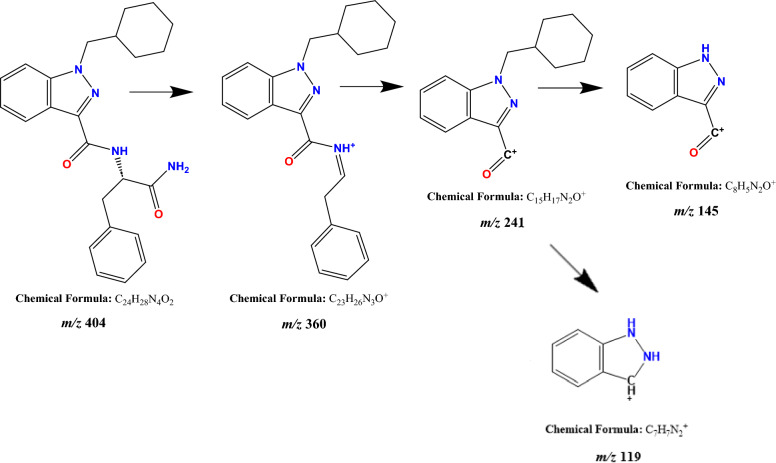
The metabolic pathways of APP-CHMINACA were characterized to select the markers of intake for implementation into analytical assays used by the clinical and forensic communities. We have combined the evidences obtained by both in vitro experiments and administration studies on mice.
APP-CHMINACA was incubated with either human or mouse liver microsomes. Urine and blood samples were collected at different time points from mice after injection of a 3 mg/kg dose of the test compound. Samples were analyzed using liquid chromatography-tandem mass spectrometry.
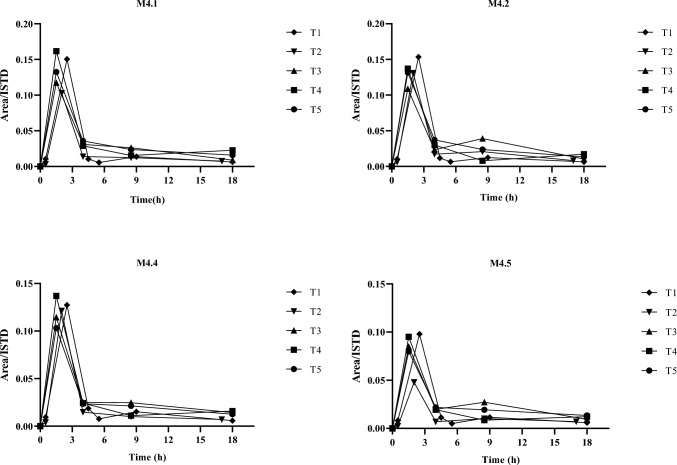
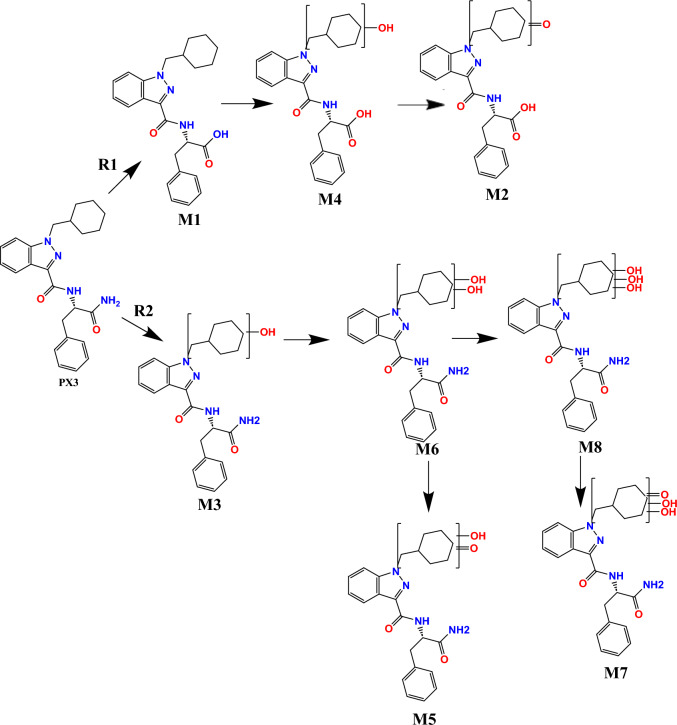
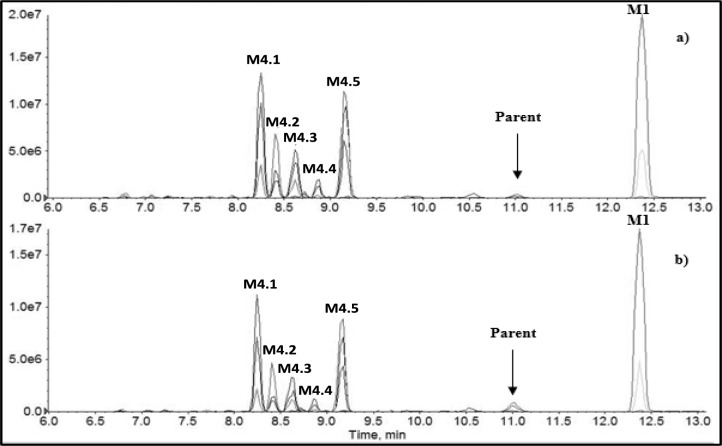
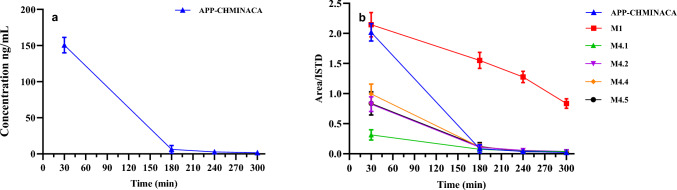
The in vitro studies allowed to isolate eight different metabolic reactions, formed by two metabolic routes, with no differences between human and mouse liver microsomes. The main biotransformation route involved the hydrolysis of the distal amide group and the subsequent hydroxylation on the cyclohexyl-methyl ring. The second route involved multiple hydroxylation of the parent compound, followed by reduction to generate minor metabolites. In blood samples, the most abundant substances identified were APP-CHMINACA unchanged and the metabolites formed by the hydrolysis of the distal amide together with its hydroxylated products. In urine samples, four metabolites formed following the hydroxylation of the distal amide hydrolysis metabolite were detected as the most abundant and long-term metabolites.
The outcomes of our study showed that the most suitable markers to detect the intake of APP-CHMINACA in blood and urine samples in the framework of toxicological, clinical and forensic investigations were the metabolite formed by the hydrolysis of the distal amide and its hydroxylated products.
对APP-CHMINACA的代谢途径进行表征,以选择摄入标志物,用于临床和法医领域使用的分析检测方法。我们结合了体外实验和小鼠给药研究获得的证据。
将APP-CHMINACA与人或小鼠肝微粒体一起孵育。给小鼠注射3mg/kg剂量的受试化合物后,在不同时间点采集尿液和血液样本。使用液相色谱-串联质谱法对样本进行分析。
体外研究分离出了由两条代谢途径形成的八种不同代谢反应,人肝微粒体和小鼠肝微粒体之间没有差异。主要生物转化途径涉及末端酰胺基团的水解以及随后在环己基甲基环上的羟基化。第二条途径涉及母体化合物的多次羟基化,随后还原生成次要代谢产物。在血液样本中,鉴定出的最丰富物质是未变化的APP-CHMINACA以及末端酰胺水解形成的代谢产物及其羟基化产物。在尿液样本中,检测到末端酰胺水解代谢产物羟基化后形成的四种代谢产物是最丰富和长期存在的代谢产物。
我们的研究结果表明,在毒理学、临床和法医调查框架内,检测血液和尿液样本中APP-CHMINACA摄入的最合适标志物是末端酰胺水解形成的代谢产物及其羟基化产物。