Department of Dermatology, Xiangya Hospital, Central South University, Changsha, Hunan Province, China.
National Engineering Research Center of Personalized Diagnostic and Therapeutic Technology, Changsha, Hunan Province, China.
J Immunother Cancer. 2024 Nov 24;12(11):e009805. doi: 10.1136/jitc-2024-009805.
Despite the successful application of immunotherapy, both innate and acquired resistance are typical in melanoma. Ferroptosis induction appears to be a potential strategy to enhance the effectiveness of immunotherapy. However, the relationship between the status of ferroptosis and the effectiveness of immunotherapy, as well as viable strategies to augment ferroptosis, remains unclear.
A screening of 200 cardiovascular drugs obtained from the Food and Drug Administration-approved drug library was conducted to identify the potential ferroptosis sensitizer. In vitro and in vivo experiments explored the effects of propafenone on ferroptosis in melanoma. Animal models and transcriptomic analyses evaluated the therapeutic effects and survival benefits of propafenone combined with immune checkpoint blockades (ICBs). The relationship between propafenone targets and the efficacy of ICBs was validated using the Xiangya melanoma data set and publicly available clinical data sets.
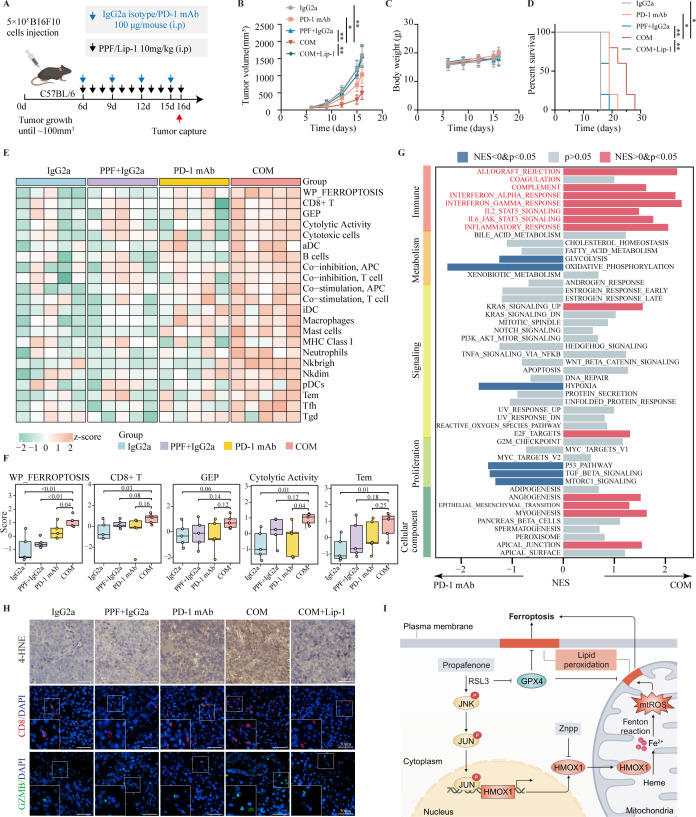
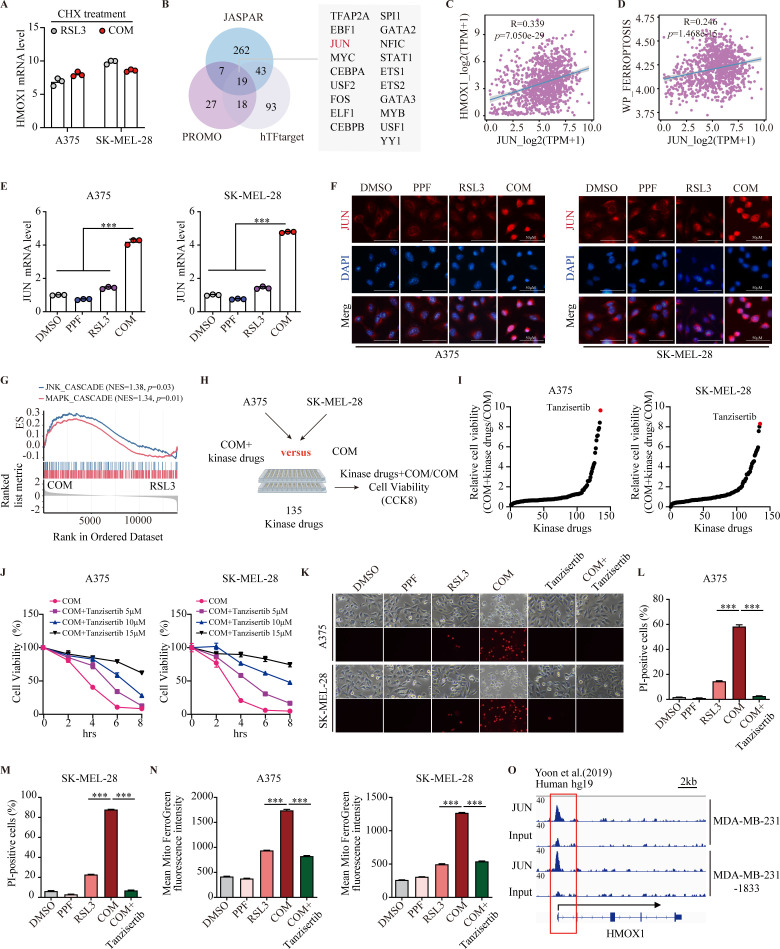
Through large-scale drug screening of cardiovascular drugs, we identified propafenone, an anti-arrhythmia medication, as capable of synergizing with ferroptosis inducers in melanoma. Furthermore, we observed that propafenone, in combination with glutathione peroxidase 4 inhibitor RSL3, collaboratively induces mitochondrial-associated ferroptosis. Mechanistically, propafenone transcriptionally upregulates mitochondrial heme oxygenase 1 through the activation of the Jun N-terminal kinase (JNK)/JUN signaling pathway under RSL3 treatment, leading to overloaded ferrous iron and reactive oxygen species within the mitochondria. In xenograft models, the combination of propafenone and ferroptosis induction led to nearly complete tumor regression and prolonged survival. Consistently, propafenone enhances immunotherapy-induced tumorous ferroptosis and antitumor immunity in tumor-bearing mice. Significantly, patients exhibiting high levels of ferroptosis/JUN/HMOX1 exhibited improved efficacy of immunotherapy and prolonged progression-free survival.
Taken together, our findings suggest that propafenone holds promise as a candidate drug for enhancing the efficacy of immunotherapy and other ferroptosis-targeted therapies in the treatment of melanoma.
尽管免疫疗法取得了成功,但黑色素瘤中存在固有和获得性耐药。诱导铁死亡似乎是增强免疫疗法效果的一种潜在策略。然而,铁死亡状态与免疫疗法效果的关系以及增强铁死亡的可行策略尚不清楚。
从美国食品和药物管理局批准的药物库中筛选了 200 种心血管药物,以确定潜在的铁死亡敏化剂。在体外和体内实验中研究了普罗帕酮对黑色素瘤中铁死亡的影响。动物模型和转录组分析评估了普罗帕酮联合免疫检查点阻断(ICB)的治疗效果和生存获益。使用湘雅黑色素瘤数据集和公开可用的临床数据集验证普罗帕酮靶标与 ICB 疗效之间的关系。
通过对心血管药物进行大规模药物筛选,我们发现普罗帕酮,一种抗心律失常药物,能够与黑色素瘤中的铁死亡诱导剂协同作用。此外,我们观察到普罗帕酮与谷胱甘肽过氧化物酶 4 抑制剂 RSL3 联合使用可协同诱导线粒体相关铁死亡。在机制上,普罗帕酮通过在 RSL3 处理下激活 Jun N 端激酶(JNK)/JUN 信号通路转录上调线粒体血红素加氧酶 1,导致线粒体中铁离子和活性氧超负荷。在异种移植模型中,普罗帕酮与铁死亡诱导剂的联合使用导致肿瘤几乎完全消退并延长了生存时间。一致地,普罗帕酮增强了荷瘤小鼠中免疫治疗诱导的肿瘤铁死亡和抗肿瘤免疫。重要的是,表现出高铁死亡/JUN/HMOX1 水平的患者对免疫治疗的疗效提高,并延长了无进展生存期。
总之,我们的研究结果表明普罗帕酮有望成为增强免疫疗法和其他铁死亡靶向疗法在黑色素瘤治疗中的疗效的候选药物。