Gomes-Silva Joana, Pinho Marcos D, Friães Ana, Ramirez Mário, Melo-Cristino José, Silva-Costa Catarina
Instituto de Medicina Molecular, Faculdade de Medicina, Universidade de Lisboa, Av. Prof. Egas Moniz, Lisbon, PT 1649-028, Portugal.
Pneumonia (Nathan). 2024 Nov 25;16(1):26. doi: 10.1186/s41479-024-00151-x.
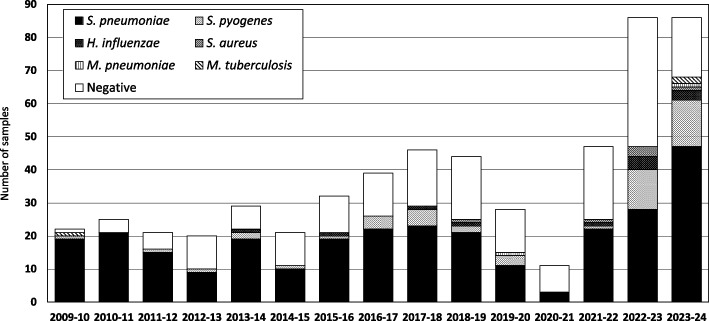
Nucleic acid amplification tests (NAATs) greatly enhance the capacity to identify the etiology of pediatric complicated pneumonia. However, the use of pneumococcal conjugate vaccines could reduce the importance of Streptococcus pneumoniae in pediatric complicated pneumonia with the potential emergence of other bacterial agents. Using an expanded NAAT in culture negative pleural fluid or empyema samples collected in 2010-2024 (n = 554) in Portugal, we show that S. pneumoniae remains the most frequent agent despite decades of pneumococcal conjugate vaccine use and the COVID-19 pandemic. A rebound in pediatric complicated pneumonia occurred post-pandemic, including a rise in cases by Streptococcus pyogenes and Haemophilus influenzae. Empiric therapy of pediatric complicated pneumonia should still consider S. pneumoniae as the most likely cause, even in countries where the pneumococcal conjugate vaccine is in the national immunization program with a high uptake.
核酸扩增检测(NAATs)极大地提高了识别儿童复杂性肺炎病因的能力。然而,肺炎球菌结合疫苗的使用可能会降低肺炎链球菌在儿童复杂性肺炎中的重要性,其他细菌病原体可能会出现。通过对2010年至2024年在葡萄牙收集的培养阴性胸腔积液或脓胸样本(n = 554)使用扩展的NAAT,我们发现尽管使用肺炎球菌结合疫苗数十年且经历了新冠疫情,但肺炎链球菌仍然是最常见的病原体。疫情后儿童复杂性肺炎出现反弹,包括化脓性链球菌和流感嗜血杆菌导致的病例增加。即使在肺炎球菌结合疫苗已纳入国家免疫规划且接种率很高的国家,儿童复杂性肺炎的经验性治疗仍应将肺炎链球菌视为最可能的病因。