• 文献检索
  • 文档翻译
  • 深度研究
  • 学术资讯
  • Suppr Zotero 插件Zotero 插件
  • 邀请有礼
  • 套餐&价格
  • 历史记录
应用&插件
Suppr Zotero 插件Zotero 插件浏览器插件Mac 客户端Windows 客户端微信小程序
定价
高级版会员购买积分包购买API积分包
服务
文献检索文档翻译深度研究API 文档MCP 服务
关于我们
关于 Suppr公司介绍联系我们用户协议隐私条款
关注我们

Suppr 超能文献

核心技术专利:CN118964589B侵权必究
粤ICP备2023148730 号-1Suppr @ 2026

文献检索

告别复杂PubMed语法,用中文像聊天一样搜索,搜遍4000万医学文献。AI智能推荐,让科研检索更轻松。

立即免费搜索

文件翻译

保留排版,准确专业,支持PDF/Word/PPT等文件格式,支持 12+语言互译。

免费翻译文档

深度研究

AI帮你快速写综述,25分钟生成高质量综述,智能提取关键信息,辅助科研写作。

立即免费体验

Pre-emptive use of glucose 5% as the standard drug solvent reduces hypernatremia in critically ill patients.

作者信息

Hardenberg Jan-Hendrik B, Kunz Julius Valentin, Rubarth Kerstin, Mittermaier Mirja, Pigorsch Mareen, Balzer Felix, Witzenrath Martin, Hinz Ricarda Merle, Körner Roland, Eckardt Kai-Uwe, Knauf Felix, Hinrichs Carl, Enghard Philipp

机构信息

Charité - Universitätsmedizin Berlin, Corporate Member of Freie Universität Berlin and Humboldt Universität zu Berlin, Department of Nephrology and Medical Intensive Care, Augustenburger Platz 1, Berlin, Germany.

Berlin Institute of Health at Charité - Universitätsmedizin Berlin, BIH Biomedical Innovation Academy, BIH Charité Junior Digital Clinician Scientist Program, Charitéplatz 1, Berlin, Germany.

出版信息

Clin Kidney J. 2024 Nov 4;17(11):sfae328. doi: 10.1093/ckj/sfae328. eCollection 2024 Nov.

DOI:10.1093/ckj/sfae328
PMID:39582778
原文链接:https://pmc.ncbi.nlm.nih.gov/articles/PMC11584513/
Abstract

BACKGROUND

Hypernatremia presents a common complication in intensive care unit (ICU) patients, associated with increased mortality and length of stay. This study investigates the effect of sodium chloride 0.9% compared with glucose 5% solution as the standard intravenous drug diluent on the prevalence of hypernatremia in a medical ICU.

METHODS

This is a retrospective before-and-after study comparing two consecutive patient groups before and after the standard drug solvent was changed from sodium chloride 0.9% to glucose 5% solution for compatible medications. A total of 265 adult COVID-19 patients admitted between October 2020 and March 2021 to the study ICU were included, with 161 patients in the timeframe when sodium chloride 0.9% was employed as the standard drug solvent and 104 patients when glucose 5% was used. Routine sodium measurements from arterial and venous blood gases, along with heparinized lithium plasma, were analyzed. The daily sodium concentrations and the prevalence of severe hypernatremia (>150 mmol/l) were assessed during the first 8 days after ICU admission.

RESULTS

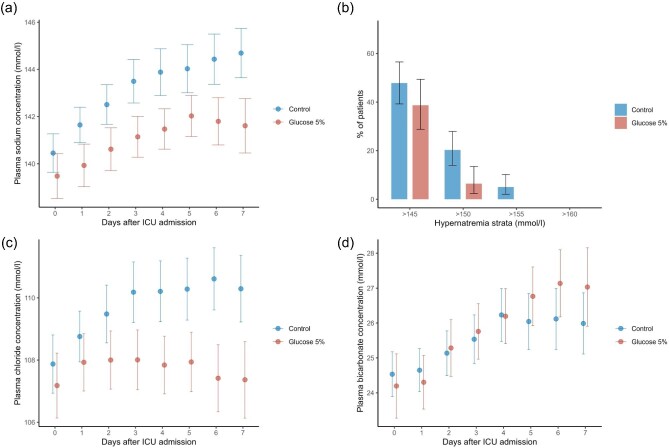
Baseline characteristics were similar between the two groups. The cumulative volume of intravenous drug diluents was comparable. In the glucose 5% group, about half of the total drug diluent volume was glucose 5% [mean (SD): 2251.6 (2355.4) ml], compared to 135.0 (746.9) ml ( < .001) in the control group. Average sodium concentrations diverged after day two, with the glucose 5% group consistently showing lower sodium levels (mean difference of ∼2.5 mmol/l). Severe hypernatremia occurred less frequently in the glucose 5% group (6.6% vs. 20%).

CONCLUSION

Glucose 5% solution as the standard intravenous drug solvent significantly reduced sodium concentrations and the occurrence of severe hypernatremia. This simple modification in solvent choice may serve as a preventive strategy against hypernatremia in the ICU. Further prospective research is necessary to determine associated clinical outcomes.

TRIAL REGISTRATION

The trial was registered in the German Clinical Trials Register (DRKS00031877).

摘要
https://cdn.ncbi.nlm.nih.gov/pmc/blobs/a270/11584513/d50500bf9b78/sfae328fig4.jpg
https://cdn.ncbi.nlm.nih.gov/pmc/blobs/a270/11584513/82480d562f92/sfae328fig1.jpg
https://cdn.ncbi.nlm.nih.gov/pmc/blobs/a270/11584513/ebc7da048cc2/sfae328fig2.jpg
https://cdn.ncbi.nlm.nih.gov/pmc/blobs/a270/11584513/d02746b5d8df/sfae328fig3.jpg
https://cdn.ncbi.nlm.nih.gov/pmc/blobs/a270/11584513/d50500bf9b78/sfae328fig4.jpg
https://cdn.ncbi.nlm.nih.gov/pmc/blobs/a270/11584513/82480d562f92/sfae328fig1.jpg
https://cdn.ncbi.nlm.nih.gov/pmc/blobs/a270/11584513/ebc7da048cc2/sfae328fig2.jpg
https://cdn.ncbi.nlm.nih.gov/pmc/blobs/a270/11584513/d02746b5d8df/sfae328fig3.jpg
https://cdn.ncbi.nlm.nih.gov/pmc/blobs/a270/11584513/d50500bf9b78/sfae328fig4.jpg

相似文献

1
Pre-emptive use of glucose 5% as the standard drug solvent reduces hypernatremia in critically ill patients.
Clin Kidney J. 2024 Nov 4;17(11):sfae328. doi: 10.1093/ckj/sfae328. eCollection 2024 Nov.
2
Characterization of intensive care unit acquired hyponatremia and hypernatremia following cardiac surgery.心脏手术后 ICU 获得性低钠血症和高钠血症的特征。
Can J Anaesth. 2010 Jul;57(7):650-8. doi: 10.1007/s12630-010-9309-1. Epub 2010 Apr 20.
3
Hypernatremia in the intensive care unit: an indicator of quality of care?重症监护病房中的高钠血症:护理质量的一个指标?
Crit Care Med. 1999 Jun;27(6):1105-8. doi: 10.1097/00003246-199906000-00029.
4
Enteral free water vs. parenteral dextrose 5% in water for the treatment of hypernatremia in the intensive care unit: a retrospective cohort study from a mixed ICU.肠内无盐水分与肠外 5%葡萄糖水在重症监护病房治疗高钠血症的对比:一项来自混合 ICU 的回顾性队列研究。
J Anesth. 2023 Dec;37(6):868-879. doi: 10.1007/s00540-023-03246-9. Epub 2023 Aug 28.
5
ICU-acquired hypernatremia: Prevalence, patient characteristics, trajectory, risk factors, and outcomes.重症监护病房获得性高钠血症:患病率、患者特征、病程、危险因素及结局
Crit Care Resusc. 2024 Nov 22;26(4):303-310. doi: 10.1016/j.ccrj.2024.09.003. eCollection 2024 Dec.
6
Hypernatremia in the critically ill is an independent risk factor for mortality.危重症患者的高钠血症是死亡的独立危险因素。
Am J Kidney Dis. 2007 Dec;50(6):952-7. doi: 10.1053/j.ajkd.2007.08.016.
7
Early intensive care unit-acquired hypernatremia in severe sepsis patients receiving 0.9% saline fluid resuscitation.接受0.9%生理盐水液体复苏的严重脓毒症患者早期发生的重症监护病房获得性高钠血症。
Acta Anaesthesiol Scand. 2014 Sep;58(8):1007-14. doi: 10.1111/aas.12368. Epub 2014 Jul 15.
8
Long-term changes in dysnatremia incidence in the ICU: a shift from hyponatremia to hypernatremia.重症监护病房中钠代谢紊乱发生率的长期变化:从低钠血症向高钠血症的转变。
Ann Intensive Care. 2016 Dec;6(1):22. doi: 10.1186/s13613-016-0124-x. Epub 2016 Mar 17.
9
The relation between the incidence of hypernatremia and mortality in patients with severe traumatic brain injury.严重创伤性脑损伤患者高钠血症发生率与死亡率的关系。
Crit Care. 2009;13(4):R110. doi: 10.1186/cc7953. Epub 2009 Jul 7.
10
Normal saline to dilute parenteral drugs and to keep catheters open is a major and preventable source of hypernatremia acquired in the intensive care unit.用于稀释肠胃外用药及保持导管通畅的生理盐水是重症监护病房中高钠血症的一个主要且可预防的来源。
J Crit Care. 2014 Jun;29(3):390-4. doi: 10.1016/j.jcrc.2014.01.025. Epub 2014 Feb 3.

引用本文的文献

1
Multicentre pragmatic embedded stepped wedge cluster randomised trial comparing glucose 5% with sodium chloride 0.9% as the default drug diluent in the ICU: the sweet-water trial protocol.多中心实用嵌入式阶梯楔形整群随机试验:比较5%葡萄糖与0.9%氯化钠作为重症监护病房默认药物稀释剂——“甜水试验”方案
BMJ Open. 2025 Jun 5;15(6):e097361. doi: 10.1136/bmjopen-2024-097361.