Department of Pharmacology, Harbin Medical University, Heilongjiang, 163319, People's Republic of China.
Morphological Experiment Center, Harbin Medical University, Heilongjiang, 163319, People's Republic of China.
Int J Nanomedicine. 2024 Nov 19;19:11973-11996. doi: 10.2147/IJN.S488532. eCollection 2024.
Myocardial ischemia-reperfusion injury (MI/RI) is associated with increased oxidative damage and mitochondrial dysfunction, resulting in an elevated risk of mortality. MI/RI may be alleviated by protecting cardiomyocytes from oxidative stress. Lutein, which belongs to a class of carotenoids, has proven to be effective in cardiovascular disease treatment due to its remarkable antioxidant properties, but its application is limited due to its poor stability and low bioavailability in vivo.
In this study, a delivery system was developed based on distearoyl phosphatidyl ethanolamine (DSPE)-thiol-ketone (TK)-PEG2K (polyethylene glycol 2000) (abbreviated as DTP) and PCM-SH (CWLSEAGPVVTVRALRGTGSW) to deliver lutein (abbreviated as lutein@DTPP) to damaged myocardium. First, lutein, lutein@DTP, or lutein@DTPP were injected through the tail vein once a day for 3 days and then MI/RI model rats were established by exposing rats to ischemia for 45 min and reperfusion for 6 h. We employed a range of experimental techniques including qRT-PCR, Western blotting, transmission electron microscopy, immunohistochemistry, immunofluorescence, flow cytometry, immunoprecipitation, molecular docking, and molecular dynamics simulations.
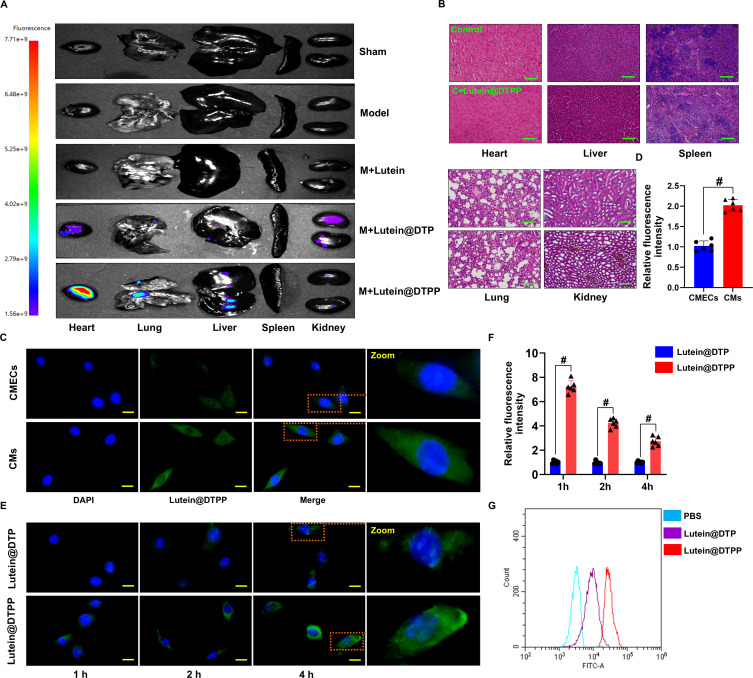
Lutein@DTPP exhibited good myocardial targeting and ROS-responsive release. Our data suggested that lutein@DTPP effectively suppresses ferroptosis in cardiomyocytes. Mechanistically, we observed an upregulation of mouse double minute-2 (MDM2) in the hearts of MI/RI models and cardiomyocytes exposed to hypoxia/reoxygenation (H/R) conditions. In addition, NADH-ubiquinone oxidoreductase 75 kDa Fe-S protein 1 (NDUFS1) translocation from the cytosol to the mitochondria was inhibited by MDM2 upregulation. Notably, no significant variation in the total NDUFS1 expression was observed in H/R-exposed cardiomyocytes following treatment with siMDM2. Further study indicated that lutein facilitates the translocation of NDUFS1 from the cytosol to mitochondria by directly binding and sequestering MDM2, thereby improving mitochondrial function and inhibiting ferroptosis.
Lutein@DTPP promoted the mitochondrial translocation of NDUFS1 to restore mitochondrial function and inhibited the ferroptosis of cardiomyocytes by directly binding and sequestering MDM2.
心肌缺血再灌注损伤(MI/RI)与氧化损伤和线粒体功能障碍增加有关,导致死亡率升高。通过保护心肌细胞免受氧化应激,可能减轻 MI/RI。叶黄素属于类胡萝卜素,由于其显著的抗氧化特性,已被证明可有效治疗心血管疾病,但由于其在体内稳定性差和生物利用度低,其应用受到限制。
本研究基于二硬脂酰基磷脂酰乙醇胺(DSPE)-硫醇-酮(TK)-聚乙二醇 2000(PEG2000)(简称 DTP)和 PCM-SH(CWLSEAGPVVTVRALRGTGSW)开发了一种输送系统,将叶黄素(简称 lutein@DTPP)输送到受损的心肌。首先,通过尾静脉每天注射一次,连续 3 天,然后用暴露大鼠缺血 45 分钟和再灌注 6 小时的方法建立 MI/RI 模型大鼠。我们采用了一系列实验技术,包括 qRT-PCR、Western blot、透射电子显微镜、免疫组织化学、免疫荧光、流式细胞术、免疫沉淀、分子对接和分子动力学模拟。
lutein@DTPP 表现出良好的心肌靶向性和 ROS 响应性释放。我们的数据表明,lutein@DTPP 可有效抑制心肌细胞中的铁死亡。从机制上讲,我们观察到 MI/RI 模型和缺氧/复氧(H/R)条件下暴露的心肌细胞中鼠双微体 2(MDM2)的上调。此外,NADH-泛醌氧化还原酶 75 kDa Fe-S 蛋白 1(NDUFS1)从细胞质向线粒体的易位被 MDM2 上调抑制。值得注意的是,用 siMDM2 处理 H/R 暴露的心肌细胞后,总 NDUFS1 表达无明显变化。进一步的研究表明,叶黄素通过直接结合和隔离 MDM2,促进 NDUFS1 从细胞质向线粒体的易位,从而改善线粒体功能并抑制铁死亡。
lutein@DTPP 通过直接结合和隔离 MDM2,促进 NDUFS1 向线粒体的易位,恢复线粒体功能,并抑制心肌细胞的铁死亡。