Hakkenberg Christopher R, Clark Matthew L, Bailey Tim, Burns Patrick, Goetz Scott J
School of Informatics, Computing & Cyber Systems, Northern Arizona University, Flagstaff, AZ USA.
Center for Interdisciplinary Geospatial Analysis, Department of Geography, Environment, & Planning, Sonoma State University, Rohnert Park, CA USA.
Commun Earth Environ. 2024;5(1):721. doi: 10.1038/s43247-024-01893-8. Epub 2024 Nov 20.
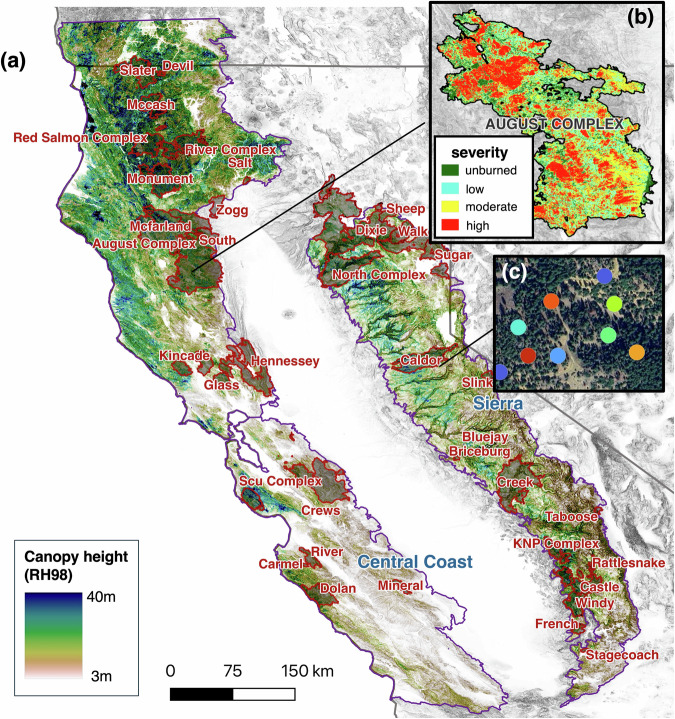
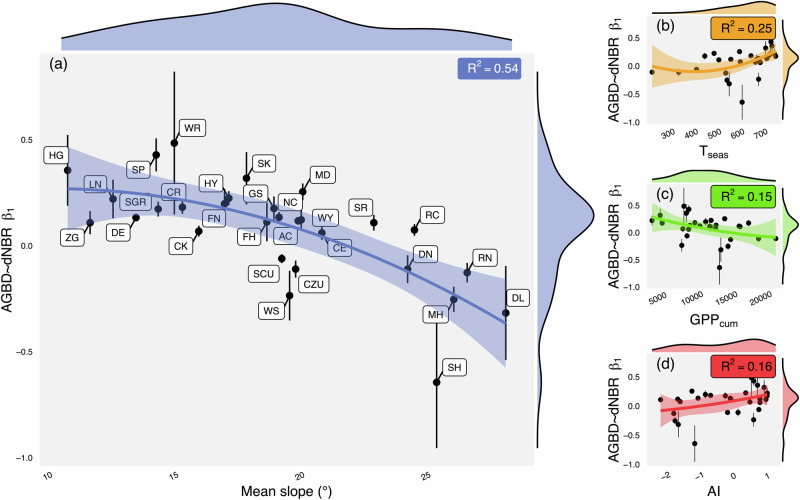
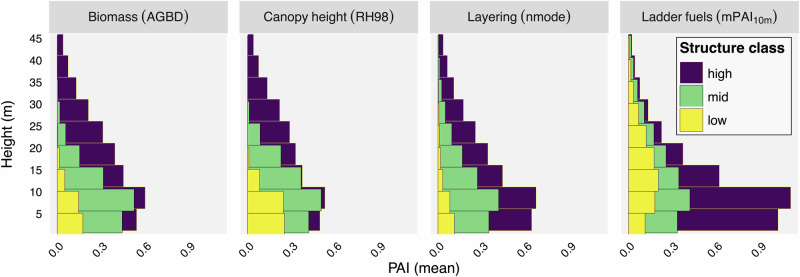
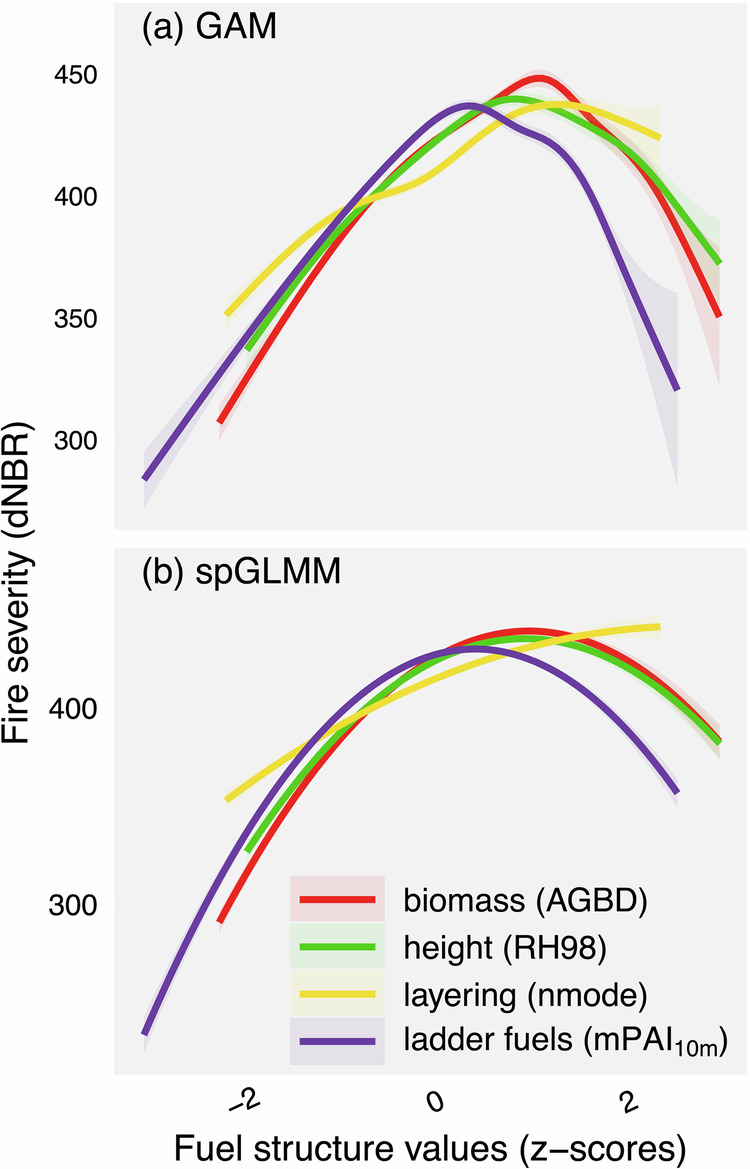
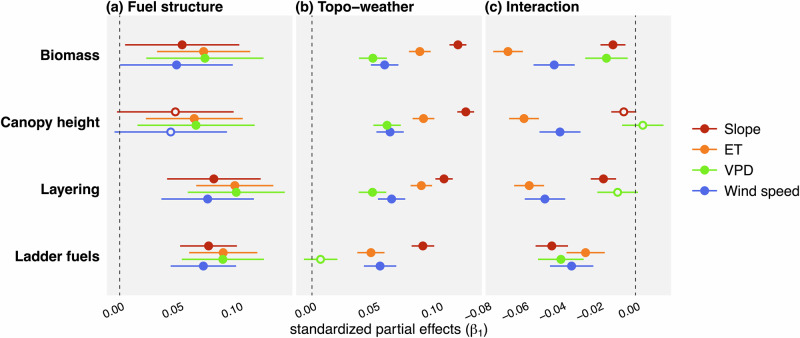
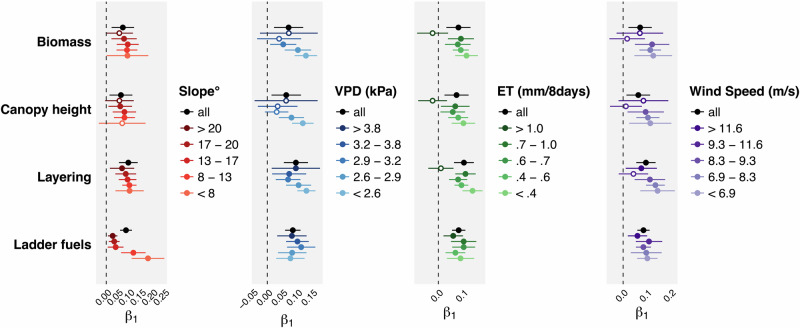
Drivers of forest wildfire severity include fuels, topography and weather. However, because only fuels can be actively managed, quantifying their effects on severity has become an urgent research priority. Here we employed GEDI spaceborne lidar to consistently assess how pre-fire forest fuel structure affected wildfire severity across 42 California wildfires between 2019-2021. Using a spatial-hierarchical modeling framework, we found a positive concave-down relationship between GEDI-derived fuel structure and wildfire severity, marked by increasing severity with greater fuel loads until a decline in severity in the tallest and most voluminous forest canopies. Critically, indicators of canopy fuel volumes (like biomass and height) became decoupled from severity patterns in extreme topographic and weather conditions (slopes >20°; winds > 9.3 m/s). On the other hand, vertical continuity metrics like layering and ladder fuels more consistently predicted severity in extreme conditions - especially ladder fuels, where sparse understories were uniformly associated with lower severity levels. These results confirm that GEDI-derived fuel estimates can overcome limitations of optical imagery and airborne lidar for quantifying the interactive drivers of wildfire severity. Furthermore, these findings have direct implications for designing treatment interventions that target ladder fuels versus entire canopies and for delineating wildfire risk across topographic and weather conditions.
森林野火严重程度的驱动因素包括燃料、地形和天气。然而,由于只有燃料可以被主动管理,量化它们对严重程度的影响已成为一项紧迫的研究重点。在此,我们利用GEDI星载激光雷达,持续评估了2019年至2021年间加利福尼亚州42起野火发生前的森林燃料结构如何影响野火严重程度。通过一个空间分层建模框架,我们发现GEDI得出的燃料结构与野火严重程度之间呈正的向下凹关系,其特征是随着燃料负荷增加严重程度上升,直到在最高且最茂密的森林树冠中严重程度下降。至关重要的是,在极端地形和天气条件下(坡度>20°;风速>9.3米/秒),树冠燃料体积指标(如生物量和高度)与严重程度模式脱钩。另一方面,分层和阶梯燃料等垂直连续性指标在极端条件下更能持续预测严重程度——尤其是阶梯燃料,稀疏的林下植被与较低的严重程度水平始终相关。这些结果证实,GEDI得出的燃料估计可以克服光学图像和机载激光雷达在量化野火严重程度的相互作用驱动因素方面的局限性。此外,这些发现对于设计针对阶梯燃料而非整个树冠的处理干预措施以及描绘不同地形和天气条件下的野火风险具有直接意义。