Reproductive Medicine Center, Renmin Hospital of Wuhan University, Wuhan, China.
Hubei Clinic Research Center for Assisted Reproductive Technology and Embryonic Development, Wuhan, China.
Front Endocrinol (Lausanne). 2024 Nov 8;15:1478848. doi: 10.3389/fendo.2024.1478848. eCollection 2024.
Infertility is increasingly recognized as a global health issue affecting couples of reproductive age, with male factors contributing to approximately 50% of infertility cases. However, the association between depression and anxiety-two of the most prevalent mental health conditions-and impaired male fertility remains a subject of ongoing debate.
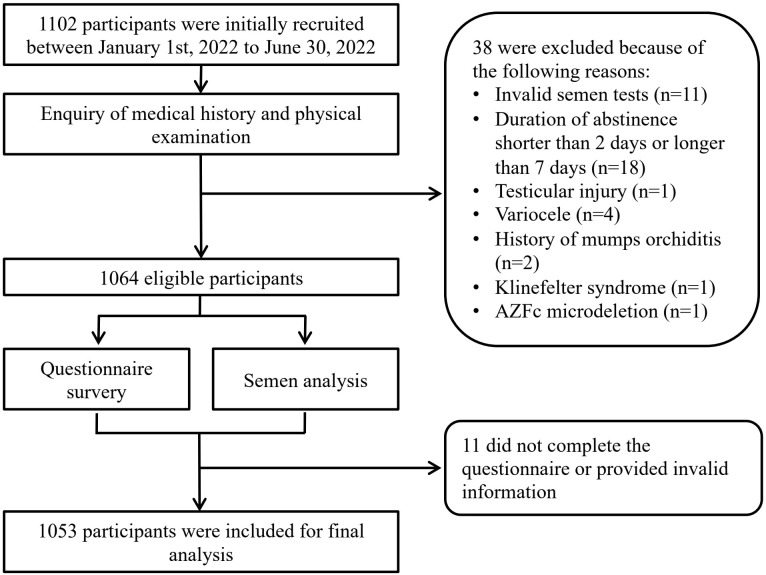
In this cross-sectional study, male participants seeking fertility counseling at an IVF clinic were recruited. Symptoms of depression and anxiety were assessed using the Patient Health Questionnaire-9 (PHQ-9) and the Generalized Anxiety Disorder-7 (GAD-7), respectively. Generalized linear regression models (GLMs) were employed to investigate the relationships between mental health status and semen parameters.
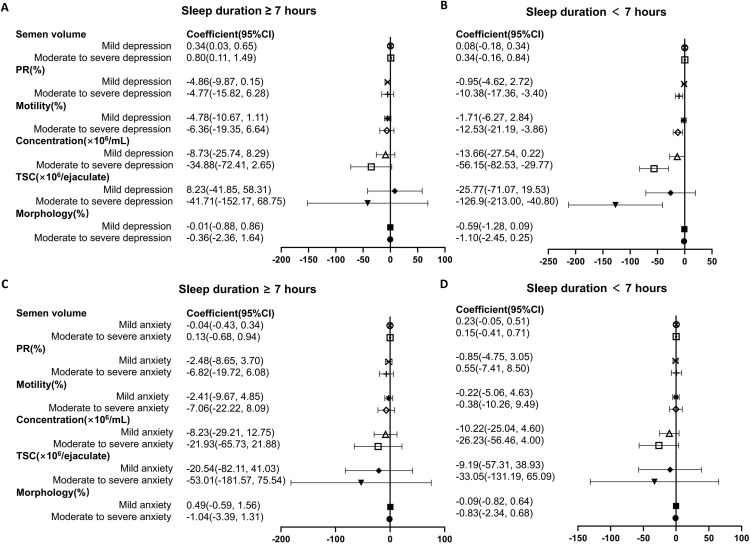
Status of depression was negatively associated with semen quality parameters, whereas no statistically significant association was recognized between anxiety and semen quality except that sperm concentration was decreased by 25.60 (95% CI, 1.226 to 49.965, =0.040) ×10/ml in moderate to severe anxiety group referring to normal group. Furthermore, when stratified by sleep duration, moderate to severe depression group showed a great decrease in progressive motility (PR), total motility, concentration and total sperm count (TSC) as referred to normal group in participants with sleep duration less than 7 hours.
The present study revealed that depression rather than anxiety was a negative factor that affected semen quality, especially in individuals with shorter sleep duration.
不孕不育日益被视为影响育龄夫妇的全球性健康问题,其中男性因素约占不孕不育病例的 50%。然而,抑郁和焦虑——两种最常见的心理健康状况——与男性生育能力受损之间的关联仍然是一个争论的话题。
在这项横断面研究中,招募了在试管婴儿诊所寻求生育咨询的男性参与者。使用患者健康问卷-9(PHQ-9)和广泛性焦虑症-7(GAD-7)分别评估抑郁和焦虑症状。采用广义线性回归模型(GLMs)研究心理健康状况与精液参数之间的关系。
抑郁状况与精液质量参数呈负相关,而焦虑与精液质量之间未发现统计学显著关联,除了中重度焦虑组的精子浓度较正常组降低 25.60(95%置信区间,1.226 至 49.965,=0.040)×10/ml 外。此外,按睡眠时间分层后,与正常组相比,睡眠时间小于 7 小时的参与者中,中重度抑郁组的前向运动精子(PR)、总运动精子、浓度和总精子数(TSC)均有较大下降。
本研究表明,抑郁而非焦虑是影响精液质量的负面因素,尤其是在睡眠不足的人群中。