Department of Nephrology, Shuguang Hospital Affiliated to Shanghai University of Traditional Chinese Medicine, Shanghai, China.
Key Laboratory of Liver and Kidney Diseases, Ministry of Education, Shanghai University of Traditional Chinese Medicine, Shanghai, China.
Ren Fail. 2024 Dec;46(2):2428337. doi: 10.1080/0886022X.2024.2428337. Epub 2024 Nov 25.
Renal hypoxia and ischemia significantly contribute to chronic kidney disease (CKD) progression, underscoring the need for noninvasive quantitative assessments. This study employs blood oxygenation level-dependent magnetic resonance imaging (BOLD-MRI) and arterial spin labeling (ASL) MRI to comprehensively evaluate renal oxygenation and blood flow in CKD patients.
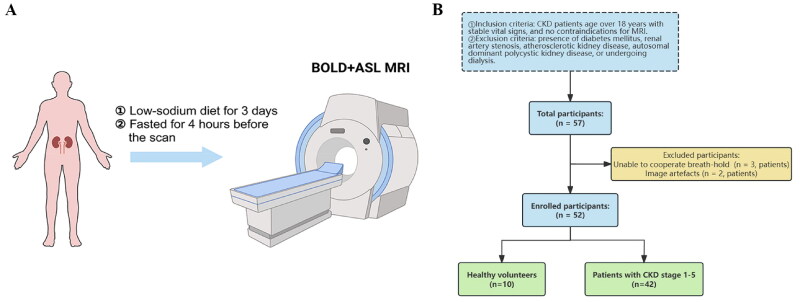
Forty-two CKD patients across stages 1-5 and ten healthy volunteers underwent simultaneous BOLD-MRI and ASL-MRI. We measured oxygenation (T2* values) and renal blood flow (RBF) in both the renal cortex and medulla, assessing their correlations with estimated glomerular filtration rate (eGFR) and other renal function indicators.
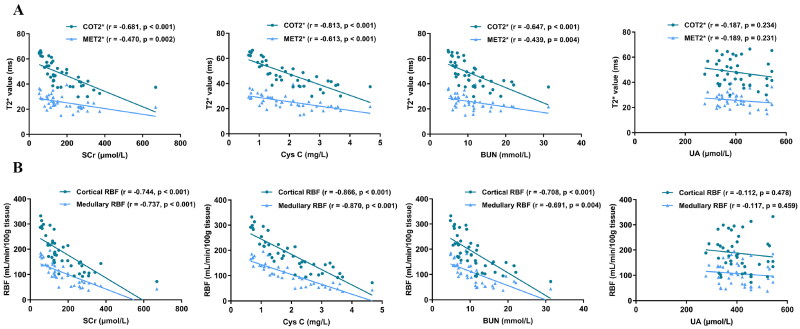
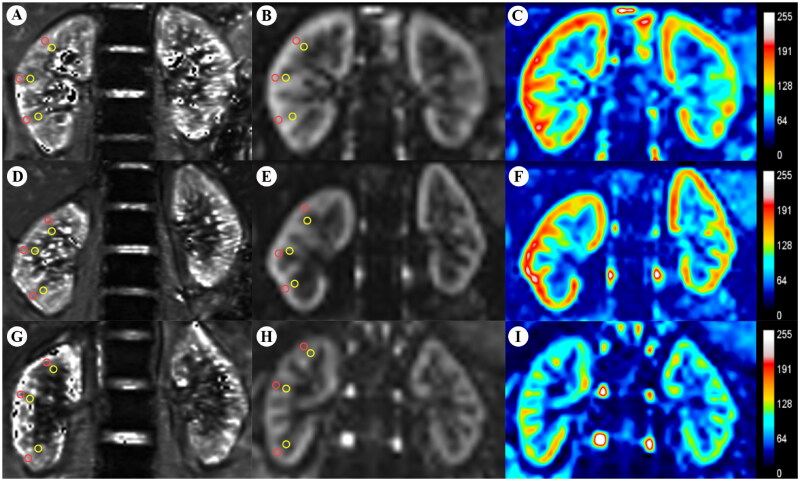
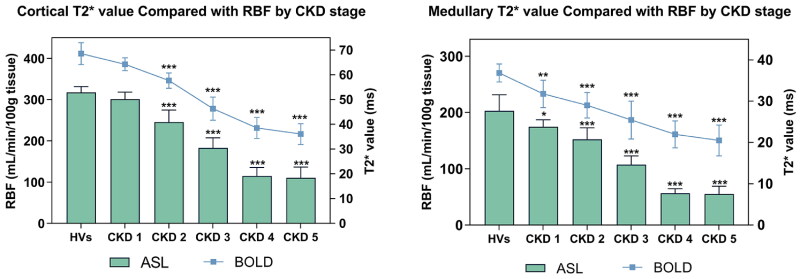
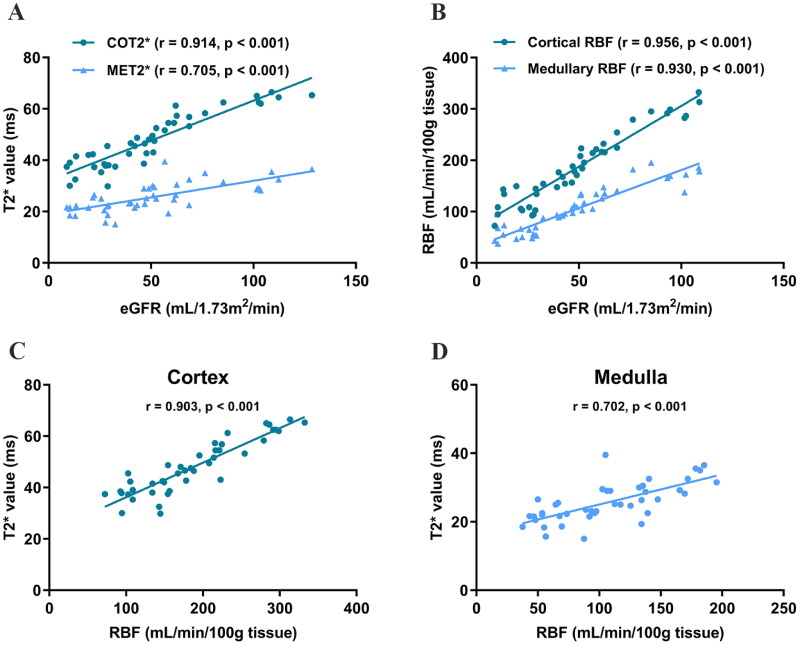
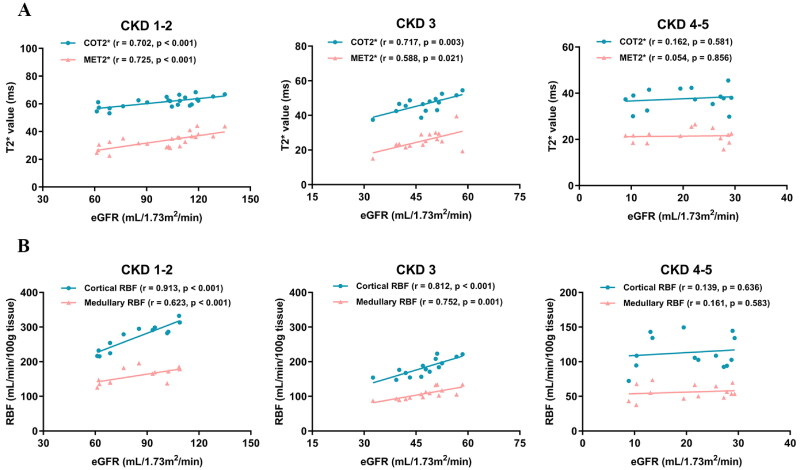
BOLD and ASL revealed higher oxygenation and RBF in the renal cortex than in the medulla. Across CKD stages 2-5, both cortical and medullary oxygenation levels, as well as RBF, were lower than those in the control group and progressively decreased with CKD advancement. Additionally, renal oxygenation and blood flow levels positively correlated with serum creatinine (SCr), cystatin C (Cys C), and blood urea nitrogen (BUN), and negatively correlated with estimated glomerular filtration rate (eGFR) ( < 0.001). However, no significant correlation was observed with uric acid (UA) ( > 0.05). Notably, patients with CKD stages 1-3 exhibited strong correlations between renal oxygenation levels, RBF, and eGFR, while those with CKD stages 4-5 displayed weak correlations.
BOLD-MRI and ASL-MRI effectively measure renal oxygenation and perfusion noninvasively, confirming their utility in tracking CKD progression. These modalities provide accurate assessments of renal function and hypoxic-ischemic injuries across CKD stages, particularly in the early stages.
肾缺氧和缺血显著促进慢性肾脏病(CKD)的进展,这凸显了对非侵入性定量评估的需求。本研究采用血氧水平依赖磁共振成像(BOLD-MRI)和动脉自旋标记(ASL)MRI 全面评估 CKD 患者的肾脏氧合和血流。
42 名 CKD 患者(1-5 期)和 10 名健康志愿者接受了同步 BOLD-MRI 和 ASL-MRI 检查。我们测量了肾脏皮质和髓质的氧合(T2* 值)和肾血流(RBF),评估了它们与估计肾小球滤过率(eGFR)和其他肾功能指标的相关性。
BOLD 和 ASL 显示肾脏皮质的氧合和 RBF 高于髓质。在 CKD 2-5 期,皮质和髓质的氧合水平以及 RBF 均低于对照组,并随着 CKD 的进展而逐渐降低。此外,肾脏氧合和血流水平与血清肌酐(SCr)、胱抑素 C(Cys C)和血尿素氮(BUN)呈正相关,与估计肾小球滤过率(eGFR)呈负相关(<0.001)。然而,与尿酸(UA)无显著相关性(>0.05)。值得注意的是,CKD 1-3 期患者的肾脏氧合水平、RBF 和 eGFR 之间存在较强的相关性,而 CKD 4-5 期患者的相关性较弱。
BOLD-MRI 和 ASL-MRI 可有效无创地测量肾脏氧合和灌注,证实了它们在跟踪 CKD 进展方面的应用价值。这些方法可在 CKD 各期,特别是早期,准确评估肾功能和缺氧缺血损伤。