Department of Psychiatry, Yonsei University College of Medicine, Seoul, Republic of Korea.
Institute of Health Services Research, Yonsei University, Seoul, Republic of Korea.
Sci Rep. 2024 Nov 25;14(1):29171. doi: 10.1038/s41598-024-80557-1.
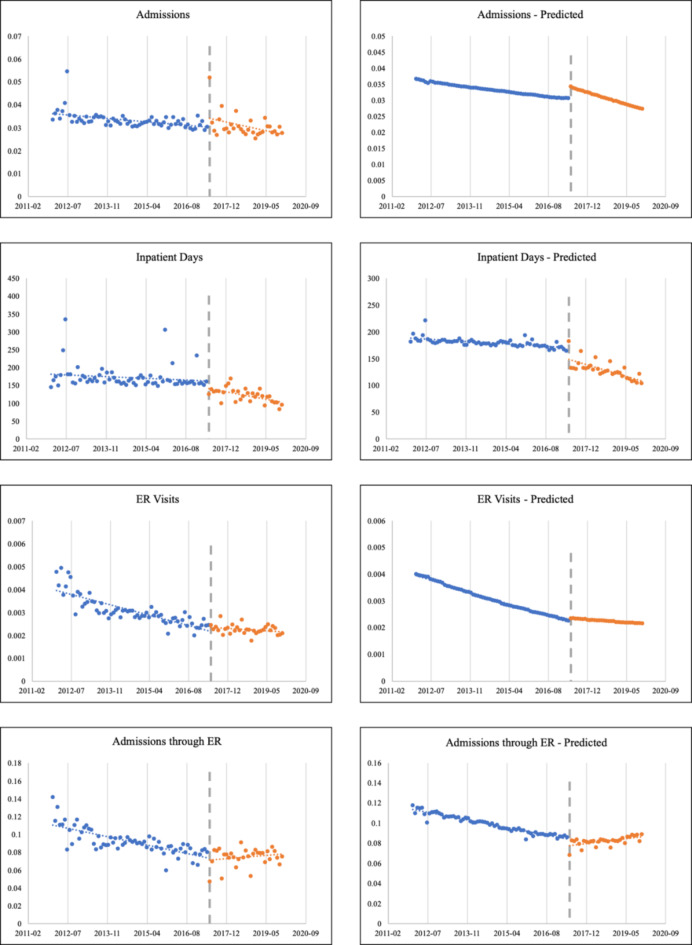
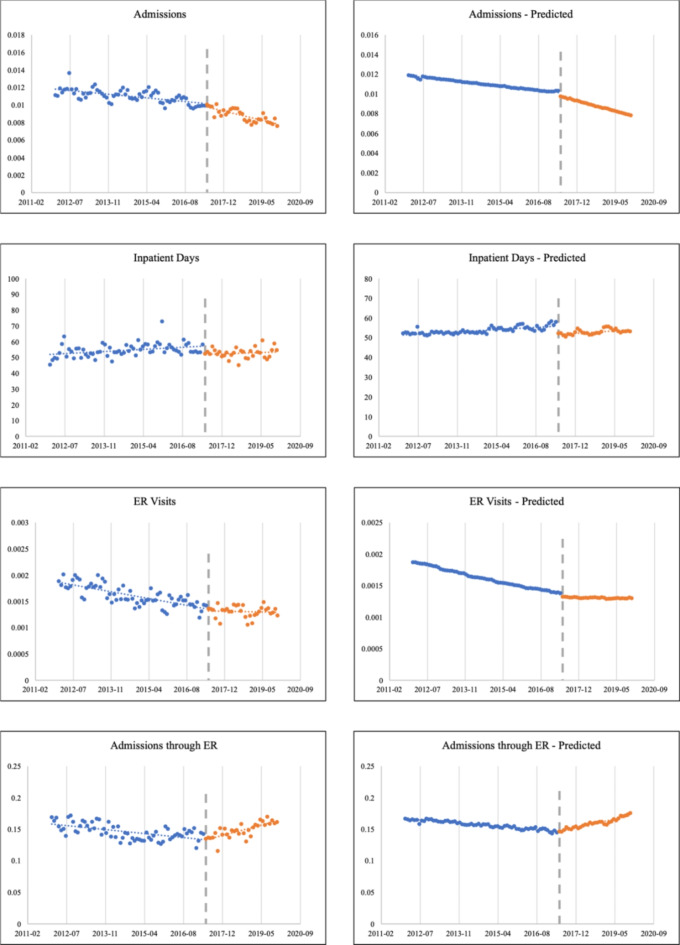
To reduce long hospitalization durations and the high rate of compulsory psychiatric hospitalization in Korea, a revision of the Mental Health Welfare law was passed and implemented in 2017. This study quantitatively analyzed changes in hospitalization use behavior of patients with psychotic and mood disorders after revision of the Mental Health Welfare law in South Korea. The intervention time was June 2017. Data from the National Health Insurance claims were used. Participants were all patients with hospital visits involving psychotic disorders and mood disorders. We used the interrupted time-series method with segmented regression. In patients with psychotic disorders, admission decreased after the law revision. The average inpatient length of hospitalization decreased immediately after the revision, leading to a long-term decrease. Emergency room visits increased following the revision, and admission through the emergency room also increased. In patients with mood disorders, admission decreased both immediately and over the long-term after the revision. Additionally, the average inpatient length of hospitalization decreased immediately, with no significant change observed in the long term. Emergency room visits increased following the revision. Following the law revision, patients with psychiatric disorders showed a decrease in hospital admissions and length of hospital stay. However, an increasing trend in emergency room visits was identified, suggesting an increase in crisis situations. These findings indicate the need to reduce admissions and length of hospitalization while also protecting the rights of patients with psychiatric disorders. System improvements are thus necessary to prevent an increase in crisis situations and ensure appropriate treatment.
为了缩短韩国精神疾病患者的住院时间和降低强制住院率,2017 年韩国修订并实施了《精神健康福利法》。本研究定量分析了韩国《精神健康福利法》修订后,精神障碍和心境障碍患者住院使用行为的变化。干预时间为 2017 年 6 月。使用国家健康保险索赔数据。参与者均为因精神障碍和心境障碍住院的患者。我们使用了截断回归的中断时间序列法。在精神障碍患者中,法律修订后入院减少。修订后,住院时间立即缩短,导致长期减少。修订后急诊就诊增加,通过急诊入院也增加。在心境障碍患者中,修订后立即和长期入院均减少。此外,住院时间立即缩短,长期无明显变化。修订后急诊就诊增加。法律修订后,精神障碍患者的住院人数和住院时间减少。然而,急诊就诊的增加趋势表明危机情况增加。这些发现表明需要减少住院人数和住院时间,同时保护精神障碍患者的权利。因此,需要进行系统改进,以防止危机情况的增加,并确保提供适当的治疗。