Papadimitriou Nikos, Murphy Neil, Jenab Mazda, Chen Zhishan, Brenner Hermann, Kweon Sun-Seog, Le Marchand Loic, Moreno Victor, Platz Elizabeth A, van Duijnhoven Fränzel J B, Cheng Iona, Pai Rish K, Phipps Amanda I, Peters Ulrike, Zheng Wei, Hughes David J
Nutrition and Metabolism Branch, International Agency for Research on Cancer, Lyon, France.
Division of Epidemiology, Department of Medicine, Vanderbilt Epidemiology Center, Vanderbilt-Ingram Cancer Center, Vanderbilt University School of Medicine, Nashville, Tennessee, USA.
Pediatr Obes. 2025 Jan;20(1):e13186. doi: 10.1111/ijpo.13186. Epub 2024 Nov 25.
Varying obesogenic inherited predisposition in early to later life may differentially impact colorectal cancer (CRC) development. Previous Mendelian randomization (MR) studies, conducted in populations of European genetic similarity, have not observed any significant associations between early life body weight with CRC risk. However, it remains unclear whether body mass index (BMI) at different early lifetime points is causally related with CRC risk in both Europeans and East Asian populations.
We conducted a two-sample MR study to investigate potential causal relationships between genetically predicted BMI during early life (birth to 8 years old) and at specific periods (birth, transient, early rise and late rise) and CRC risk.
Summary data were obtained from genome-wide association study (GWAS) of BMI in 28 681 children from the Norwegian Mother, Father and Child Cohort Study (MoBa) study and applied to CRC GWAS data from European and East Asian descent populations (102 893 cases and 485 083 non-cases).
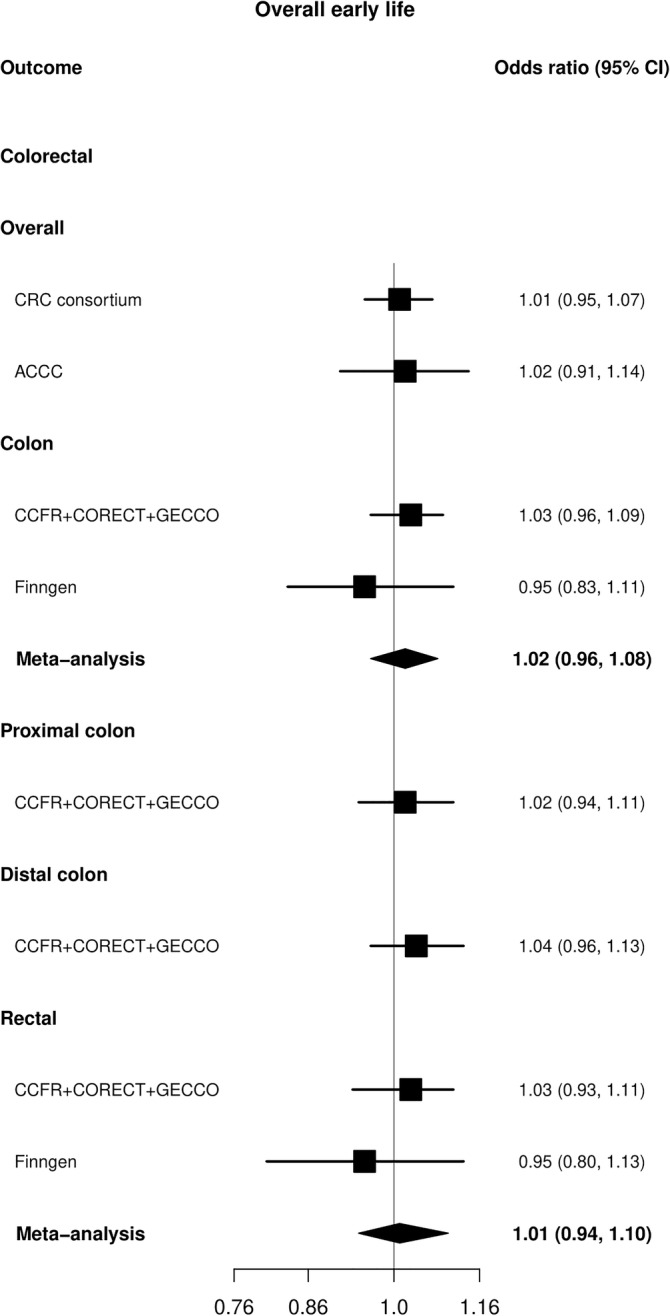
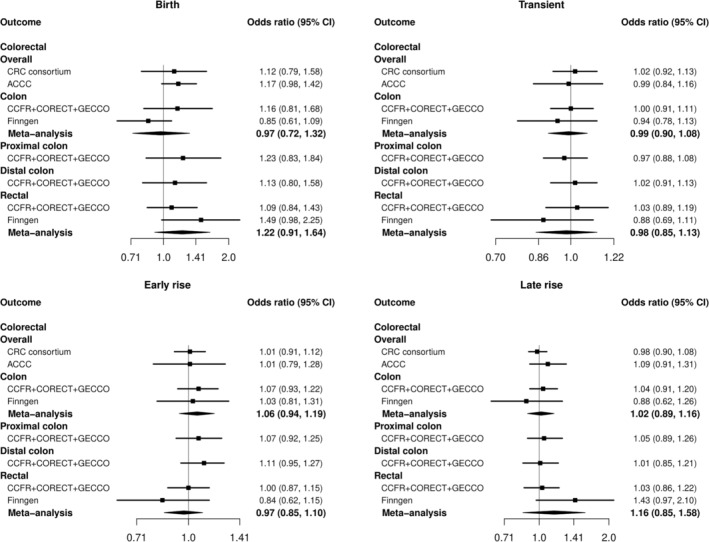
There were no significant associations observed between early life BMI and CRC risk in European or East Asian populations. The effect estimates were similar in European studies (odds ratio [OR] per a 1-standard deviation [SD] increase: 1.01, 95% confidence interval [CI]: 0.95, 1.07) and in East Asians (OR per a 1-SD increase: 1.02, 95% CI: 0.91, 1.14). Similar nonsignificant associations were found between time of BMI measurement during childhood and cancer-site-specific analyses.
We found little evidence of any associations between early life adiposity on later life CRC risk.
从幼年到成年,不同的致肥胖遗传易感性可能对结直肠癌(CRC)的发展产生不同影响。此前在欧洲遗传相似人群中进行的孟德尔随机化(MR)研究未发现幼年体重与CRC风险之间存在任何显著关联。然而,在欧洲人和东亚人群中,不同幼年时期的体重指数(BMI)与CRC风险之间是否存在因果关系仍不清楚。
我们进行了一项两样本MR研究,以调查幼年(出生至8岁)及特定时期(出生、短暂期、早期上升期和晚期上升期)基因预测的BMI与CRC风险之间的潜在因果关系。
汇总数据来自挪威母亲、父亲和儿童队列研究(MoBa)中28681名儿童的BMI全基因组关联研究(GWAS),并应用于欧洲和东亚血统人群的CRC GWAS数据(102893例病例和485083例非病例)。
在欧洲或东亚人群中,未观察到幼年BMI与CRC风险之间存在显著关联。欧洲研究中的效应估计值(每增加1个标准差[SD]的优势比[OR]:1.01,95%置信区间[CI]:0.95,1.07)与东亚人群中的效应估计值(每增加1个SD的OR:1.02,95%CI:0.91,1.14)相似。在儿童期BMI测量时间与癌症部位特异性分析之间也发现了类似的非显著关联。
我们几乎没有发现幼年肥胖与成年后CRC风险之间存在任何关联的证据。