School of Medicine, Nankai University, Nankai District, 94 Weijin Road, Tianjin, 300071, China.
State Key Laboratory of Experimental Hematology, Institute of Hematology & Blood Diseases Hospital, National Clinical Research Center for Blood Diseases, Haihe Laboratory of Cell Ecosystem, Chinese Academy of Medical Sciences & Peking Union Medical College, 288 Nanjing Road, Heping District, Tianjin, 300041, China.
BMC Med. 2024 Nov 25;22(1):555. doi: 10.1186/s12916-024-03782-5.
Failure of systemic corticosteroid therapy is common in patients with newly diagnosed acute graft-versus-host disease (aGVHD) above grade II. Mesenchymal stem cells (MSCs) have been used as a tolerable and potentially effective second-line therapy for steroid-refractory aGVHD (SR-aGVHD); however, well-designed, prospective, controlled studies are lacking.
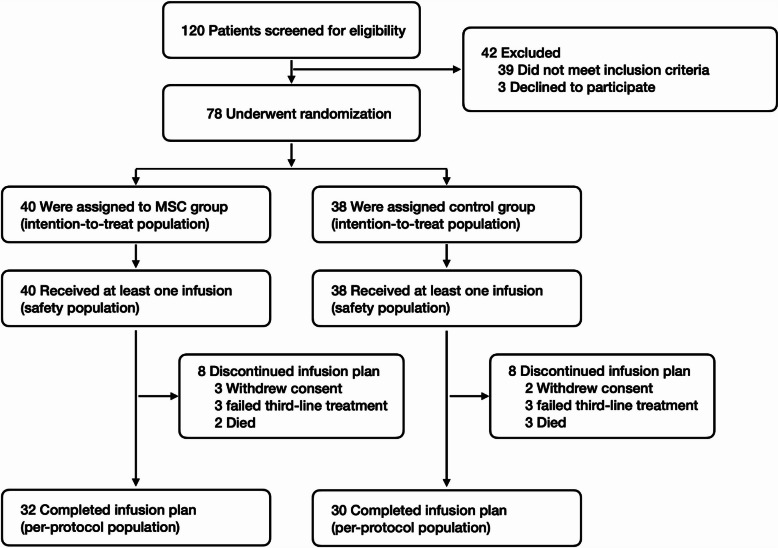
This multicentre, randomized, double-blind, placebo-controlled, exploratory phase 2 study enrolled patients with SR-aGVHD above grade II from 7 centres. Patients were randomized 1:1 to receive umbilical cord-derived MSCs or placebo added to one centre's choice of second-line agents (except for ruxolitinib). The agents were infused twice weekly. Patients with complete response (CR), no response (NR), or progression of disease (PD) at d28 received 8 infusions, and those with partial response (PR) received the above infusions for another 4 weeks. The per-protocol population consisted of patients who received ≥ 8 infusions. The primary endpoint was the overall response rate (ORR, CR + PR) at d28, analyzed in the per-protocol and intention-to-treat populations.
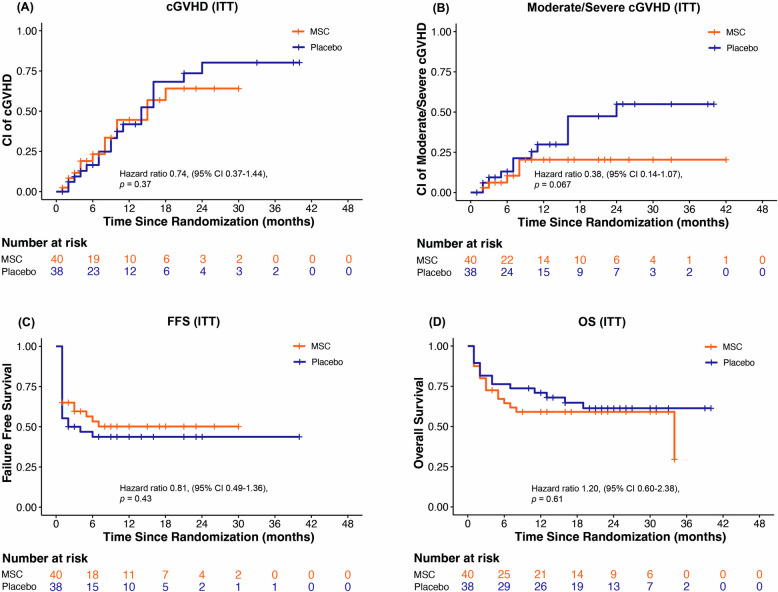
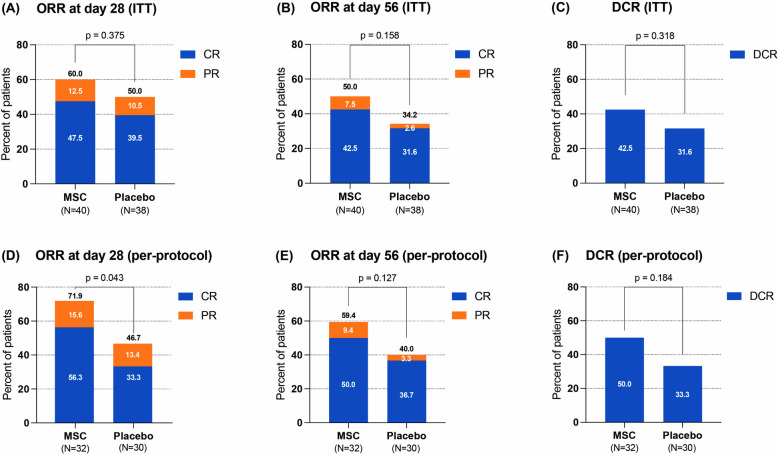
Seventy-eight patients (median age 38, range 13-62) were enrolled: 40 in the MSC group and 38 in the control. Patients in the MSC group received a median of 8 doses, with a median response time of 14 days. In intention-to-treat analysis, ORR at d28 was 60% for MSC group and 50% for control group (p = 0.375). The 2-year cumulative incidence of moderate to severe cGVHD was marginally lower in the MSC group than in the control (13.8% vs. 39.8%, p = 0.067). The 2-year failure-free survival was similar between the MSC and control groups (52.5% vs. 44.4%, p = 0.43). In per-protocol analysis (n = 62), ORR at d28 was significantly greater in the MSC group than in the control group (71.9% vs. 46.7%, p = 0.043). Among patients with gut involvement, ORR at d28 was significantly greater in the MSC group than in the control (66.7% vs. 33.3%, p = 0.031). The adverse events incidences were similar between groups.
In this exploratory study, there was no superior ORR at d28 demonstrated in the MSC group compared with the control. However, MSCs showed a gradual treatment effect at a median of 2 weeks. Patients who completed 8 infusions may benefit from adding MSCs to one conventional second-line agent, especially those with gut involvement. MSCs was well tolerated in patients with SR-aGVHD.
chictr.org.cn ChiCTR2000035740.
新诊断的急性移植物抗宿主病(aGVHD)≥2 级患者中,全身皮质类固醇治疗失败较为常见。间充质干细胞(MSCs)已被用作治疗皮质类固醇难治性 aGVHD(SR-aGVHD)的一种可耐受且潜在有效的二线治疗方法;然而,目前尚缺乏精心设计的前瞻性对照研究。
本研究为多中心、随机、双盲、安慰剂对照、探索性 2 期研究,共纳入 7 个中心的≥2 级 SR-aGVHD 患者。患者按 1:1 随机接受脐带来源的 MSCs 或安慰剂,加用一个中心选择的二线药物(除鲁索替尼外)。药物每周输注 2 次。第 28 天完全缓解(CR)、无反应(NR)或疾病进展(PD)的患者接受 8 次输注,部分缓解(PR)的患者再接受上述输注 4 周。方案人群包括接受≥8 次输注的患者。主要终点为第 28 天的总缓解率(ORR,CR+PR),在方案人群和意向治疗人群中进行分析。
共纳入 78 例患者(中位年龄 38 岁,范围 13-62 岁):MSC 组 40 例,对照组 38 例。MSC 组患者接受了中位 8 次剂量,中位反应时间为 14 天。意向治疗分析显示,MSC 组第 28 天的 ORR 为 60%,对照组为 50%(p=0.375)。2 年时中重度慢性移植物抗宿主病的累积发生率,MSC 组略低于对照组(13.8%比 39.8%,p=0.067)。MSC 组和对照组 2 年无失败生存率相似(52.5%比 44.4%,p=0.43)。在方案人群(n=62)中,第 28 天 MSC 组的 ORR 明显高于对照组(71.9%比 46.7%,p=0.043)。在有肠道受累的患者中,第 28 天 MSC 组的 ORR 明显高于对照组(66.7%比 33.3%,p=0.031)。两组不良反应发生率相似。
在这项探索性研究中,与对照组相比,MSC 组第 28 天的 ORR 并无显著提高。然而,MSC 显示出了 2 周时的逐渐治疗效果。完成 8 次输注的患者可能从添加 MSCs 到一种常规二线药物中获益,尤其是有肠道受累的患者。在 SR-aGVHD 患者中,MSC 具有良好的耐受性。
chictr.org.cn ChiCTR2000035740。