School of Health Management and Information Sciences, Iran University of Medical Sciences, Tehran, Iran.
Health Management and Economics Research Center, Health Management Research Institute, Iran University of Medical Sciences, Yasemi St, Valiasr St, Vanaq Sq, Tehran, Iran.
BMC Health Serv Res. 2024 Nov 25;24(1):1458. doi: 10.1186/s12913-024-11970-5.
Hospital-at-home (HaH) care is known as a healthcare delivery approach providing acute care services at home as an alternative to traditional hospital care. This study aimed to explore the dimensions and components of HaH care.
A systematic review was conducted in accordance with the Preferred Reporting Items for Systematic Reviews and Meta-Analyses (PRISMA) statement. The databases including ScienceDirect, Scopus, PubMed, the Cochrane library, the Web of Science Core Collection, and the Wiley online library were searched for articles on HaH care dimensions and components of from early 2000 to February 19, 2024. The inclusion criteria of the study included articles published in the English language, and and those pertaining to various dimensions and components of HaH care. The quality of the studies was assessed using the Strengthening the Reporting of Observational Studies in Epidemiology (STROBE) checklist and data were analysed using the framework analysis method.
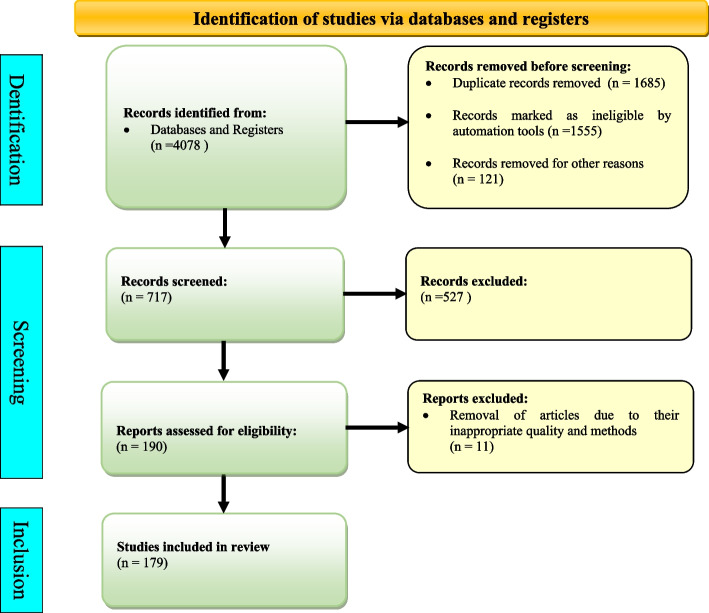
A total of 4078 articles were retrieved. After screening and quality assessment, 179 articles were included in the review, identifying 88 dimensions and components of HaH care across seven main categories: benefits, challenges and obstacles, facilitators, management-related factors, medical conditions, factors associated with patients and their families, and factors associated with caregivers. The common components included cost savings (n = 30), patient and family satisfaction (n = 23), reduction in re-admissions (n = 13), medication management (n = 12), communication, coordination, and cooperation among healthcare teams, patients, and families (n = 12), preferences of patients and families (n = 12), and education of patients, families, and healthcare teams (n = 10).
Based on the results, HaH includes many and diverse dimensions and components. So, healthcare policymakers and planners are urged to consider the dimensions and components of HaH care including benefits, challenges and obstacles, facilitators, management-related factors, medical conditions, factors associated with patients and their families, and factors associated with caregivers when developing models and programs to ensure effective outcomes following implementation.
医院居家(HaH)护理被认为是一种医疗保健提供方式,它在家中提供急性护理服务,作为传统医院护理的替代方案。本研究旨在探讨 HaH 护理的维度和组成部分。
本研究按照系统评价和荟萃分析的首选报告项目(PRISMA)声明进行了系统综述。检索了 2000 年初至 2024 年 2 月 19 日期间,关于 HaH 护理维度和组成部分的 ScienceDirect、Scopus、PubMed、Cochrane 图书馆、Web of Science 核心合集和 Wiley 在线图书馆的数据库。研究的纳入标准包括以英文发表的文章,以及涉及 HaH 护理各个维度和组成部分的文章。使用观察性研究的流行病学强化报告(STROBE)检查表评估研究质量,并使用框架分析方法对数据进行分析。
共检索到 4078 篇文章。经过筛选和质量评估,有 179 篇文章纳入综述,确定了 HaH 护理的 88 个维度和组成部分,分为七个主要类别:效益、挑战和障碍、促进因素、管理相关因素、医疗条件、与患者及其家属相关的因素以及与护理人员相关的因素。常见的组成部分包括节省成本(n=30)、患者和家属满意度(n=23)、减少再入院(n=13)、药物管理(n=12)、医疗团队、患者和家属之间的沟通、协调与合作(n=12)、患者和家属的偏好(n=12)以及患者、家属和医疗团队的教育(n=10)。
根据研究结果,HaH 包含许多不同的维度和组成部分。因此,医疗保健政策制定者和规划者在制定模型和方案时,应考虑 HaH 护理的维度和组成部分,包括效益、挑战和障碍、促进因素、管理相关因素、医疗条件、与患者及其家属相关的因素以及与护理人员相关的因素,以确保实施后取得有效的结果。