
胰腺癌中 p53 突变体的选择性代谢调控。
Selective metabolic regulations by p53 mutant variants in pancreatic cancer.
机构信息
Chair for Systems Toxicology, Department of Biology, University of Konstanz, Konstanz, Germany.
Department of Pathology, University of California San Diego School of Medicine, La Jolla, San Diego, CA, USA.
出版信息
J Exp Clin Cancer Res. 2024 Nov 26;43(1):310. doi: 10.1186/s13046-024-03232-3.
BACKGROUND
Approximately half of all human cancers harbour mutations in the p53 gene, leading to the generation of neomorphic p53 mutant proteins. These mutants can exert gain-of-function (GOF) effects, potentially promoting tumour progression. However, the clinical significance of p53 GOF mutations, as well as the selectivity of individual variants, remains controversial and unclear.
METHODS
To elucidate the metabolic regulations and molecular underpinnings associated with the specific p53 and p53 mutant variants (the mouse equivalents of human p53 and p53, respectively), we employed a comprehensive approach. This included integrating global metabolomic analysis with epigenomic and transcriptomic profiling in mouse pancreatic cancer cells. Additionally, we assessed metabolic parameters such as oxygen consumption rate and conducted analyses of proliferation and cell-cell competition to validate the biological impact of metabolic changes on pancreatic ductal adenocarcinoma (PDAC) phenotype. Our findings were further corroborated through analysis of clinical datasets from human cancer cohorts.
RESULTS
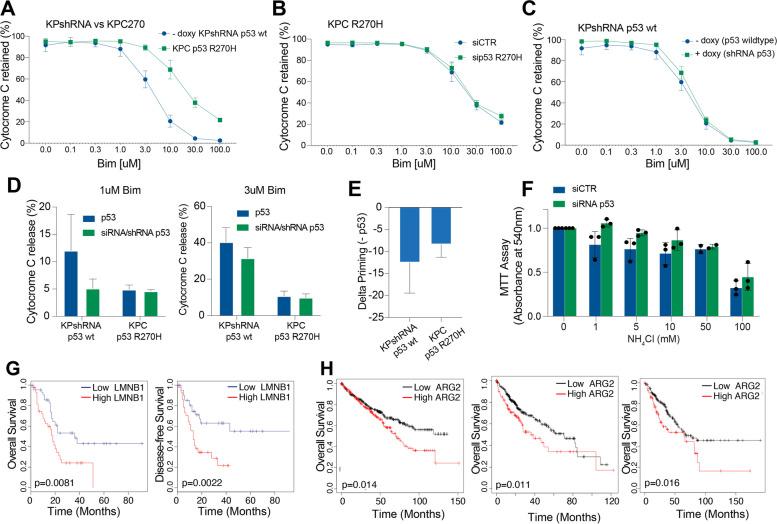
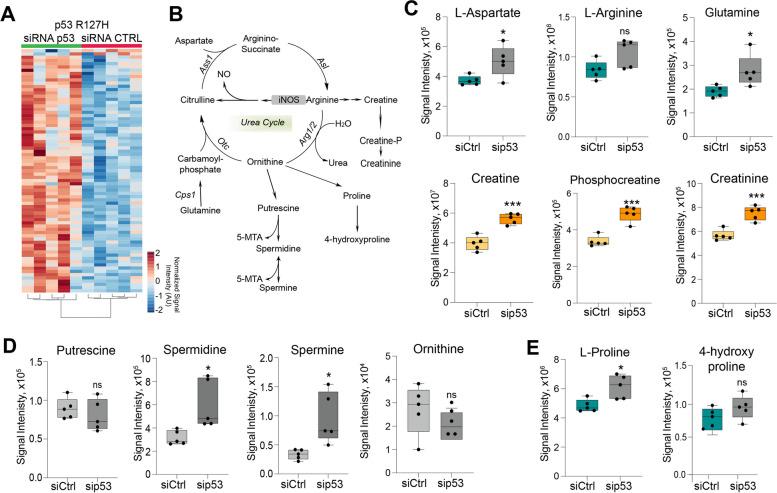
Our investigation revealed that the p53 variant, but not p53, sustains mitochondrial function and energy production while also influencing cellular antioxidant capacity. Conversely, p53, while not affecting mitochondrial metabolism, attenuates the activation of pro-tumorigenic metabolic pathways such as the urea cycle. Thus, the two variants selectively control different metabolic pathways in pancreatic cancer cells. Mechanistically, p53 induces alterations in the expression of genes associated with oxidative stress and reduction in mitochondrial respiration. In contrast, p53 specifically impacts the expression levels of enzymes involved in the urea metabolism. However, our analysis of cell proliferation and cell competition suggested that the expression of either p53 or p53 does not influence confer any selective advantage to this cellular model in vitro. Furthermore, assessment of mitochondrial priming indicated that the p53-driven mitochondrial effect does not alter cytochrome c release or the apoptotic propensity of pancreatic cancer cells.
CONCLUSIONS
Our study elucidates the mutant-specific impact of p53 and p53 on metabolism of PDAC cancer cells, highlighting the need to shift from viewing p53 mutant variants as a homogeneous group of entities to a systematic assessment of each specific p53 mutant protein. Moreover, our finding underscores the importance of further exploring the significance of p53 mutant proteins using models that more accurately reflect tumor ecology.
背景
大约一半的人类癌症都存在 p53 基因突变,导致新的 p53 突变蛋白的产生。这些突变体可以发挥获得功能(GOF)效应,可能促进肿瘤的进展。然而,p53GOF 突变的临床意义以及个别变体的选择性仍然存在争议和不清楚。
方法
为了阐明与特定的 p53 和 p53 突变体(分别为人类 p53 和 p53 的小鼠等效物)相关的代谢调节和分子基础,我们采用了一种综合的方法。这包括将全局代谢组学分析与小鼠胰腺癌细胞的表观基因组和转录组谱整合。此外,我们评估了代谢参数,如耗氧率,并进行了增殖和细胞间竞争分析,以验证代谢变化对胰腺导管腺癌(PDAC)表型的生物学影响。我们的研究结果通过分析来自人类癌症队列的临床数据集得到了进一步证实。
结果
我们的研究表明,p53 变体而不是 p53 维持线粒体功能和能量产生,同时也影响细胞抗氧化能力。相反,p53 虽然不影响线粒体代谢,但会减弱促肿瘤代谢途径的激活,如尿素循环。因此,这两个变体在胰腺癌细胞中选择性地控制不同的代谢途径。从机制上讲,p53 诱导与氧化应激和减少线粒体呼吸相关的基因表达的改变。相比之下,p53 特异性地影响与尿素代谢相关的酶的表达水平。然而,我们对细胞增殖和细胞竞争的分析表明,p53 或 p53 的表达并不影响这个细胞模型在体外的任何选择性优势。此外,评估线粒体启动表明,p53 驱动的线粒体效应不会改变细胞色素 c 的释放或胰腺癌细胞的凋亡倾向。
结论
我们的研究阐明了 p53 和 p53 对 PDAC 癌细胞代谢的突变体特异性影响,强调需要从将 p53 突变体视为同质群体转变为对每个特定的 p53 突变蛋白进行系统评估。此外,我们的发现强调了使用更准确地反映肿瘤生态的模型进一步探索 p53 突变蛋白意义的重要性。



 Zotero 插件