Biosciences Laboratory, IRCCS Istituto Romagnolo per lo Studio dei Tumori (IRST) "Dino Amadori", Via Piero Maroncelli, 40, 47014, Meldola, FC, Italy.
Fondazione Pisana per la Scienza ONLUS, San Giuliano Terme, Italy.
J Transl Med. 2024 Nov 26;22(1):1062. doi: 10.1186/s12967-024-05838-9.
The introduction of antibody-drug conjugates represents a significant advancement in targeted therapy of acute myeloid leukemia (AML) and acute lymphoblastic leukemia (ALL). Our study aims to investigate the role of the DNA damage response pathway and the impact of PARP1 inhibition, utilizing talazoparib, on the response of AML and ALL cells to Gemtuzumab ozogamicin (GO) and Inotuzumab ozogamicin (INO), respectively.
AML and ALL cells were treated with GO, INO and γ-calicheamicin in order to induce severe DNA damage and activate the G2/M cell-cycle checkpoint in a dose- and time-dependent manner. The efficacy of PARP1 inhibitors and, in particular, talazoparib in enhancing INO or GO against ALL or AML cells was assessed through measurements of cell viability, cell death, cell cycle progression, DNA damage repair, accumulation of mitotic DNA damage and inhibition of clonogenic capacity.
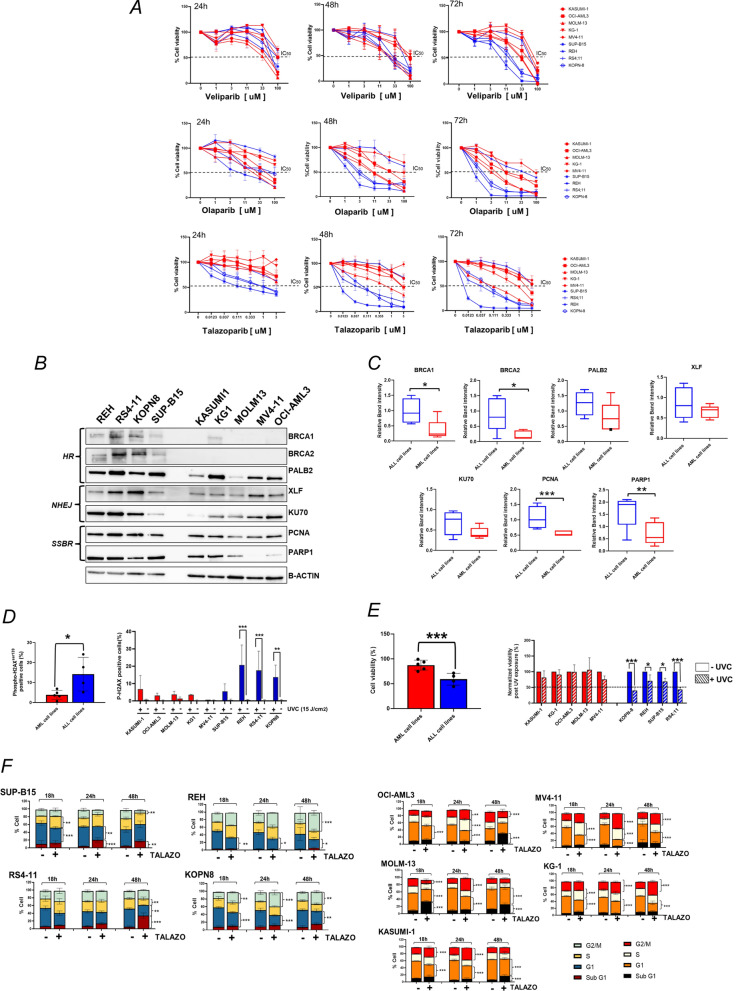
We observed that both ALL and AML cell lines activate the G2/M cell-cycle checkpoint in response to γ-calicheamicin-induced DNA damage, highlighting a shared cellular response mechanism. Talazoparib significantly enhanced the efficacy of INO against ALL cell lines, resulting in reduced cell viability, increased cell death, G2/M cell-cycle checkpoint override, accumulation of mitotic DNA damage and inhibition of clonogenic capacity. Strong synergism was observed in primary ALL cells treated with the combination. In contrast, AML cells exhibited a heterogeneous response to talazoparib in combination with GO. Our findings suggest a potential link between the differential responses of ALL and AML cells to the drug combinations and the ability of talazoparibto override G2/M cell-cycle arrest induced by antibody-drug conjugates.
PARP1 emerges as a key player in the response of ALL cells to INO and represents a promising target for therapeutic intervention in this leukemia setting. Our study sheds light on the intricate interplay between the DNA damage response pathway, PARP1 inhibition, and response of γ-calicheamicin-induced DNA damages in AML and ALL. These findings underscore the importance of targeted therapeutic strategies and pave the way for future research aimed at optimizing leukemia treatment approaches.
抗体药物偶联物的引入代表了急性髓细胞白血病(AML)和急性淋巴细胞白血病(ALL)靶向治疗的重大进展。我们的研究旨在探讨 DNA 损伤反应通路的作用,以及利用 PARP1 抑制剂他拉唑帕尼对 AML 和 ALL 细胞对吉妥珠单抗奥佐米星(GO)和伊诺妥珠单抗奥佐米星(INO)的反应的影响。
AML 和 ALL 细胞分别用 GO、INO 和γ-卡奇霉素处理,以诱导严重的 DNA 损伤,并在剂量和时间依赖性方式下激活 G2/M 细胞周期检查点。通过测量细胞活力、细胞死亡、细胞周期进程、DNA 损伤修复、有丝分裂 DNA 损伤积累和克隆形成能力抑制,评估 PARP1 抑制剂,特别是他拉唑帕尼增强 INO 或 GO 对 ALL 或 AML 细胞的疗效。
我们观察到,ALL 和 AML 细胞系均通过 γ-卡奇霉素诱导的 DNA 损伤激活 G2/M 细胞周期检查点,强调了一种共同的细胞反应机制。他拉唑帕尼显著增强了 INO 对 ALL 细胞系的疗效,导致细胞活力降低、细胞死亡增加、G2/M 细胞周期检查点被绕过、有丝分裂 DNA 损伤积累和克隆形成能力抑制。用该组合处理的原发性 ALL 细胞观察到强烈的协同作用。相比之下,AML 细胞对他拉唑帕尼与 GO 的组合反应存在异质性。我们的研究结果表明,ALL 和 AML 细胞对药物组合的不同反应与他拉唑帕尼克服抗体药物偶联物诱导的 G2/M 细胞周期阻滞的能力之间存在潜在联系。
PARP1 成为 ALL 细胞对 INO 反应的关键因素,代表了在这种白血病治疗中具有治疗干预潜力的靶点。我们的研究阐明了 DNA 损伤反应通路、PARP1 抑制以及 γ-卡奇霉素诱导的 DNA 损伤在 AML 和 ALL 中的反应之间的复杂相互作用。这些发现强调了靶向治疗策略的重要性,并为旨在优化白血病治疗方法的未来研究铺平了道路。