International Unresponsive Wakefulness Syndrome and Consciousness Science Institute, Hangzhou Normal University, Hangzhou, China.
Intensive Care Unite, Hangzhou First People's Hospital, Hangzhou, China.
Ann Med. 2024 Dec;56(1):2423794. doi: 10.1080/07853890.2024.2423794. Epub 2024 Nov 25.
We aim to investigate the ethical attitudes of the Chinese population toward withdrawal of life-sustaining treatment (WLST) in disorders of consciousness (DoC) patients.
A self-administered questionnaire concerning WLST was distributed to Chinese medical professionals and non-medical participants between February and July 2022. Statistical analysis included chi-square tests and logistic regressions.
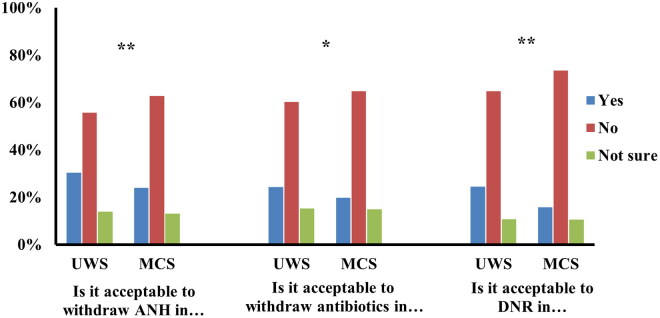
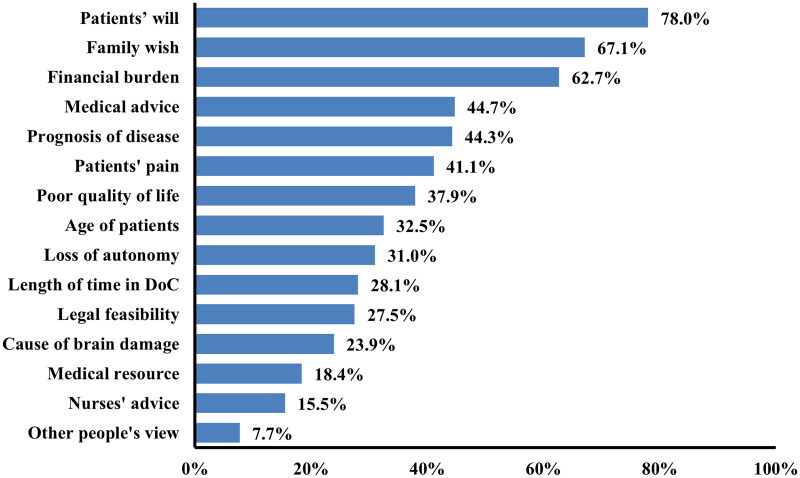
A total of 1223 Chinese participants responded to the questionnaire (39% of whom were medical professionals). Less than one third of participants reported positive attitudes towards withdrawing artificial nutrition and hydration (ANH), antibiotics, and do-not-resuscitation (DNR) orders in patients with unresponsive wakefulness syndrome (UWS) (30%, 24%, 24%) and minimally conscious state (MCS) (23%, 19%, 15%). More respondents agreed with WLST in UWS compared to MCS ( < 0.05). Positive attitudes toward DNR orders were associated with participants' older age, religion, monthly income > 5000 RMB and medical profession ( < 0.05). Most participants deemed patient's will (78%), families' wishes (67%), and financial burden (63%) to be crucial factors when considering WLST.
Chinese respondents exhibit a relatively low propensity to accept WLST in DoC. Ethical attitudes toward WLST resulted to be affected by individual characteristics of responders. These results call for developing better regulations for identifying qualified surrogate decision-makers and reducing legal ambiguities.
我们旨在调查中国人对意识障碍(DoC)患者停止生命维持治疗(WLST)的伦理态度。
我们于 2022 年 2 月至 7 月期间向中国的医疗专业人员和非医疗参与者发放了一份关于 WLST 的自我管理式问卷。统计分析包括卡方检验和逻辑回归。
共有 1223 名中国参与者对问卷做出了回应(其中 39%为医疗专业人员)。不到三分之一的参与者对停止无反应觉醒综合征(UWS)(30%、24%、24%)和最小意识状态(MCS)(23%、19%、15%)患者的人工营养和水合、抗生素和不复苏(DNR)医嘱持积极态度。与 MCS 相比,更多的参与者同意 UWS 中的 WLST( < 0.05)。对 DNR 医嘱持积极态度与参与者的年龄较大、宗教信仰、月收入>5000 元人民币和医疗职业有关( < 0.05)。大多数参与者认为患者的意愿(78%)、家属的愿望(67%)和经济负担(63%)是考虑 WLST 的关键因素。
中国受访者对 DoC 中的 WLST 接受度相对较低。对 WLST 的伦理态度受到应答者个体特征的影响。这些结果呼吁制定更好的法规,以确定合格的替代决策人并减少法律上的模糊性。