Washmuth Nicholas B, Stephens Richard, Ballmann Christopher G
Department of Physical Therapy, Samford University, Birmingham, AL, United States.
School of Psychology, Keele University, Keele, United Kingdom.
Front Psychol. 2024 Nov 11;15:1445175. doi: 10.3389/fpsyg.2024.1445175. eCollection 2024.
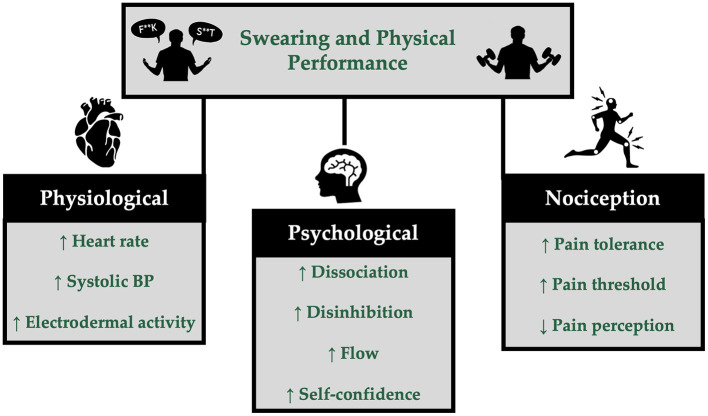
Swearing, or using taboo language with the potential to offend, has been shown to improve physical performance during short and intense tasks requiring strength and power development. While consistent ergogenic effects of swearing have been observed across studies, the mechanisms by which swearing impacts physical performance are not fully clear. Swearing has been shown to modulate physiological (i.e., heart rate, blood pressure, skin conductance), psychological (i.e., state disinhibition), and nociceptive (i.e., pain threshold, pain tolerance, pain perception) responses, thus making it plausible that these mechanisms allow swearing to positively impact physical performance. A variety of dosages of swearing (i.e., word used, intensity, frequency, quantity) have been reported to improve physical performance. Although habituation to the positive physical performance effects of swearing has not been explored formally through empirical research, habituation to swearing has been observed in other contexts. From a practical application standpoint, swearing represents a low-risk, effective, and inexpensive intervention that has the potential to acutely improve physical performance although the taboo nature of swearing may limit its utility in real-world situations. The purpose of the following review is to provide an overview of available evidence on swearing and physical performance and discuss likely underlying mechanisms. Exploration of different swearing approaches and habituation will also be highlighted and suggestions for future research will be discussed, to more comprehensively understand if swearing can be strategically used for performance enhancement.
咒骂,即使用可能冒犯他人的禁忌语言,已被证明在需要力量和爆发力的短期高强度任务中能提高身体表现。虽然在各项研究中都观察到了咒骂持续的促力效果,但咒骂影响身体表现的机制尚不完全清楚。咒骂已被证明能调节生理反应(如心率、血压、皮肤电传导)、心理反应(如状态去抑制)和伤害感受反应(如痛阈、疼痛耐受力、疼痛感知),因此这些机制使咒骂有可能对身体表现产生积极影响,这是有道理的。据报道,各种咒骂剂量(如使用的词汇、强度、频率、数量)都能提高身体表现。虽然尚未通过实证研究正式探讨对咒骂积极身体表现效果的习惯化,但在其他情境中已观察到对咒骂的习惯化。从实际应用的角度来看,咒骂是一种低风险、有效且廉价的干预措施,有可能迅速提高身体表现,尽管咒骂的禁忌性质可能会限制其在现实世界中的效用。以下综述的目的是概述关于咒骂与身体表现的现有证据,并讨论可能的潜在机制。还将重点探讨不同的咒骂方式和习惯化,并讨论对未来研究的建议,以便更全面地了解咒骂是否可以策略性地用于提高表现。