D'Hondt Joachim, Chapelle Laurent, Bishop Chris, Aerenhouts Dirk, De Pauw Kevin, Clarys Peter, D'Hondt Eva
Movement and Nutrition for Health and Performance (MOVE) Research Group, Department of Movement and Sport Sciences, Faculty of Physical Education and Physiotherapy, Vrije Universiteit Brussel, Pleinlaan 2, 1050, Brussels, Belgium.
London Sport Institute, Middlesex University, London, UK.
Sports Med Open. 2024 Nov 26;10(1):127. doi: 10.1186/s40798-024-00790-w.
The presence of inter-limb asymmetry in the human body has traditionally been perceived to be detrimental for athletic performance. However, a systematic review addressing and comprehensively assessing the association of asymmetry between the lower limbs and middle- and long-distance running performance-related metrics is currently lacking.
The main purpose of this systematic review was to examine the relationship between lower inter-limb asymmetry and determinants of running performance in healthy middle- and long-distance runners. The secondary objective was to identify possible avenues for further research in this area.
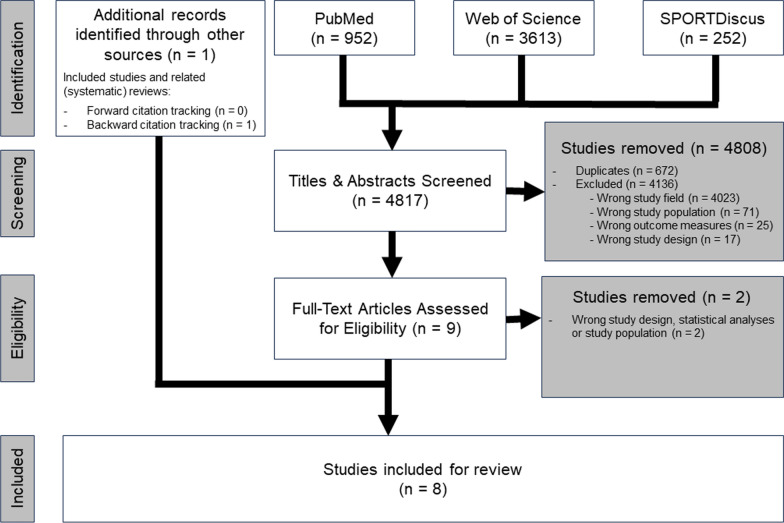
PubMed, Web of Science and SPORTDiscus were systematically searched for studies investigating the relationship between lower inter-limb asymmetry and (determinants of) running performance in healthy and injury-free middle- and long-distance runners. The quality of studies eligible for inclusion was assessed using the Downs and Black Quality Index Tool.
Out of 4817 articles screened, 8 studies were included in this review which assessed the association between functional, morphological, kinematic and kinetic asymmetry and running performance-related metrics. The quality score of the included research varied between 5/10 and 9/10. Our results revealed mixed findings, showing both significant negative (n = 16) and positive (n = 1) associations as well as no significant associations (n = 30) between inter-limb asymmetry and running performance-related metrics.
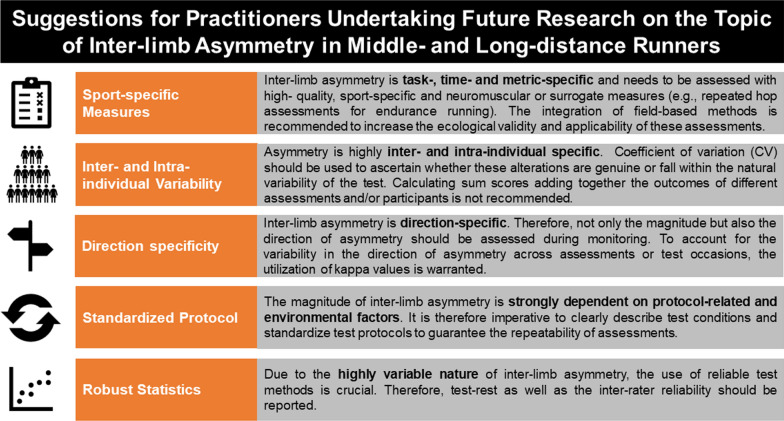
A high heterogeneity across study methods and outcomes was apparent, making it difficult to draw a straightforward conclusion. Our results indicate that the majority of metrics of functional, morphological, kinematic and kinetic inter-limb asymmetry are negatively or not associated with running performance (and/or its determinants). Thus, a more extensive high-quality body of research using standardised asymmetry magnitude metrics is essential to determine whether, and to what extent asymmetry between the lower limbs could affect middle- and long-distance running performance. Future studies should establish potential trade-off values to help practitioners develop evidence-based training programs.
In the majority of the metrics, the magnitude of lower inter-limb asymmetry was negatively or not associated with middle- and long-distance running performance. Coaches, athletes and researchers should be attentive of the task, time- and metric-specificity as well as the inter- and intra- individual variability of magnitude outcomes, when assessing inter-limb asymmetries.
人体四肢间的不对称现象传统上被认为对运动表现不利。然而,目前缺乏一项系统评价来探讨和全面评估下肢不对称与中长跑运动表现相关指标之间的关联。
本系统评价的主要目的是研究健康中长跑运动员下肢间不对称与跑步表现决定因素之间的关系。次要目的是确定该领域进一步研究的可能途径。
系统检索了PubMed、Web of Science和SPORTDiscus数据库,以查找有关健康且无损伤的中长跑运动员下肢间不对称与跑步表现(及其决定因素)之间关系的研究。使用唐斯和布莱克质量指数工具评估纳入研究的质量。
在筛选的4817篇文章中,本评价纳入了8项研究,这些研究评估了功能、形态、运动学和动力学不对称与跑步表现相关指标之间的关联。纳入研究的质量得分在5/10至9/10之间。我们的结果显示出混合的结果,表明下肢间不对称与跑步表现相关指标之间既有显著的负相关(n = 16)和正相关(n = 1),也有不显著的关联(n = 30)。
研究方法和结果存在高度异质性,难以得出直接的结论。我们的结果表明,功能、形态、运动学和动力学下肢间不对称的大多数指标与跑步表现(和/或其决定因素)呈负相关或无关联。因此,需要开展更多使用标准化不对称程度指标的高质量研究,以确定下肢不对称是否以及在多大程度上会影响中长跑运动表现。未来的研究应确定潜在的权衡值,以帮助从业者制定基于证据的训练计划。
在大多数指标中,下肢间不对称程度与中长跑运动表现呈负相关或无关联。在评估下肢间不对称时,教练、运动员和研究人员应注意任务、时间和指标的特异性,以及程度结果的个体间和个体内变异性。