School of Materials Science and Engineering, Hainan University, Haikou 570228, China.
Biosensors (Basel). 2024 Nov 1;14(11):527. doi: 10.3390/bios14110527.
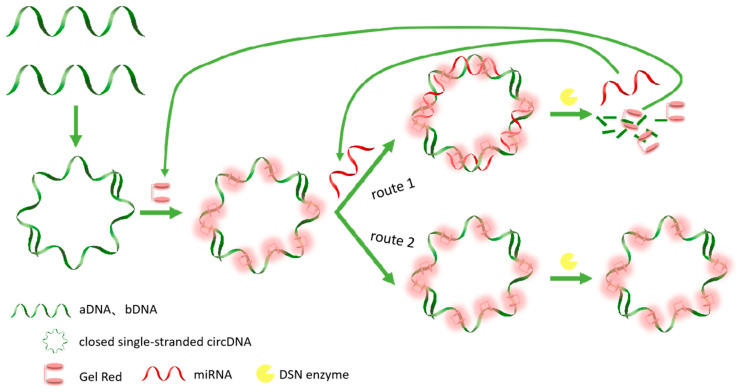
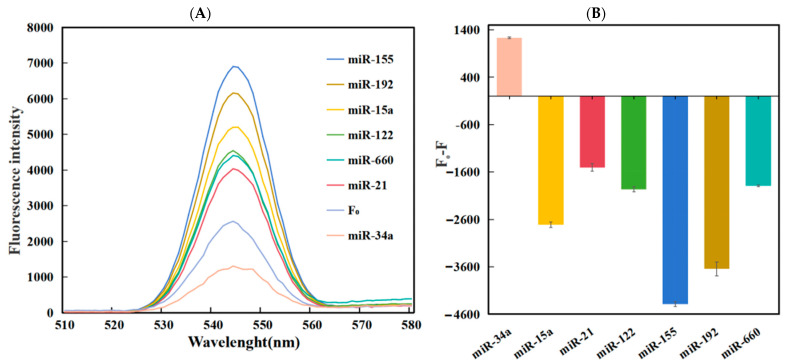
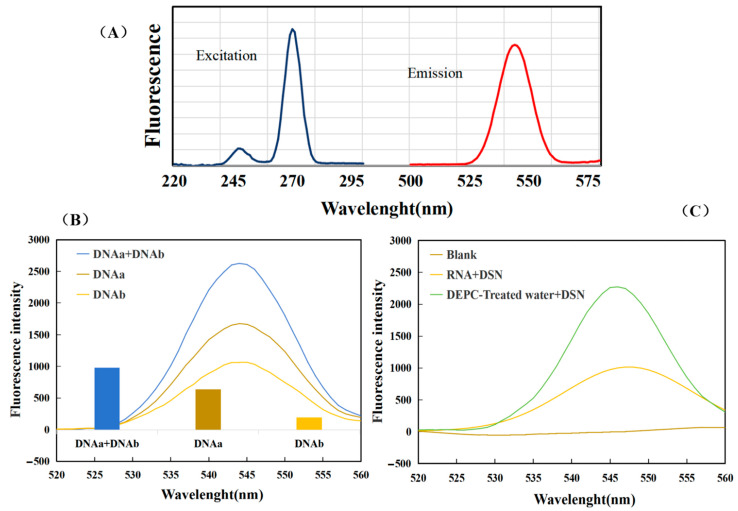
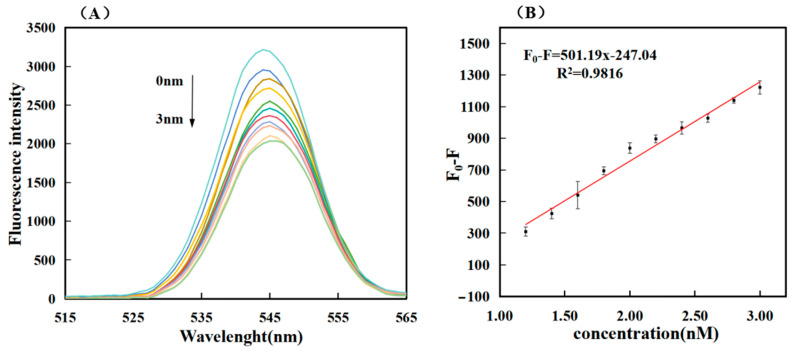
Fluorescent biosensor, which has the characteristics of high sensitivity, specificity, and low cost, can be directly detected in physiological fluids such as blood and serum. Therefore, the development of fluorescence sensor platforms for miRNA detection has a positive effect on the prevention and treatment of various diseases. In this paper, miR-34a was selected as a biological indicator of Alzheimer's disease (AD). We designed a circular single-stranded DNA (CSSD) biosensor, which uses two unmodified single-stranded DNA (ssDNA) with complementary ends, DNAa and DNAb, to form CSSD by DNA sequence pairing to improve thermal stability and achieve signal amplification. At the same time, CSSD can react with miR-34a, and then the DNA of the DNA-RNA chain is hydrolyzed by duplex-specific nuclease (DSN enzyme). Finally, miR-34a is released to partake in the subsequent step, thus realizing cycle amplification. By evaluating the change in fluorescence signal under the optimized conditions, we discovered that this approach exhibits impressive sensitivity, with a detection threshold reaching as low as 0.36 nM. This surpasses the performance of numerous preceding miRNA detection biosensors. Furthermore, the system displays excellent detection capabilities even in intricate settings like serum, showcasing a strong ability to differentiate and choose effectively. In summary, this is a signal-off fluorescent biosensor, which realizes the purpose of double amplification of biosensor signal by using CSSD and enzyme assistance so that it can be used as a valuable tool for early diagnosis of diseases.
荧光生物传感器具有灵敏度高、特异性强、成本低等特点,可以直接检测血液、血清等生理体液中的物质。因此,开发用于 miRNA 检测的荧光传感器平台对各种疾病的预防和治疗具有积极意义。本文选择 miR-34a 作为阿尔茨海默病(AD)的生物标志物。我们设计了一种环状单链 DNA(CSSD)生物传感器,该传感器使用两条互补末端的未修饰单链 DNA(ssDNA)DNAa 和 DNAb 通过 DNA 序列配对形成 CSSD,以提高热稳定性并实现信号放大。同时,CSSD 可以与 miR-34a 反应,然后双链特异性核酸酶(DSN 酶)将 DNA-DNA 链水解。最后,miR-34a 被释放出来参与后续步骤,从而实现循环放大。在优化条件下评估荧光信号的变化,我们发现该方法具有令人印象深刻的灵敏度,检测阈值低至 0.36 nM。这超过了许多先前的 miRNA 检测生物传感器的性能。此外,该系统在血清等复杂环境下表现出出色的检测能力,具有较强的有效区分和选择能力。总之,这是一种信号关闭型荧光生物传感器,通过 CSSD 和酶辅助实现了生物传感器信号的双重放大,可作为疾病早期诊断的有价值工具。