Department of Mechanical Engineering and Applied Mechanics, University of Pennsylvania, Philadelphia, PA 19104, USA.
West African Centre for Cell Biology of Infectious Pathogens (WACCBIP), University of Ghana, Legon, Accra P.O. Box LG 54, Ghana.
Biosensors (Basel). 2024 Nov 13;14(11):554. doi: 10.3390/bios14110554.
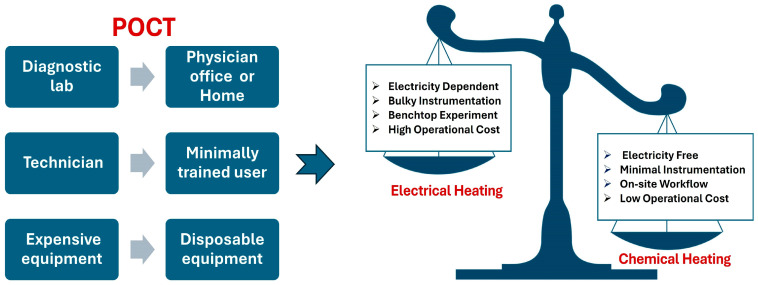
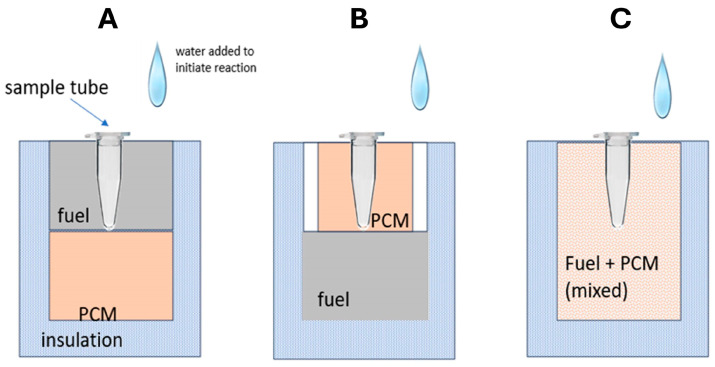
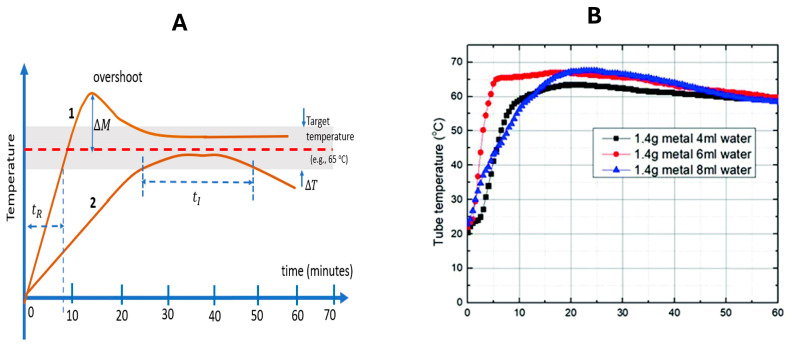
The minimal instrumentation of portable medical diagnostic devices for point-of-care applications is facilitated by using chemical heating in place of temperature-regulated electrical heaters. The main applications are for isothermal nucleic acid amplification tests (NAATs) and other enzymatic assays that require elevated, controlled temperatures. In the most common implementation, heat is generated by the exothermic reaction of a metal (e.g., magnesium, calcium, or lithium) with water or air, buffered by a phase-change material that maintains a near-constant temperature to heat the assay reactions. The ability to incubate NAATs electricity-free and to further to detect amplification with minimal instrumentation opens the door for fully disposable, inexpensive molecular diagnostic devices that can be used for pathogen detection as needed in resource-limited areas and during natural disasters, wars, and civil disturbances when access to electricity may be interrupted. Several design approaches are reviewed, including more elaborate schemes for multiple stages of incubation at different temperatures.
便携式医疗诊断设备的最小化仪器化可通过使用化学加热代替温度调节电加热器来实现。主要应用是用于等温核酸扩增测试(NAAT)和其他需要升高、受控温度的酶检测。在最常见的实施方式中,通过金属(例如镁、钙或锂)与水或空气的放热反应产生热量,并通过相变材料进行缓冲,该材料保持近乎恒定的温度以加热检测反应。能够在无电的情况下孵育 NAAT,并进一步使用最小的仪器化进行扩增检测,为完全一次性、廉价的分子诊断设备打开了大门,这些设备可在资源有限的地区以及在发生自然灾害、战争和内乱时,根据需要用于病原体检测,因为在这些情况下可能会中断电力供应。本文回顾了几种设计方法,包括用于不同温度下多个孵育阶段的更复杂方案。