Clinical Neurology Unit, Udine University Hospital, Piazzale Santa Maria della Misericordia 15, 33100 Udine, Italy.
Neurology Unit, Udine University Hospital, Piazzale Santa Maria Della Misericordia 15, 33100 Udine, Italy.
Toxins (Basel). 2024 Nov 20;16(11):500. doi: 10.3390/toxins16110500.
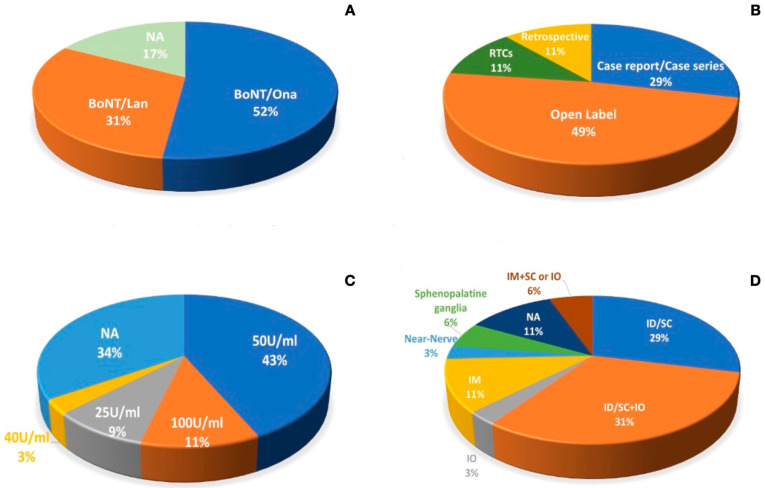
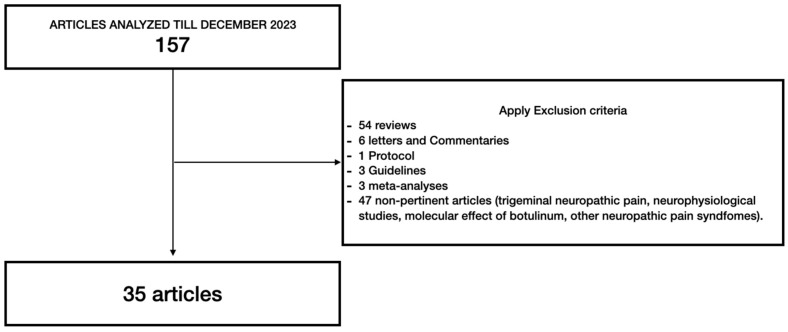
Trigeminal neuralgia is a neuropathic pain syndrome responsive to botulinum toxin type A therapy. This review had the goal of analyzing the different studies published from 2002 to January 2024 to better define the techniques and the types of botulinum toxin type A used, the doses, the injection routes, and the different populations of trigeminal neuralgia patients treated. We considered only articles in which the therapy was administered to humans to treat trigeminal neuralgia. Case reports, case series, open-label, retrospective, and RCT studies were considered. The research was conducted on MEDLINE and the keywords included (trigeminal neuralgia) and (botulinum). Thirty-five articles were considered suitable for this review. Botulinum toxin type A was shown to be an effective therapy for TN pain in all the articles analyzed, albeit there is a lack of standardization in methods and outcomes. The techniques, the doses, and the injection approaches were very heterogeneous among the studies. Only two botulinum toxin type A formulations have been used in this setting: onabotulinumtoxinA and lanbotulinumtoxinA. There were 300 patients treated with onabotulinumtoxinA and 760 treated with lanbotulinumtoxinA overall (in 42 patients, the formulation was not specified). The distinction between etiological and clinical types of TN has been made by only a small portion of the studies. The main adverse event was transient facial asymmetry. Botulinum toxin type A is indeed a promising therapy that is clearly effective for trigeminal neuralgia. OnabotulinumtoxinA is the most common formulation used in Western countries; however, the meager sample of TN patients treated, and the lack of standardization are not sufficient for this therapy to be approved by the FDA or EMA. Indeed, more studies with standardized methods and larger samples are needed for this purpose.
三叉神经痛是一种对肉毒毒素 A 治疗有反应的神经性疼痛综合征。本综述的目的是分析 2002 年至 2024 年 1 月发表的不同研究,以更好地定义使用的肉毒毒素 A 类型、剂量、注射途径以及治疗的不同三叉神经痛患者人群。我们仅考虑将该疗法用于治疗三叉神经痛的人类的文章。病例报告、病例系列、开放标签、回顾性和 RCT 研究均被认为是合适的。研究在 MEDLINE 上进行,关键词包括(三叉神经痛)和(肉毒毒素)。考虑了 35 篇适合本综述的文章。在所有分析的文章中,肉毒毒素 A 被证明是治疗 TN 疼痛的有效疗法,尽管在方法和结果方面缺乏标准化。研究之间的技术、剂量和注射方法非常多样化。在这种情况下仅使用了两种肉毒毒素 A 制剂:onabotulinumtoxinA 和 lanbotulinumtoxinA。有 300 名患者接受了 onabotulinumtoxinA 治疗,760 名患者接受了 lanbotulinumtoxinA 治疗(在 42 名患者中,未指定制剂)。只有一小部分研究对三叉神经痛的病因和临床类型进行了区分。主要的不良事件是短暂的面部不对称。肉毒毒素 A 确实是一种有前途的治疗方法,对三叉神经痛明显有效。在西方国家,onabotulinumtoxinA 是最常用的制剂;然而,接受治疗的三叉神经痛患者样本量少,缺乏标准化,不足以使该疗法获得 FDA 或 EMA 的批准。实际上,需要更多具有标准化方法和更大样本量的研究来实现这一目标。