Health and Care Research Wales Evidence Centre, Cardiff University, Cardiff, United Kingdom.
Science Evidence Advice Division, Welsh Government, Cardiff, United Kingdom.
PLoS One. 2024 Nov 26;19(11):e0314461. doi: 10.1371/journal.pone.0314461. eCollection 2024.
The Wales COVID-19 Evidence Centre (WCEC) was established from 2021-23 to ensure that the latest coronavirus (COVID-19) relevant research evidence was readily available to inform health and social care policy and practice decision-makers. Although decisions need to be evidence-based, ensuring that accessible and relevant research evidence is available to decision-makers is challenging, especially in a rapidly evolving pandemic environment when timeframes for decision-making are days or weeks rather than months or years. We set up knowledge mobilisation processes to bridge the gap between evidence review and informing decisions, making sure that the right information reaches the right people at the right time.
To describe the knowledge mobilisation processes used by the WCEC, evaluate the impact of the WCEC rapid evidence reviews, and share lessons learned.
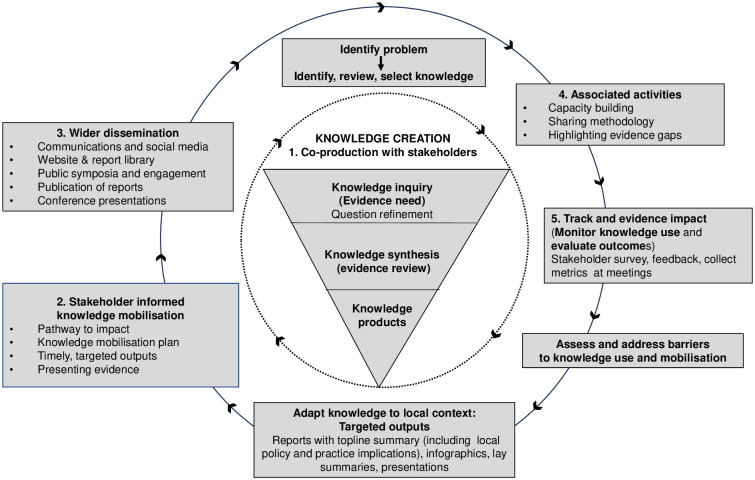
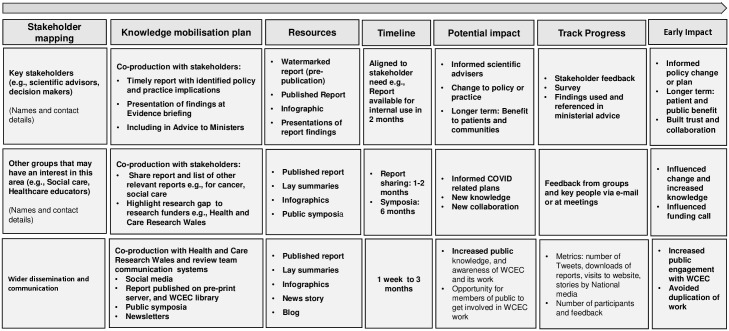
Our knowledge mobilisation methods were flexible and tailored to meet stakeholders' needs. They included stakeholder co-production in our rapid evidence review processes, stakeholder-informed and participatory knowledge mobilisation, wider dissemination of outputs and associated activities including public engagement, capacity building and sharing of methodologies. Feedback on processes and evidence of impact was collected via stakeholder engagement and a stakeholder survey.
Findings indicate that knowledge mobilisation processes successfully enabled use of the WCEC's rapid evidence reviews to inform policy and practice decision-makers during the COVID-19 pandemic in Wales. Realising actual public and patient benefit from this 'pathway to impact' work will take further time and resources.
The WCEC knowledge mobilisation processes successfully supported co-production and use of rapid evidence review findings by scientific advisors and policy and practice decision-makers during the COVID-19 pandemic. Identified barriers and facilitators are of potential relevance to wider evidence initiatives, for setting up similar Centres during crisis situations, and supporting future evidence-based policy and practice decision-making.
威尔士 COVID-19 证据中心(WCEC)成立于 2021-2023 年,旨在确保最新的冠状病毒(COVID-19)相关研究证据随时可供卫生和社会保健政策和实践决策者使用。尽管决策需要基于证据,但确保决策者能够获得可及和相关的研究证据具有挑战性,尤其是在快速演变的大流行环境中,决策的时间框架是数天或数周,而不是数月或数年。我们建立了知识动员流程,以弥合证据审查和为决策提供信息之间的差距,确保正确的信息在正确的时间到达正确的人手中。
描述 WCEC 使用的知识动员流程,评估 WCEC 快速证据审查的影响,并分享经验教训。
我们的知识动员方法灵活且量身定制,以满足利益相关者的需求。它们包括在我们的快速证据审查过程中进行利益相关者共同制定、利益相关者知情和参与式知识动员、更广泛地传播产出和相关活动,包括公众参与、能力建设和方法共享。通过利益相关者参与和利益相关者调查收集了对流程的反馈和影响证据。
调查结果表明,知识动员流程成功地使 WCEC 的快速证据审查能够在威尔士 COVID-19 大流行期间为政策和实践决策者提供信息。要从这项“影响途径”工作中真正实现公众和患者的利益,还需要更多的时间和资源。
WCEC 的知识动员流程成功地支持了科学顾问以及政策和实践决策者在 COVID-19 大流行期间对快速证据审查结果的共同制定和使用。确定的障碍和促进因素可能与更广泛的证据倡议、在危机情况下建立类似中心以及支持未来基于证据的政策和实践决策相关。