Division of Nephrology and Hypertension, Cincinnati Children's Hospital Medical Center, 268-280 Albert Sabin Way, location T, floor 6, suite 272, Cincinnati, OH, 45229, USA.
Division of Molecular Cardiovascular Biology, Cincinnati Children's Hospital Medical Center, Cincinnati, OH, USA.
Sci Rep. 2024 Nov 26;14(1):29307. doi: 10.1038/s41598-024-80930-0.
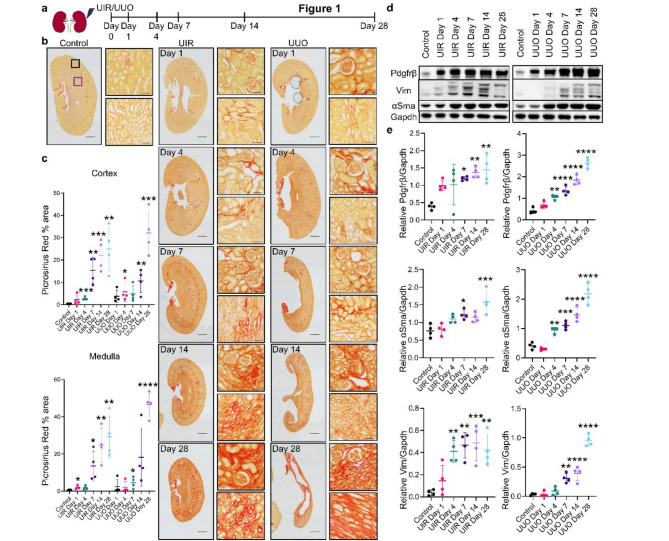
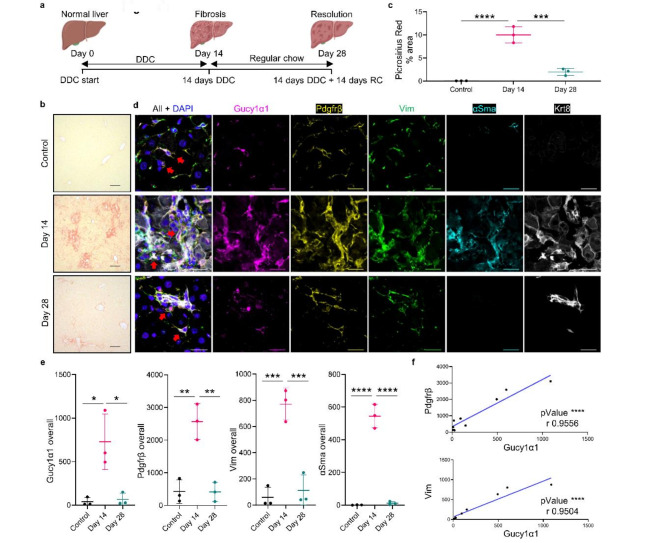
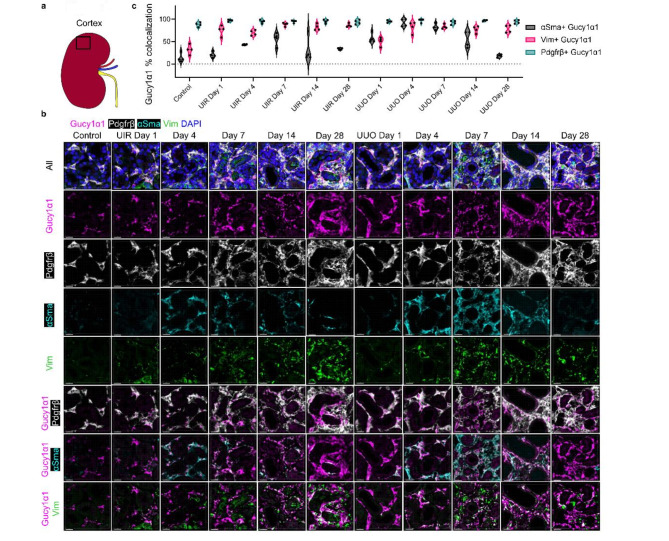
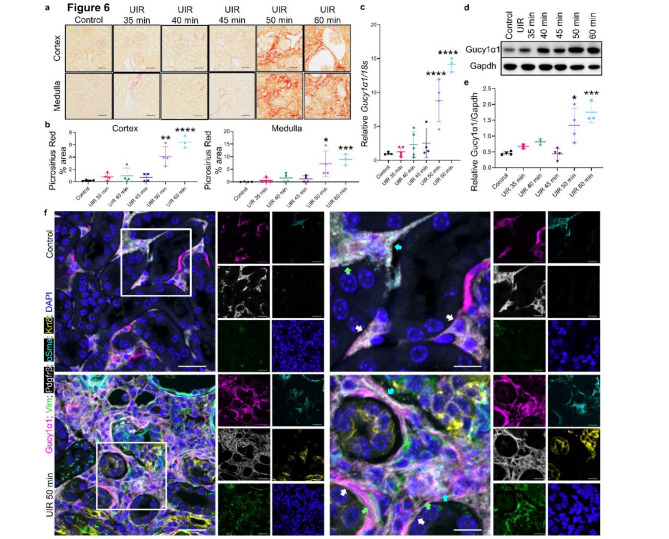
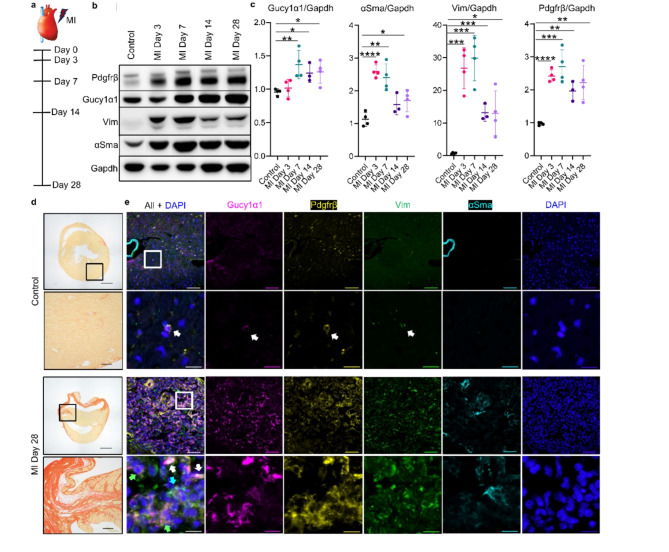
Fibrosis is a common outcome of numerous pathologies, including chronic kidney disease (CKD), a progressive renal function deterioration. Current approaches to target activated fibroblasts, key effector contributors to fibrotic tissue remodeling, lack specificity. Here, we report Gucy1α1 as a specific kidney fibroblast marker. Gucy1α1 levels significantly increased over the course of two clinically relevant murine CKD models and directly correlated with established fibrosis markers. Immunofluorescent (IF) imaging showed that Gucy1α1 comprehensively labelled cortical and medullary quiescent and activated fibroblasts in the control kidney and throughout injury progression, respectively. Unlike traditionally used markers platelet derived growth factor receptor beta (Pdgfrβ) and vimentin (Vim), Gucy1α1 did not overlap with off-target populations such as podocytes. Notably, Gucy1α1 labelled kidney fibroblasts in both male and female mice. Furthermore, we observed elevated GUCY1α1 expression in the human fibrotic kidney and lung. Studies in the murine models of cardiac and liver fibrosis revealed Gucy1α1 elevation in activated Pdgfrβ-, Vim- and alpha smooth muscle actin (αSma)-expressing fibroblasts paralleling injury progression and resolution. Overall, we demonstrate Gucy1α1 as an exclusive fibroblast marker in both sexes. Due to its multiorgan translational potential, GUCY1α1 might provide a novel promising strategy to specifically target and mechanistically examine fibroblasts.
纤维化是许多病理的常见结果,包括慢性肾脏病(CKD),这是一种进行性肾功能恶化。目前针对激活的成纤维细胞(纤维化组织重塑的关键效应贡献者)的方法缺乏特异性。在这里,我们报告 Gucy1α1 作为一种特异性的肾脏成纤维细胞标志物。在两种临床相关的小鼠 CKD 模型中,Gucy1α1 的水平显著增加,并且与已建立的纤维化标志物直接相关。免疫荧光(IF)成像显示,Gucy1α1 在对照肾脏和损伤进展过程中全面标记皮质和髓质静止和激活的成纤维细胞。与传统使用的标志物血小板衍生生长因子受体β(Pdgfrβ)和波形蛋白(Vim)不同,Gucy1α1 与诸如足细胞等非靶细胞群不重叠。值得注意的是,Gucy1α1 标记了雄性和雌性小鼠的肾脏成纤维细胞。此外,我们观察到纤维化的人类肾脏和肺部中 GUCY1α1 的表达升高。在心脏和肝脏纤维化的小鼠模型中进行的研究表明,在损伤进展和消退过程中,激活的 Pdgfrβ、Vim 和α平滑肌肌动蛋白(αSma)表达的成纤维细胞中 Gucy1α1 的表达升高。总的来说,我们证明了 Gucy1α1 是两性中特异性的成纤维细胞标志物。由于其多器官转化的潜力,GUCY1α1 可能为特异性靶向和机制研究成纤维细胞提供一种有前途的新策略。