Usui Ryota, Hamamoto Yoshiyuki, Imura Masahiro, Omori Yasuhiro, Yamazaki Yuji, Kuwata Hitoshi, Tatsuoka Hisato, Shimomura Kazuhiro, Murotani Kenta, Yamada Yuichiro, Seino Yutaka
Center for Diabetes, Endocrinology and Metabolism, Kansai Electric Power Hospital, Osaka, Japan.
Yutaka Seino Distinguished Center for Diabetes Research, Kansai Electric Power Medical Research Institute, Kyoto, Japan.
Diabetes Obes Metab. 2025 Feb;27(2):856-865. doi: 10.1111/dom.16086. Epub 2024 Nov 26.
Imeglimin is a new oral anti-diabetic drug with a similar structure to that of metformin; however, unlike metformin, clinical trials indicate that imeglimin elicits its glucose-lowering effect mainly by enhancement of insulin secretion. The comparative effects of the two drugs on incretin secretion remains to be elucidated.
A single-center, open-label, randomized controlled trial was conducted in patients with type 2 diabetes who were drug-naïve or were on a single oral hypoglycaemic agent (OHA). For patients taking a single OHA, an 8-week washout period was employed before randomization. Participants were randomized to the imeglimin group (IME, 2000 mg/day) or the metformin group (MET, 1000 mg/day), and OGTT was performed before treatment and after 12 and 24 weeks of treatment.
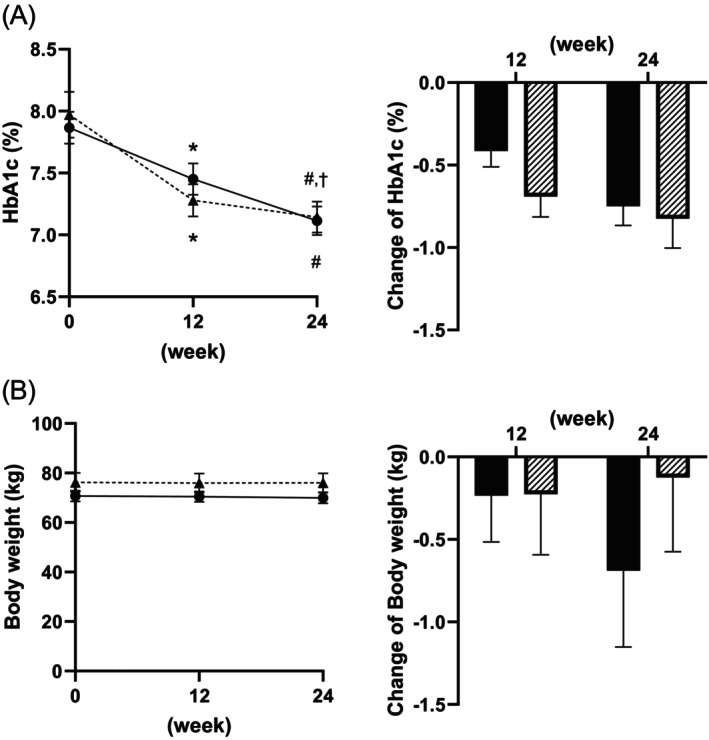
The reduction in HbA1c at 24 weeks was similar in IME and MET. OGTT revealed a comparable decrease in post-challenge blood glucose excursion in both groups, but insulin levels were increased only in IME. Total and active glucagon-like peptide-1 (GLP-1) levels were increased in both IME and MET; however, total and active glucose-dependent insulinotropic peptide (GIP) levels were increased only in IME. Interestingly, while an increase in insulin levels in IME was positively correlated with an increase in GLP-1 at 12 weeks, it was correlated only with an increase in GIP at 24 weeks.
Unlike metformin, imeglimin enhances GIP secretion as well as GLP-1 secretion, in addition to its direct insulinotropic mechanism of glucose control, emphasizing its potential as a therapeutic option in the treatment of patients with diabetes.
依美格列明是一种新型口服抗糖尿病药物,其结构与二甲双胍相似;然而,与二甲双胍不同的是,临床试验表明依美格列明主要通过增强胰岛素分泌来发挥降糖作用。这两种药物对肠促胰岛素分泌的比较效果仍有待阐明。
在初治或正在服用单一口服降糖药(OHA)的2型糖尿病患者中进行了一项单中心、开放标签、随机对照试验。对于正在服用单一OHA的患者,在随机分组前采用8周的洗脱期。参与者被随机分为依美格列明组(IME,2000毫克/天)或二甲双胍组(MET,1000毫克/天),并在治疗前以及治疗12周和24周后进行口服葡萄糖耐量试验(OGTT)。
IME组和MET组在24周时糖化血红蛋白(HbA1c)的降低情况相似。OGTT显示两组餐后血糖波动均有类似程度的下降,但仅IME组的胰岛素水平升高。IME组和MET组的总胰高血糖素样肽-1(GLP-1)和活性GLP-1水平均升高;然而,仅IME组的总葡萄糖依赖性促胰岛素多肽(GIP)和活性GIP水平升高。有趣的是,虽然IME组胰岛素水平的升高在12周时与GLP-1的升高呈正相关,但在24周时仅与GIP的升高相关。
与二甲双胍不同,依美格列明除了其直接的促胰岛素降糖机制外,还能增强GIP分泌以及GLP-1分泌,这突出了其作为糖尿病患者治疗选择的潜力。