Multescu Mihaela, Culetu Alina, Susman Iulia Elena
National Institute of Research & Development for Food Bioresources, IBA Bucharest, 6 Dinu Vintila Street, 021102 Bucharest, Romania.
Foods. 2024 Nov 5;13(22):3528. doi: 10.3390/foods13223528.
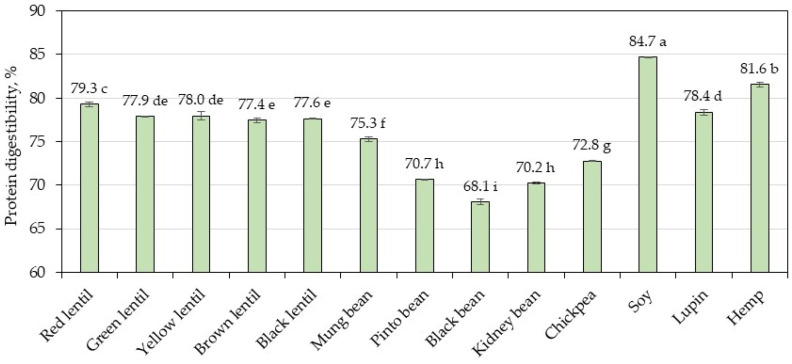
This study provides an assessment of nutrients (protein, amino acid profiles, fiber, starch), phenolic content TPC, flavonoid content TFC, and antioxidant capacity through different in vitro methods in 12 legume species (red, green, yellow, brown, and black lentils; mung, pinto, black, and kidney beans; chickpea, soy, and lupin) and hemp. Legumes with a protein content above 30% were black lentil, lupin, and soy. Chickpea, soy, black bean, kidney bean, and mung bean did not have any limiting amino acids. All samples had moderate overall protein quality, except green and brown lentils. Black bean was less digestible (68.1%), while soy, hemp, and red lentil had higher protein digestibility (79.3-84.7%). Pinto bean had the highest TPC (425.19 mg GAE/100 g), comparable with hemp, but the lowest TFC (0.24 mg QE/100 g). Yellow and red lentils showed the lowest TPC (69-85.89 mg GAE/100 g). Mung bean presented the highest concentration of flavonoids (45.47 mg QE/100 g), followed by black lentil (28.57 mg QE/100 g). There were distinct variations in the antioxidant capacity across different legume samples and assays. Pinto bean, hemp, and green lentil had the highest relative antioxidant capacity index, while yellow lentil, red lentil, and chickpea presented the lowest. Dark-colored legume samples showed a higher TPC and a lower antioxidant capacity (CUPRAC and PCL assays), while yellow legumes had less antioxidant capacity (DPPH assay). A high correlation coefficient was observed between TPC and DPPH (r = 0.8133), TPC and FRAP (r = 0.8528), TPC and CUPRAC (r = 0.9425), and TPC and ACL (r = 0.8261) methods. The results highlight large variations in the legume properties and support the exploitation of the nutritional properties of legumes as raw materials for the development of products designed to fulfil modern consumer demands.
本研究通过不同的体外方法,对12种豆类(红扁豆、绿扁豆、黄扁豆、棕扁豆和黑扁豆;绿豆、斑豆、黑豆和芸豆;鹰嘴豆、大豆和羽扇豆)以及大麻中的营养成分(蛋白质、氨基酸谱、纤维、淀粉)、酚类含量(总酚含量,TPC)、黄酮类含量(总黄酮含量,TFC)和抗氧化能力进行了评估。蛋白质含量高于30%的豆类是黑扁豆、羽扇豆和大豆。鹰嘴豆、大豆、黑豆、芸豆和绿豆没有任何限制氨基酸。除了绿扁豆和棕扁豆外,所有样品的总体蛋白质质量中等。黑豆的消化率较低(68.1%),而大豆、大麻和红扁豆的蛋白质消化率较高(79.3 - 84.7%)。斑豆的总酚含量最高(425.19毫克没食子酸当量/100克),与大麻相当,但总黄酮含量最低(0.24毫克芦丁当量/100克)。黄扁豆和红扁豆的总酚含量最低(69 - 85.89毫克没食子酸当量/100克)。绿豆的黄酮类化合物浓度最高(45.47毫克芦丁当量/100克),其次是黑扁豆(28.57毫克芦丁当量/100克)。不同豆类样品和检测方法的抗氧化能力存在明显差异。斑豆、大麻和绿扁豆的相对抗氧化能力指数最高,而黄扁豆、红扁豆和鹰嘴豆的相对抗氧化能力指数最低。深色豆类样品的总酚含量较高,但抗氧化能力较低(铜离子还原抗氧化能力测定法和磷钼酸络合物测定法),而黄色豆类的抗氧化能力较低(二苯基苦味酰基自由基测定法)。在总酚含量与二苯基苦味酰基自由基测定法(r = 0.8133)、总酚含量与铁离子还原抗氧化能力测定法(r = 0.8528)、总酚含量与铜离子还原抗氧化能力测定法(r = 0.9425)以及总酚含量与抗坏血酸清除自由基能力测定法(r = 0.8261)之间观察到较高的相关系数。研究结果突出了豆类特性的巨大差异,并支持将豆类的营养特性作为开发满足现代消费者需求产品的原材料加以利用。