Markus Birgit, Kreutz Julian, Chatzis Giorgios, Syntila Styliani, Kuchenbuch Jannis, Mueller Charlotte, Choukeir Maryana, Schieffer Bernhard, Patsalis Nikolaos
Department of Cardiology, Angiology, and Intensive Care Medicine, University Hospital, Philipps University of Marburg, Baldinger Str., 35043 Marburg, Germany.
Biomedicines. 2024 Nov 20;12(11):2648. doi: 10.3390/biomedicines12112648.
BACKGROUND/OBJECTIVES: Secondary mitral regurgitation (MR) is a common valvular heart disease burdening the prognosis of patients with co-existing chronic heart failure. Transcatheter edge-to-edge mitral valve repair (MV-TEER) is a minimally invasive treatment option for high-risk patients. However, the effects of MV-TEER on expanded hemodynamics, tissue perfusion, and quality of life, particularly in patients with advanced renal failure, remain underexplored.
This prospective, single-center study evaluated the impact of MV-TEER on hemodynamics, renal function, and quality of life in 45 patients with severe MR. Non-invasive bioimpedance monitoring with NICaS was used to assess hemodynamics pre- and 3-5 days post-procedure. Quality of life was assessed using the EQ-5D-3L questionnaire before and 3 months post-procedure. For further analysis, patients were divided into subgroups based on the estimated baseline glomerular filtration rate (eGFR < 35 mL/min vs. eGFR ≥ 35 mL/min).
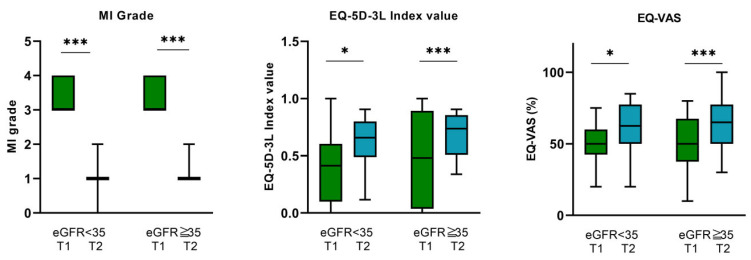
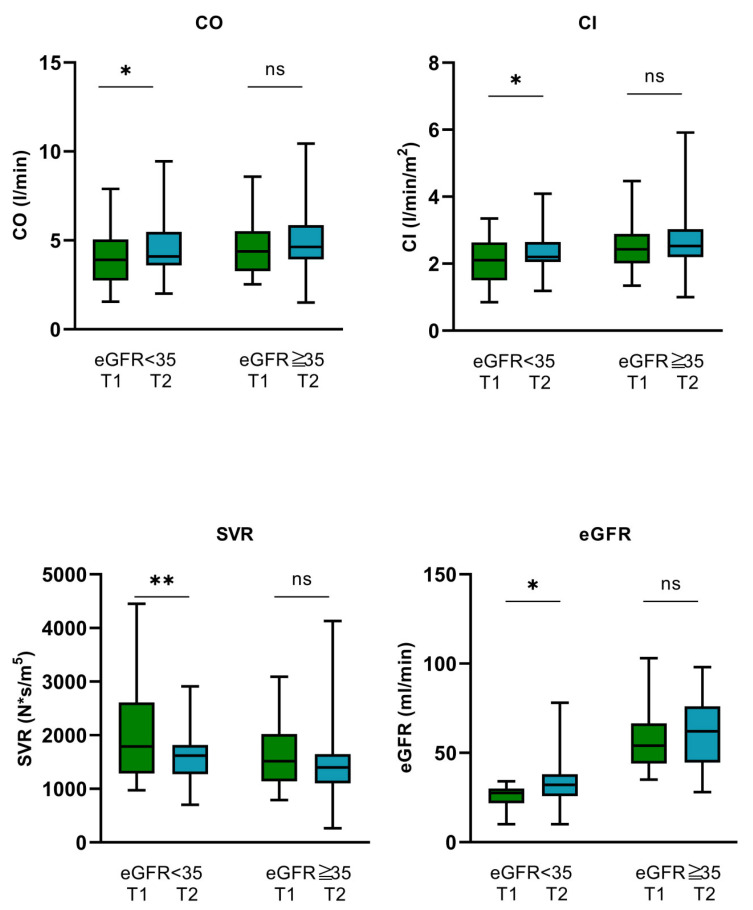
A significant reduction in systemic vascular resistance (SVR; = 0.003) and an increase in eGFR ( = 0.03) were observed in the entire cohort after MV-TEER, indicating improved tissue perfusion. Notably, particularly patients with eGFR < 35 mL/min showed a significant increase in cardiac output (CO; = 0.035), cardiac index (CI; = 0.031), and eGFR ( = 0.018), as well as a reduction in SVR ( = 0.007). Consistent with these findings, quality of life significantly improved, with the EQ-5D-3L index and EQ-VAS score increasing from 0.44 to 0.66 ( < 0.001) and from 51.7% to 62.9% ( < 0.001).
背景/目的:继发性二尖瓣反流(MR)是一种常见的瓣膜性心脏病,影响并存慢性心力衰竭患者的预后。经导管二尖瓣缘对缘修复术(MV-TEER)是高危患者的一种微创治疗选择。然而,MV-TEER对血流动力学、组织灌注和生活质量的影响,尤其是在晚期肾衰竭患者中,仍未得到充分研究。
这项前瞻性单中心研究评估了MV-TEER对45例重度MR患者的血流动力学、肾功能和生活质量的影响。使用NICaS进行非侵入性生物阻抗监测,以评估术前和术后3-5天的血流动力学。使用EQ-5D-3L问卷在术前和术后3个月评估生活质量。为了进一步分析,根据估计的基线肾小球滤过率将患者分为亚组(eGFR<35 mL/min与eGFR≥35 mL/min)。
MV-TEER术后,整个队列的全身血管阻力(SVR;P=0.003)显著降低,eGFR升高(P=0.03),表明组织灌注得到改善。值得注意的是,尤其是eGFR<35 mL/min的患者,心输出量(CO;P=0.035)、心脏指数(CI;P=0.031)和eGFR(P=0.018)显著增加,SVR降低(P=0.007)。与这些结果一致,生活质量显著改善,EQ-5D-3L指数和EQ-VAS评分分别从0.44提高到0.66(P<0.001)和从51.7%提高到62.9%(P<0.001)。