Abdelghafar Ahmed, Falzon Andrew, Hendriks Eef J, Radovanovic Ivan, Andrade Hugo, Schaafsma Joanna D, Mosimann Pascal J
Division of Neuroradiology, Joint Department of Medical Imaging, Toronto Western Hospital, University Health Network, Toronto, ON M5T 2S8, Canada.
Atkinson Morley Regional Neuroscience Centre, St George's University Hospital, Tooting, London SW17 0QT, UK.
Brain Sci. 2024 Oct 30;14(11):1097. doi: 10.3390/brainsci14111097.
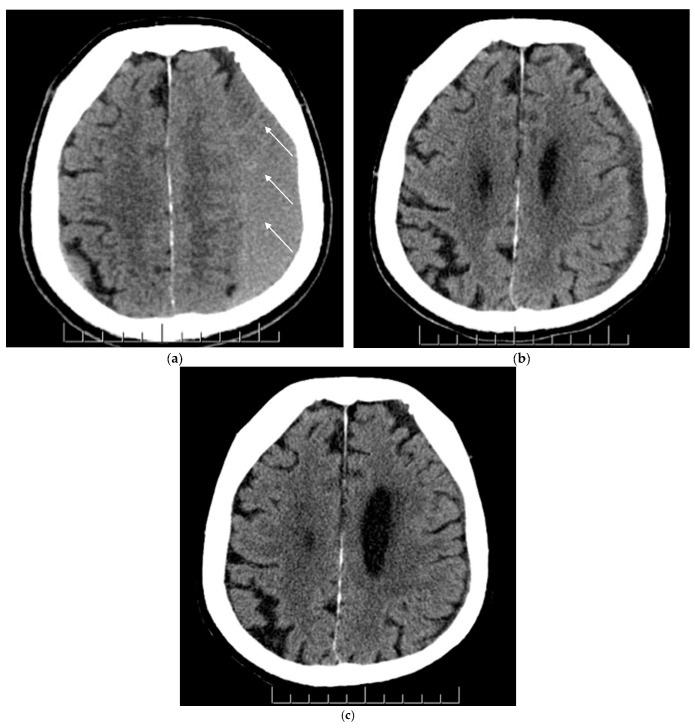
: MMAE (middle meningeal artery embolization) has emerged as a potential effective treatment for cSDH (chronic subdural hematoma). In this study, MMAE efficiency with regards to cSDH cause and architecture was explored. The comparability of cSDH thickness and volume as parameters for cSDH pre- and post-MMAE assessment was also analyzed. : In this retrospective cohort study, 52 consecutive cSDH patients treated with MMAE in a single tertiary center were included. The cohort was divided into two group pairs pertaining to cSDH cause (spontaneous or traumatic) and cSDH architecture (non-mature or mature). The radiological outcome was compared in each group before and after MMAE and between each group pair using CT imaging. A correlation analysis between cSDH thickness and volume before and after MMAE was also performed. : A statistically significant positive linear association between cSDH thickness and volume at admission and at each follow-up interval (1-3, 3-6, 6-12 months) was noticed. cSDH thickness and volume reduction in each group was statistically significant, except for a traumatic cSDH volume reduction at 6-12 months. There was no statistically significant difference between each group pair in the cSDH thickness and volume reduction difference at all the follow-up intervals. : A comparable efficiency of MMAE may be achieved in non-mature and mature as well as in spontaneous and traumatic cSDH, with an advantage for spontaneous cSDH at 6-12 months follow-up compared to traumatic cSDH. Traumatic cSDH may require a relatively long-term follow-up post-MMAE. cSDH thickness and volume, as parameters for pre- and post-MMAE cSDH evaluation, appear similar.
脑膜中动脉栓塞术(MMAE)已成为慢性硬膜下血肿(cSDH)一种潜在的有效治疗方法。在本研究中,探讨了MMAE对cSDH病因及结构的治疗效果。还分析了cSDH厚度和体积作为MMAE术前和术后评估参数的可比性。
在这项回顾性队列研究中,纳入了在一家三级中心连续接受MMAE治疗的52例cSDH患者。该队列根据cSDH病因(自发性或创伤性)和cSDH结构(未成熟或成熟)分为两组。使用CT成像比较每组MMAE术前和术后以及每组之间的影像学结果。还进行了MMAE术前和术后cSDH厚度与体积的相关性分析。
在入院时以及每个随访间隔(1 - 3个月、3 - 6个月、6 - 12个月),观察到cSDH厚度与体积之间存在统计学上显著的正线性关联。除了创伤性cSDH在6 - 12个月时体积减小外,每组cSDH厚度和体积的减小均具有统计学意义。在所有随访间隔中,每组之间cSDH厚度和体积减小差异无统计学意义。
在未成熟和成熟的cSDH以及自发性和创伤性cSDH中,MMAE可能具有相当的疗效,与创伤性cSDH相比,自发性cSDH在6 - 12个月随访时有优势。创伤性cSDH在MMAE术后可能需要相对长期的随访。cSDH厚度和体积作为MMAE术前和术后cSDH评估的参数,似乎具有相似性。