Toja-Camba Francisco José, Hermelo-Vidal Gonzalo, Feitosa-Medeiros Carolina, Vidal-Millares María, Durán-Maseda María José, Fernández-Ferreiro Anxo, Mondelo-García Cristina
Pharmacy Department, University Clinical Hospital of Santiago de Compostela (SERGAS), 15706 Santiago de Compostela, Spain.
FarmaCHUSLab Group, Health Research Institute of Santiago de Compostela (IDIS), 15706 Santiago de Compostela, Spain.
Pharmaceuticals (Basel). 2024 Oct 29;17(11):1446. doi: 10.3390/ph17111446.
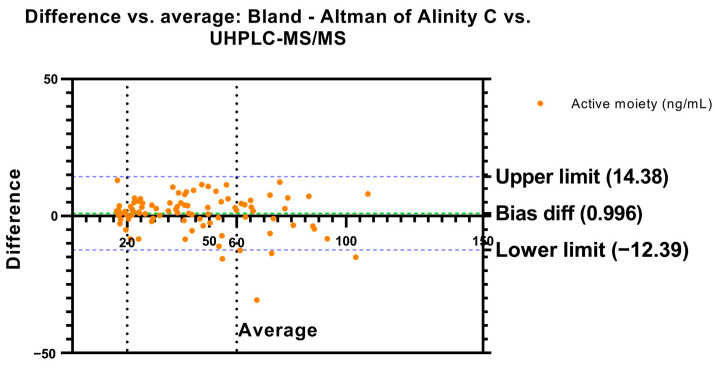
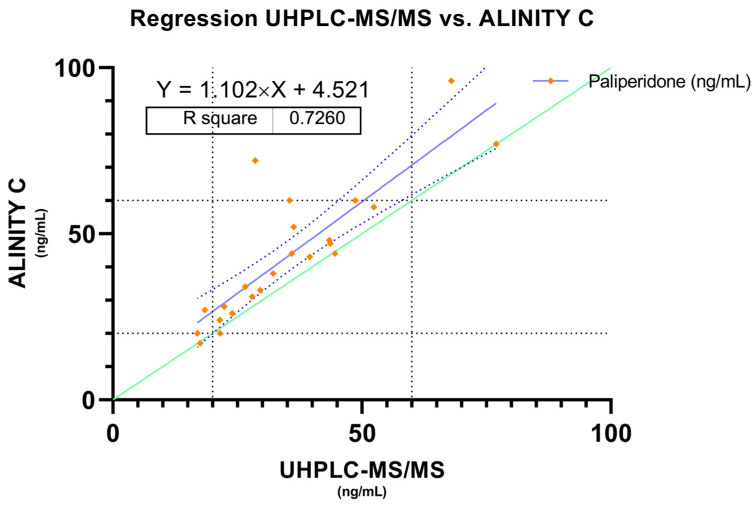
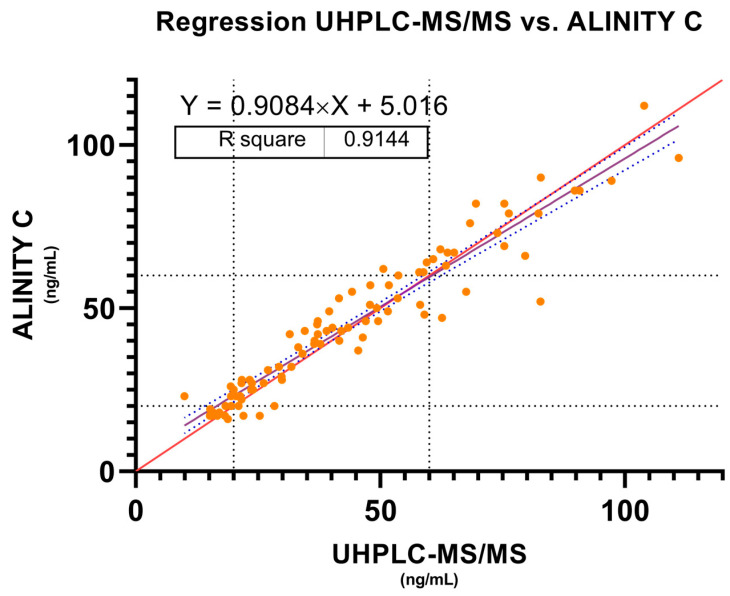
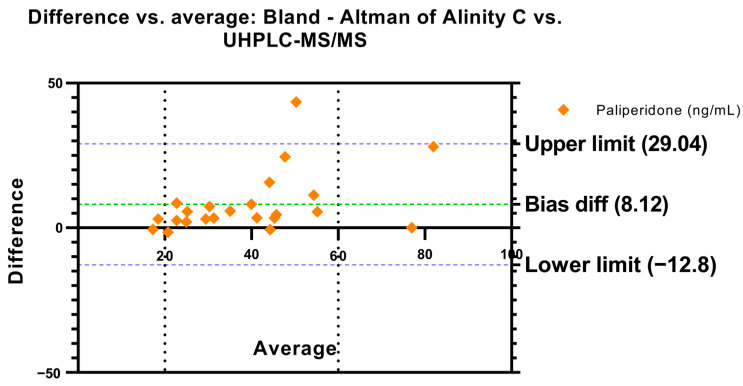
Risperidone, a second-generation antipsychotic widely used in the treatment of schizophrenia, requires therapeutic drug monitoring due to its high interindividual variability. UHPLC-MS/MS is considered the gold standard for pharmacokinetic studies owing to its superior sensitivity and specificity, although it involves time-consuming manual sample preparation. In contrast, the Alinity C system, fully automated, simplifies sample processing, but only measures the active moiety (risperidone plus paliperidone). The aim of this study is to compare the performance of UHPLC-MS/MS and the Alinity C system for the determination of risperidone and paliperidone concentrations in plasma. A total of 115 plasma samples of 115 patients, 92 and 23 under risperidone and paliperidone long-acting treatment, respectively, were analyzed using both methods. A strong correlation for the active moiety (risperidone plus 9-OH-Risperidone) (rs = 0.95) was observed. However, Bland-Altman analysis revealed a mean bias of 0.996 ng/mL, indicating that the Alinity C system slightly overestimates concentrations compared to UHPLC-MS/MS. While there was substantial agreement between methods (κ = 0.72), discrepancies were observed in 16.3% of cases, which could impact clinical decision-making. When analyzing paliperidone separately, the agreement was lower (κ = 0.63), with greater variability observed. These findings suggest that, while the Alinity C system is suitable for routine therapeutic monitoring, UHPLC-MS/MS remains the preferred method in clinical scenarios requiring higher precision, particularly for patients with concentrations near therapeutic thresholds.
利培酮是一种广泛用于治疗精神分裂症的第二代抗精神病药物,由于其个体间差异较大,需要进行治疗药物监测。超高效液相色谱-串联质谱法(UHPLC-MS/MS)因其卓越的灵敏度和特异性,被认为是药代动力学研究的金标准,尽管它需要耗时的手动样品制备。相比之下,全自动化的Alinity C系统简化了样品处理,但仅测量活性部分(利培酮加帕利哌酮)。本研究的目的是比较UHPLC-MS/MS和Alinity C系统在测定血浆中利培酮和帕利哌酮浓度方面的性能。使用这两种方法对115例患者的115份血浆样本进行了分析,其中92例和23例分别接受利培酮和帕利哌酮长效治疗。观察到活性部分(利培酮加9-羟基利培酮)有很强的相关性(rs = 0.95)。然而,Bland-Altman分析显示平均偏差为0.996 ng/mL,表明与UHPLC-MS/MS相比,Alinity C系统略微高估了浓度。虽然两种方法之间有实质性的一致性(κ = 0.72),但在16.3%的病例中观察到差异,这可能会影响临床决策。单独分析帕利哌酮时,一致性较低(κ = 0.63),观察到的变异性更大。这些发现表明,虽然Alinity C系统适用于常规治疗监测,但在需要更高精度的临床场景中,尤其是对于浓度接近治疗阈值的患者,UHPLC-MS/MS仍然是首选方法。