Lu Dingheng, Li Yuxiao, Niu Xinyang, Sun Jiazhu, Zhan Weitao, Shi Yuchen, Yu Kai, Huang Suyuelin, Liu Xiaoyan, Xie Liping, Ma Xueyou, Liu Ben
Department of Urology, The First Affiliated Hospital, Zhejiang University School of Medicine, Hangzhou, 310003 Zhejiang, China.
Department of Pathology, The First Affiliated Hospital, Zhejiang University School of Medicine, Hangzhou, 310003 Zhejiang, China.
Research (Wash D C). 2024 Nov 26;7:0539. doi: 10.34133/research.0539. eCollection 2024.
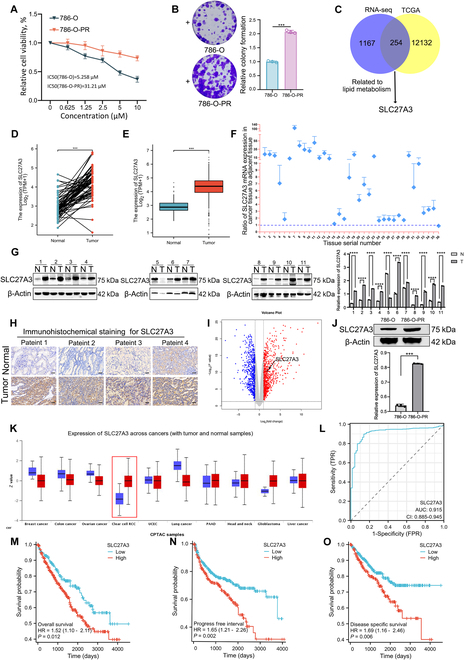
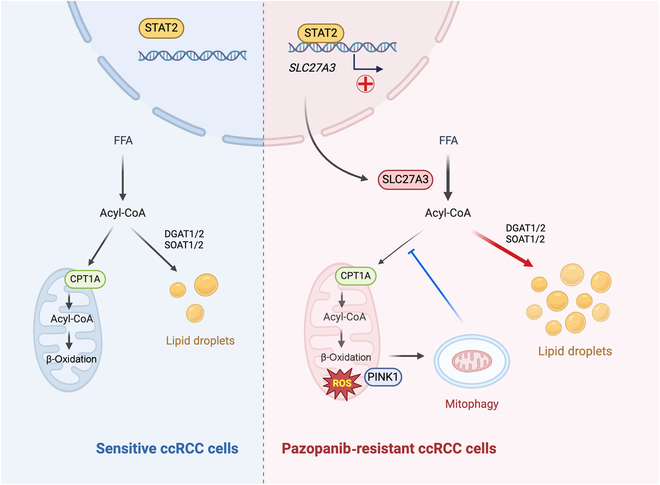
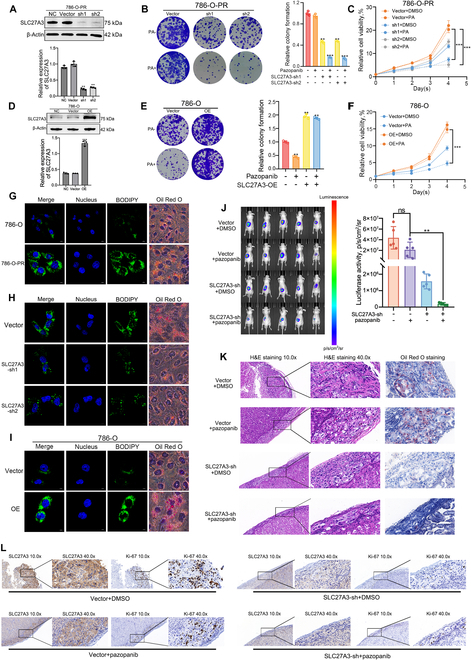
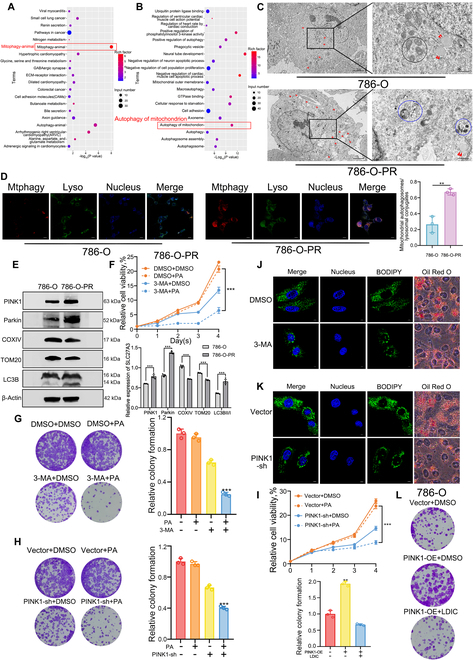
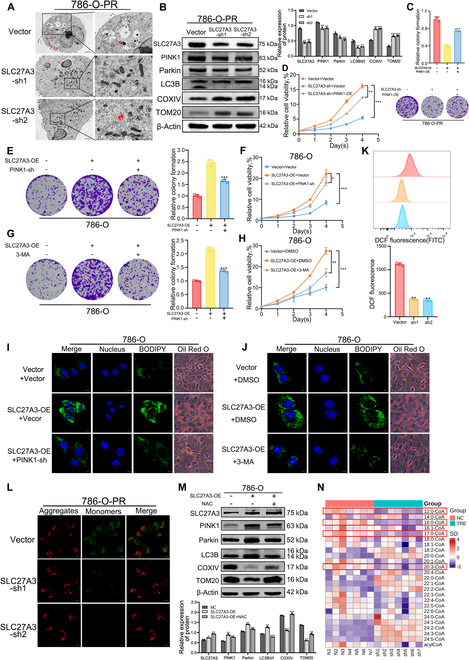
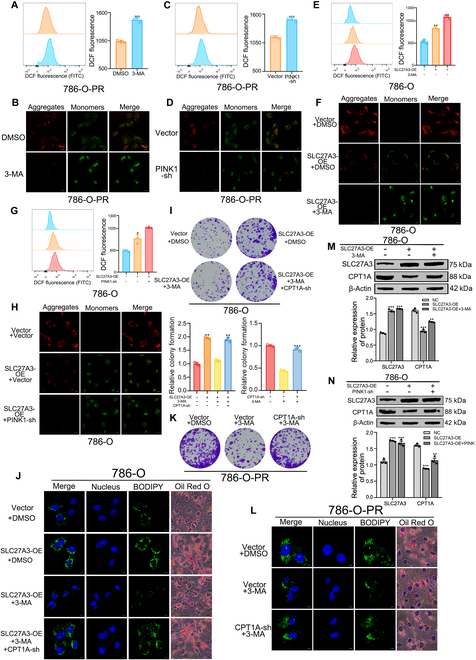
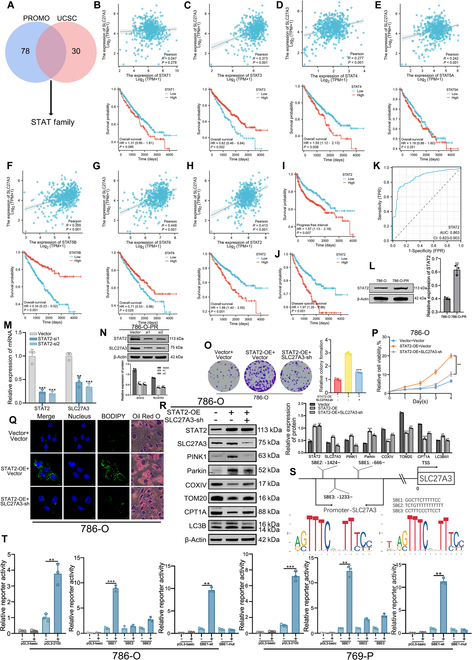
Clear cell renal cell carcinoma (ccRCC) is a prevalent malignant tumor of the urinary system. While tyrosine kinase inhibitors (TKIs) are currently the first-line treatments for advanced/metastatic ccRCC, patients often develop resistance after TKI therapy. Lipid metabolic reprogramming, a hallmark of tumor progression, contributes to acquired drug resistance in various malignant tumors. Mitophagy, a process that maintains mitochondrial homeostasis, aids tumor cells in adapting to microenvironmental changes and consequently developing drug resistance. Solute carrier family 27 member 3 (SLC27A3), highly expressed in lipid-rich tumors like ccRCC, has been associated with poor prognosis. However, the impact of SLC27A3 and the transcription factor complex containing STAT2 on lipid metabolic reprogramming, mitophagy in ccRCC, and their role in TKI resistance remain unexplored. 786-O to pazopanib resistance was induced by gradient increase of concentration, and the genes related to lipid metabolism were screened by RNA sequencing. Bioinformatics was used to analyze the differential expression of SLC27A3 and its effect on patient prognosis, and to predict the activated pathway in pazopanib-resistant cells. Lipid droplets (LDs) were detected by Red Oil O and BODIPY probe. Micro-targeted lipidomic of acyl-coenzyme A (CoA) and lipid metabolomics were performed to screen potential metabolites of SLC27A3. The differential expression of SLC27A3 was detected in clinical samples. The differential expression of SLC27A3 and its effect on drug resistance of ccRCC tumor were detected in vitro and in vivo Mitophagy was detected by electron microscopy, Mtphagy probe, and Western blot. The mitochondrial membrane potential (MMP) and reactive oxygen species (ROS) levels were detected by JC-1 and DCF probes. The binding site of the transcription factor complex to the SLC27A3 promoter was detected by dual-luciferase reporter gene assay. SLC27A3, highly expressed in lipid-rich tumors such as ccRCC and glioblastoma, predicts poor prognosis. SLC27A3 expression level also increased in pazopanib-resistant 786-O cells (786-O-PR) with more LD accumulation compared to parental cells. Gene Ontology (GO) and Kyoto Encyclopedia of Genes and Genomes (KEGG) pathway analysis from RNA sequencing showed that PINK1/Parkin-mediated mitophagy pathway was enriched in 786-O-PR. Knockdown of SLC27A3 markedly suppressed LD accumulation and mitophagy, and overcame pazopanib resistance and . Moreover, SLC27A3 functions as an acyl-CoA ligase catalyzing the formation of acyl-CoA, which refers to fatty acid oxidation accompanied by ROS production and synthesis of lipid. Overproduced acyl-CoA oxidation in mitochondria resulted in MMP decrease and amounts of ROS production, subsequently triggering PINK1/Parkin-mediated mitophagy. Moreover, mitophagy inhibition led to more ROS accumulation and cell death, indicating that mitophagy can keep ROS at an appropriate level by negative feedback. Mitophagy, simultaneously, prevented fatty acid oxidation in mitochondria by consuming CPT1A, forcing synthesis of triglycerides and cholesterol esters stored in LDs by transforming acyl-CoA, to support ccRCC progression. Besides, we found that STAT2 expression was positively correlated to SLC27A3. Transcriptional factor complex containing STAT2 could bind to the promoter of SLC27A3 mRNA to promote SLC27A3 transcription proved by dual-luciferase reporter assay, which also regulated LD metabolism and activated mitophagy during pazopanib resistance. SLC27A3 is up-regulated in pazopanib-resistant ccRCC and predicts poor prognosis. High expression of SLC27A3 produces excessive metabolites of various long-chain fatty acyl-CoA (12:0-, 16:0-, 17:0-, 20:3-CoA) to enter mitochondria for β-oxidation and produce amounts of ROS activating mitophagy. Subsequent mitophagy/ROS negative feedback controls ROS homeostasis and consumes CPT1A protein within mitochondria to suppress fatty acid β-oxidation, forcing acyl-CoA storage in LDs, mediating pazopanib resistance in ccRCC. Furthermore, STAT2 was identified as a core component of a potential upstream transcriptional factor complex for SLC27A3. Our findings shed new light on the underlying mechanism of SLC27A3 in ccRCC TKI resistance, which may provide a novel therapeutic target for the management of ccRCC.
透明细胞肾细胞癌(ccRCC)是泌尿系统中一种常见的恶性肿瘤。虽然酪氨酸激酶抑制剂(TKIs)目前是晚期/转移性ccRCC的一线治疗药物,但患者在接受TKI治疗后常出现耐药性。脂质代谢重编程是肿瘤进展的一个标志,它在各种恶性肿瘤中导致获得性耐药。线粒体自噬是维持线粒体稳态的过程,有助于肿瘤细胞适应微环境变化并因此产生耐药性。溶质载体家族27成员3(SLC27A3)在ccRCC等富含脂质的肿瘤中高表达,与预后不良有关。然而,SLC27A3以及含有STAT2的转录因子复合物对ccRCC中脂质代谢重编程、线粒体自噬的影响及其在TKI耐药中的作用仍未被探索。通过浓度梯度增加诱导786 - O对帕唑帕尼产生耐药性,并通过RNA测序筛选与脂质代谢相关的基因。利用生物信息学分析SLC27A3的差异表达及其对患者预后的影响,并预测帕唑帕尼耐药细胞中激活的通路。用红油O和BODIPY探针检测脂滴(LDs)。进行酰基辅酶A(CoA)的微靶向脂质组学和脂质代谢组学以筛选SLC27A3的潜在代谢物。在临床样本中检测SLC27A3的差异表达。在体外和体内检测SLC27A3的差异表达及其对ccRCC肿瘤耐药性的影响。通过电子显微镜、线粒体自噬探针和蛋白质免疫印迹检测线粒体自噬。用JC - 1和DCF探针检测线粒体膜电位(MMP)和活性氧(ROS)水平。通过双荧光素酶报告基因测定法检测转录因子复合物与SLC27A3启动子的结合位点。SLC27A3在ccRCC和胶质母细胞瘤等富含脂质的肿瘤中高表达,预示预后不良。与亲本细胞相比,在帕唑帕尼耐药的786 - O细胞(786 - O - PR)中SLC27A3表达水平也升高,且脂滴积累更多。RNA测序的基因本体(GO)和京都基因与基因组百科全书(KEGG)通路分析表明,PINK1/Parkin介导的线粒体自噬通路在786 - O - PR中富集。敲低SLC27A3可显著抑制脂滴积累和线粒体自噬,并克服帕唑帕尼耐药性。此外,SLC27A3作为一种酰基辅酶A连接酶发挥作用,催化酰基辅酶A的形成,这涉及脂肪酸氧化并伴有ROS产生和脂质合成。线粒体中过量产生的酰基辅酶A氧化导致MMP降低和ROS产生量增加,随后触发PINK1/Parkin介导的线粒体自噬。此外,线粒体自噬抑制导致更多ROS积累和细胞死亡,表明线粒体自噬可通过负反馈使ROS保持在适当水平。同时,线粒体自噬通过消耗CPT1A阻止线粒体中的脂肪酸氧化,通过转化酰基辅酶A迫使合成储存在脂滴中的甘油三酯和胆固醇酯,以支持ccRCC进展。此外,我们发现STAT2表达与SLC27A3呈正相关。双荧光素酶报告基因测定法证明,含有STAT2的转录因子复合物可与SLC27A3 mRNA的启动子结合以促进SLC27A3转录,其在帕唑帕尼耐药期间也调节脂滴代谢并激活线粒体自噬。SLC27A3在帕唑帕尼耐药的ccRCC中上调并预示预后不良。SLC27A3的高表达产生过量的各种长链脂肪酰基辅酶A(12:0 -、16:0 -、17:0 -、20:3 - CoA)代谢物进入线粒体进行β氧化并产生大量ROS激活线粒体自噬。随后的线粒体自噬/ROS负反馈控制ROS稳态并消耗线粒体内的CPT1A蛋白以抑制脂肪酸β氧化,迫使酰基辅酶A储存在脂滴中,介导ccRCC中的帕唑帕尼耐药性。此外,STAT2被确定为SLC27A3潜在上游转录因子复合物的核心成分。我们的研究结果为SLC27A3在ccRCC TKI耐药中的潜在机制提供了新的见解,这可能为ccRCC的治疗提供一个新的治疗靶点。