Roy Madhurima, Sengupta Ritika, Chakraborty Bidhan Chandra, Chatterjee Uttara, Stebut Esther von, Kaye Paul M, Chatterjee Mitali
Dept. of Pharmacology, Institute of Post Graduate Medical Education and Research (IPGME&R), Kolkata, India.
Multidisciplinary Research Unit (MRU) Institute of Post Graduate Medical Education and Research (IPGME&R), Kolkata, India.
PLoS Negl Trop Dis. 2024 Nov 27;18(11):e0012655. doi: 10.1371/journal.pntd.0012655. eCollection 2024 Nov.
Post Kala-azar Dermal Leishmaniasis (PKDL) is a dermal sequel of visceral leishmaniasis (VL), poses a significant threat to the success of ongoing kala-azar elimination program, due to its potential role in sustaining transmission cycles and complicating disease management strategies. In VL, neutrophils have been identified as the 'first line of defence', having multiple roles in disease pathogenesis, but their role in PKDL, if any, still remains elusive; presenting a critical gap in knowledge, and was the aim of this study.
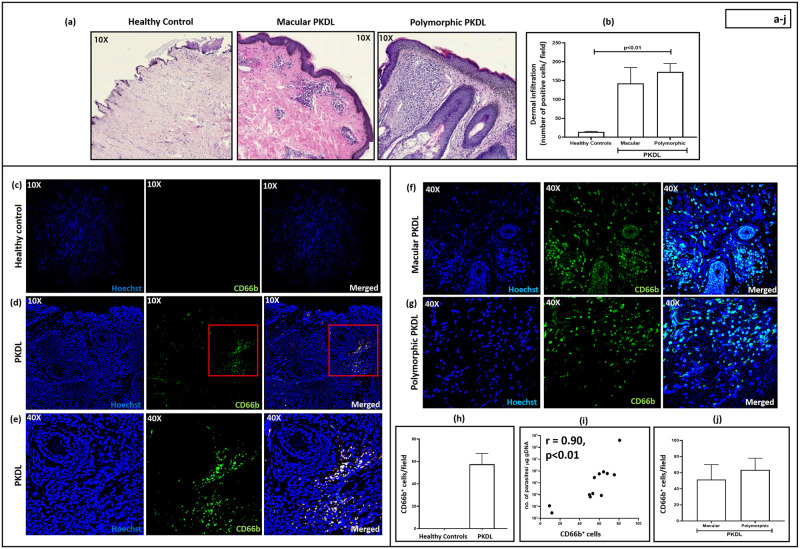
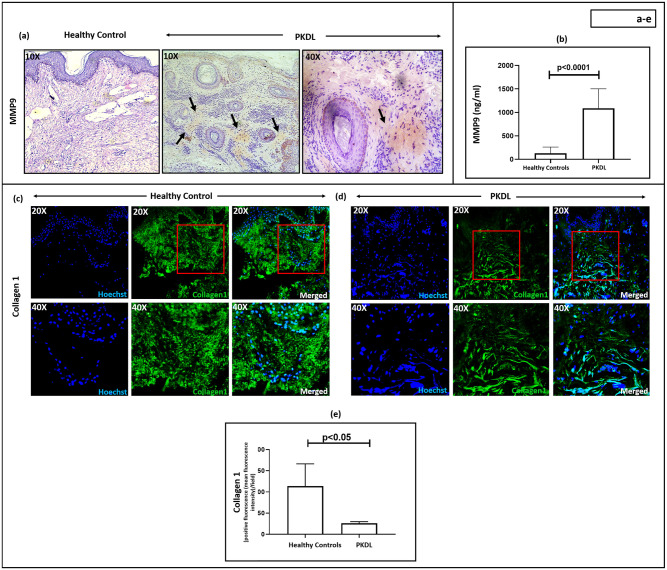
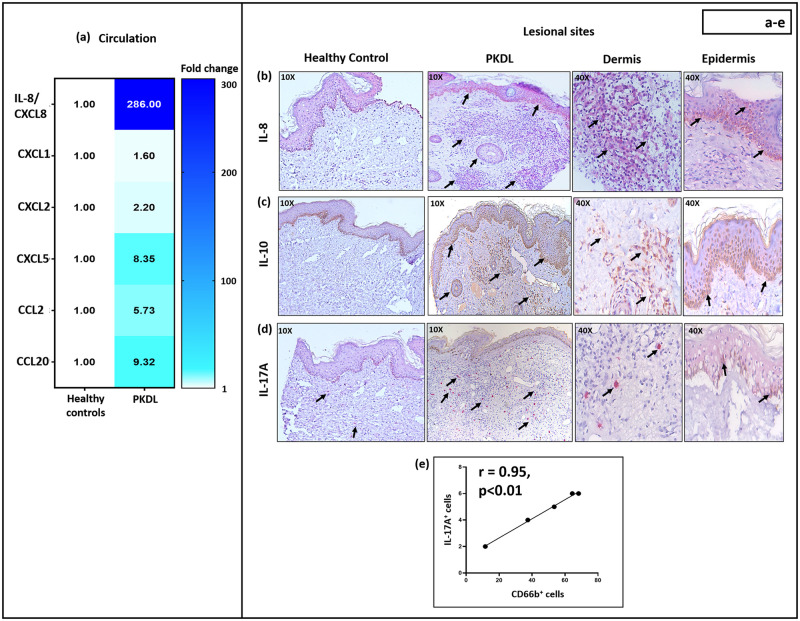
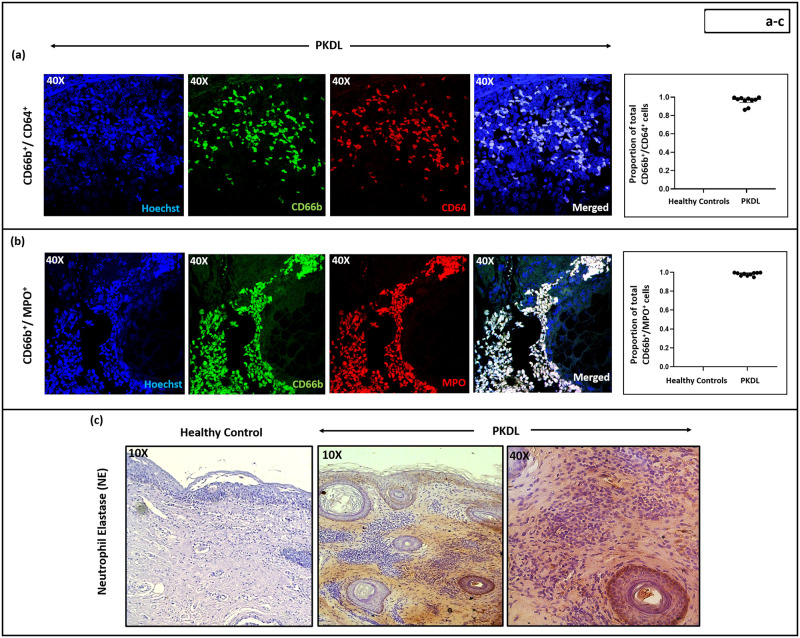
METHODOLOGY/PRINCIPAL FINDINGS: In a cohort of PKDL patients, CD66b+ neutrophils were quantified in skin biopsies, followed by immunostaining of FFPE sections to identify activated neutrophils (CD66b+/CD64+) and degranulated (CD66b+/MPO+), along with expression of neutrophil elastase (NE), matrix metalloprotease 9 (MMP9) and collagen I. Plasma levels of neutrophil chemo-attractants CXCL8/1/2/5, CCL2 and 20 and cytokines, (IL-6, IFN-γ, IL-4, IL-10, TNF-α, IL-17 and IL-22, 23) were evaluated by a multiplex assay, while lesional expression of IL-8, IL-10 and IL-17 was evaluated by immunohistochemistry. As compared to healthy individuals (control skin samples), PKDL cases at the lesional sites had an increased number of activated CD66b+ neutrophils (positive for CD64+, MPO+ and NE+). The plasma levels of neutrophil chemo-attractants, pro-inflammatory and regulatory cytokines were raised as was circulating and lesional IL-8, along with an enhanced lesional expression of IL-10 and IL-17A. An increase in circulatory and lesional MMP9 was accompanied by decreased collagen I, suggesting disintegration of matrix integrity.
CONCLUSIONS/SIGNIFICANCE: Taken together, in PKDL, activated neutrophils possibly contribute towards modulating the lesional landscape. Understanding this involvement of neutrophils in patients with PKDL, particularly in the absence of an animal model, could offer better understanding of the disease pathogenesis and provide insights into novel therapeutic strategies for the ongoing elimination program.
黑热病后皮肤利什曼病(PKDL)是内脏利什曼病(VL)的一种皮肤后遗症,由于其在维持传播循环及使疾病管理策略复杂化方面的潜在作用,对正在进行的黑热病消除计划的成功构成重大威胁。在VL中,中性粒细胞已被确定为“第一道防线”,在疾病发病机制中具有多种作用,但其在PKDL中的作用(若有)仍不清楚;这是一个关键的知识空白,也是本研究的目的。
方法/主要发现:在一组PKDL患者中,对皮肤活检组织中的CD66b+中性粒细胞进行定量,随后对福尔马林固定石蜡包埋(FFPE)切片进行免疫染色,以识别活化的中性粒细胞(CD66b+/CD64+)和脱颗粒的中性粒细胞(CD66b+/MPO+),同时检测中性粒细胞弹性蛋白酶(NE)、基质金属蛋白酶9(MMP9)和胶原蛋白I的表达。通过多重检测评估中性粒细胞趋化因子CXCL8/1/2/5、CCL2和20以及细胞因子(IL-6、IFN-γ、IL-4、IL-10、TNF-α、IL-17和IL-22、23)的血浆水平,通过免疫组织化学评估IL-8、IL-10和IL-17的皮损表达。与健康个体(对照皮肤样本)相比,PKDL患者皮损部位活化的CD66b+中性粒细胞数量增加(CD64+、MPO+和NE+呈阳性)。中性粒细胞趋化因子、促炎和调节性细胞因子的血浆水平升高,循环和皮损部位的IL-8水平也升高,同时皮损部位IL-10和IL-17A的表达增强。循环和皮损部位MMP9增加,同时胶原蛋白I减少,提示基质完整性遭到破坏。
结论/意义:总体而言,在PKDL中,活化的中性粒细胞可能有助于调节皮损情况。了解中性粒细胞在PKDL患者中的这种作用,尤其是在缺乏动物模型的情况下,有助于更好地理解疾病发病机制,并为正在进行的消除计划提供新的治疗策略思路。