Spahl Wanda, Motta Valeria, Woodcock Kate, Rubeis Giovanni
Division Biomedical and Public Health Ethics, Karl Landsteiner University of Health Sciences, Krems, Austria.
School of Psychology, University of Birmingham, Birmingham, United Kingdom.
JMIR Serious Games. 2024 Nov 28;12:e64488. doi: 10.2196/64488.
Young people are particularly at risk of developing mental health problems, a challenge exacerbated by the COVID-19 pandemic. Digital tools such as apps and chatbots show promise in providing accessible, cost-effective, and less stigmatized ways of strengthening their mental health. However, while these interventions offer benefits, they extend mental health measures beyond traditional therapeutic settings and relationships, which raises ethical concerns due to the absence of established guidelines and regulations. This is particularly notable for technologies incorporating serious gaming elements. In addition, adolescents are in a sensitive and at times vulnerable phase, which shows great potential for the effective use of preventive and sensitizing mental health measures. Considering the lack of an integration into existing mental health structures among many young users, ethical considerations become crucial.
This scoping review aims to build a knowledge base on the ethical aspects of developing and implementing gamified digital mental health interventions for young people.
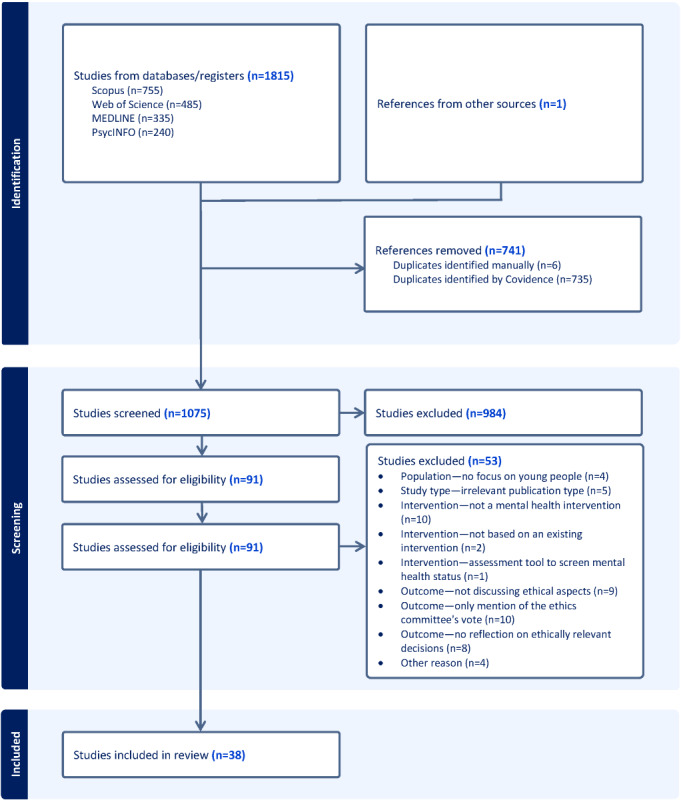
We conducted a search on research articles and conference papers from 2015 to 2023 in English, German, and Spanish. We identified 1815 studies using a unique combination of keywords in the databases Scopus, Web of Science, MEDLINE, and PsycINFO. After removing duplicates (741/1816, 40.8%), we included a total of 38 publications in this review following a double screening process.
This review found that ethically relevant aspects were discussed with regard to (1) research ethics, (2) ethical principles (including privacy, accessibility, empowerment and autonomy, cultural and social sensitivity, and co-design), (3) vulnerable groups, and (4) social implications (including implementation using facilitators in specific social contexts, relationship with other therapeutic options, economic aspects, and social embeddedness of technologies).
This scoping review identified a prevailing limited interpretation of "ethics" as research ethics across the included publications. It also shows a lack of discussion on the social embeddedness of technologies and that co-design is frequently viewed in instrumental terms and vulnerability is mostly addressed pragmatically. Through providing concrete examples of how mental health researchers and game designers thus far have addressed and mitigated ethical challenges in specific interventions, this review illustrates how ethical issues do or do not prompt diverse reflections, mitigation strategies, and actions. It advocates for ethics to be integrated as an ongoing practice throughout all stages of developing and implementing serious game elements in mental health interventions for young people.
年轻人尤其容易出现心理健康问题,而新冠疫情使这一挑战更加严峻。应用程序和聊天机器人等数字工具有望以可及、经济高效且较少受污名化的方式增强他们的心理健康。然而,尽管这些干预措施有诸多益处,但它们将心理健康措施扩展到了传统治疗环境和关系之外,由于缺乏既定的指导方针和法规,这引发了伦理问题。对于包含严肃游戏元素的技术而言,这一点尤为明显。此外,青少年正处于敏感且有时易受伤害的阶段,这显示出有效利用预防性和启发性心理健康措施的巨大潜力。鉴于许多年轻用户缺乏与现有心理健康结构的整合,伦理考量变得至关重要。
本范围综述旨在建立一个关于为年轻人开发和实施游戏化数字心理健康干预措施的伦理方面的知识库。
我们检索了2015年至2023年以英文、德文和西班牙文发表的研究文章和会议论文。我们在Scopus、科学引文索引、医学文献数据库和心理学文摘数据库中使用独特的关键词组合识别出1815项研究。在去除重复项(741/1816,40.8%)后,经过双重筛选过程,我们在本综述中总共纳入了38篇出版物。
本综述发现,在以下方面讨论了与伦理相关的内容:(1)研究伦理;(2)伦理原则(包括隐私、可及性、赋权与自主性、文化和社会敏感性以及共同设计);(3)弱势群体;(4)社会影响(包括在特定社会背景下使用促进者进行实施、与其他治疗选择的关系、经济方面以及技术的社会嵌入性)。
本范围综述发现,在所纳入的出版物中,普遍对“伦理”的解释局限于研究伦理。它还表明缺乏对技术社会嵌入性的讨论,并且共同设计常常从工具性角度看待,而脆弱性大多从务实角度处理。通过提供心理健康研究人员和游戏设计师迄今在特定干预措施中如何应对和减轻伦理挑战的具体例子,本综述说明了伦理问题如何或是否引发了不同的思考、缓解策略和行动。它主张将伦理作为一种持续的实践纳入为年轻人开展心理健康干预措施的开发和实施的所有阶段。
