Raij Tommi, Lin Fa-Hsuan, Letham Benjamin, Lankinen Kaisu, Nayak Tapsya, Witzel Thomas, Hämäläinen Matti, Ahveninen Jyrki
MGH/MIT/HMS Athinoula A. Martinos Center for Biomedical Imaging, Charlestown, MA, United States.
Physical Sciences Platform, Sunnybrook Research Institute, Toronto, ON, Canada.
Front Integr Neurosci. 2024 Nov 14;18:1427149. doi: 10.3389/fnint.2024.1427149. eCollection 2024.
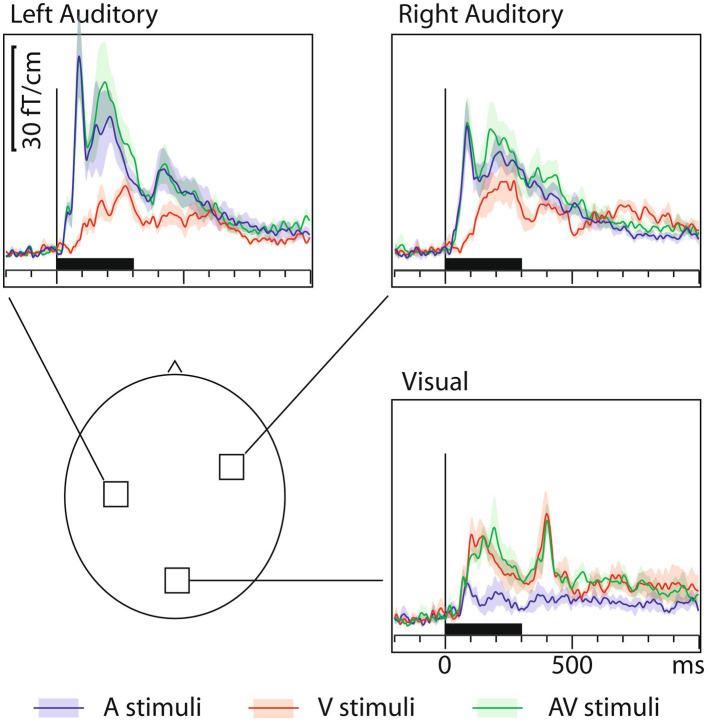
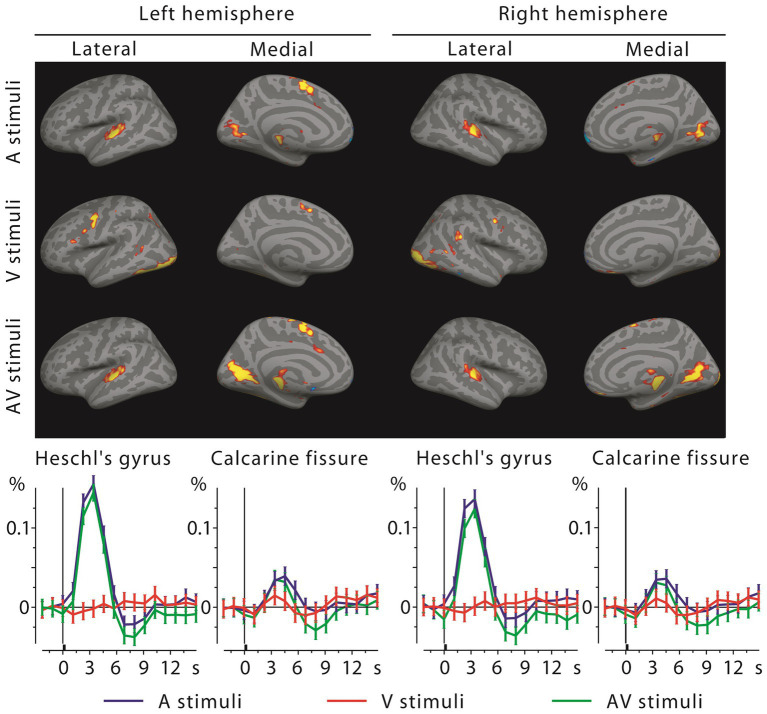
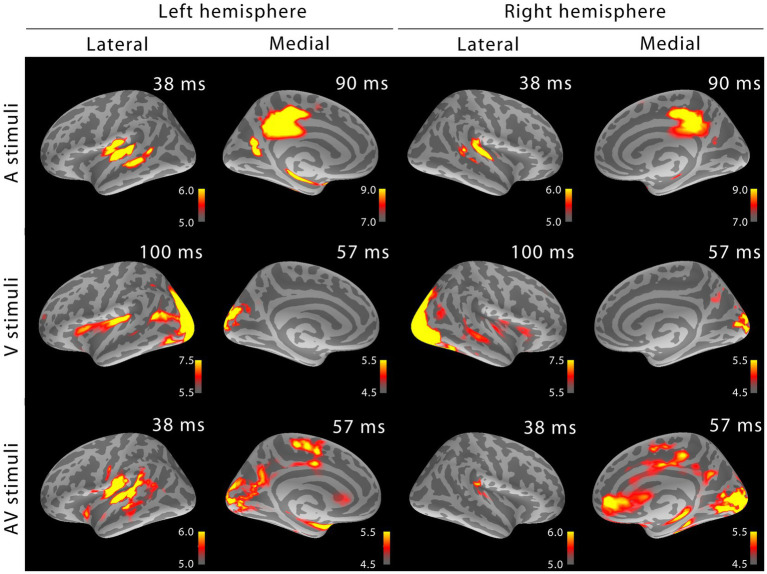
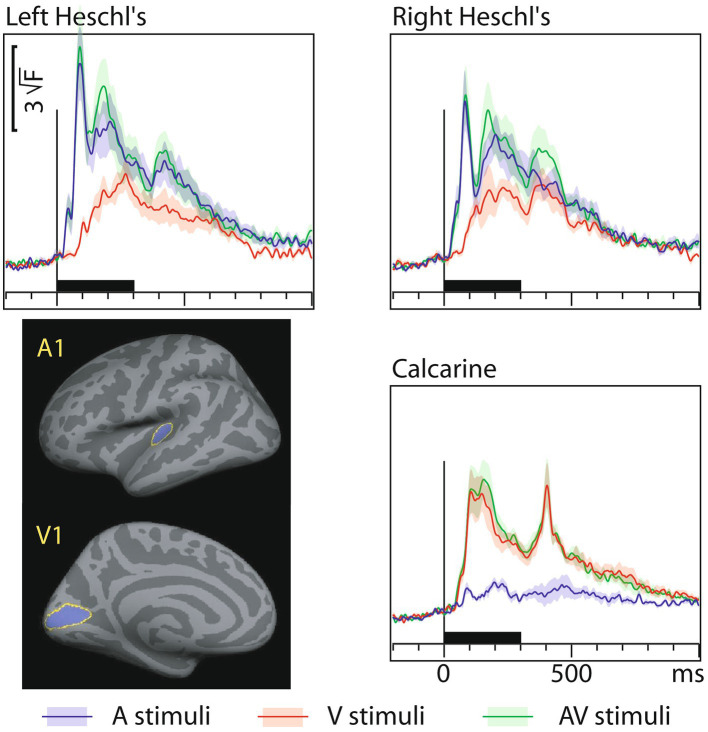
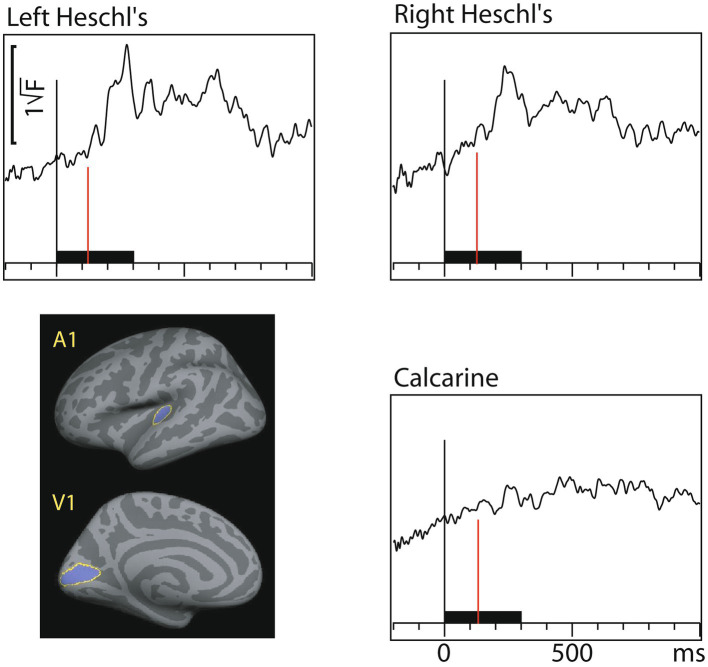
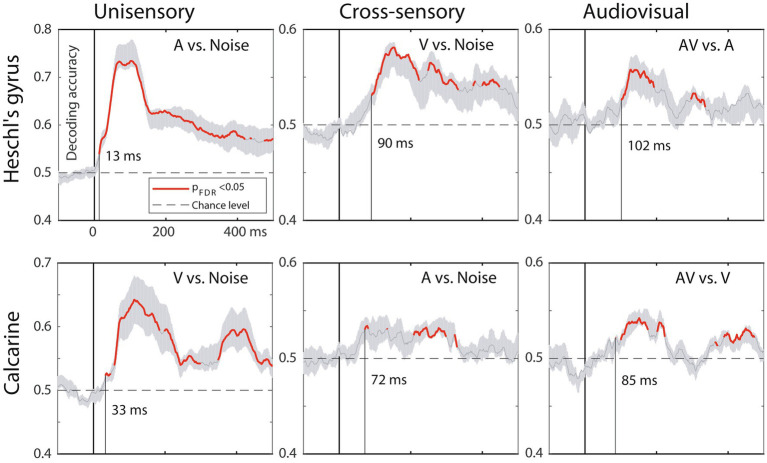
Here, we report onset latencies for multisensory processing of letters in the primary auditory and visual sensory cortices. Healthy adults were presented with 300-ms visual and/or auditory letters (uppercase Roman alphabet and the corresponding auditory letter names in English). Magnetoencephalography (MEG) evoked response generators were extracted from the auditory and visual sensory cortices for both within-modality and cross-sensory activations; these locations were mainly consistent with functional magnetic resonance imaging (fMRI) results in the same subjects. In the primary auditory cortices (Heschl's gyri) activity to auditory stimuli commenced at 25 ms and to visual stimuli at 65 ms (median values). In the primary visual cortex (Calcarine fissure) the activations started at 48 ms to visual and at 62 ms to auditory stimuli. This timing pattern suggests that the origins of the cross-sensory activations may be in the primary sensory cortices of the opposite modality, with conduction delays (from one sensory cortex to another) of 17-37 ms. Audiovisual interactions for letters started at 125 ms in the auditory and at 133 ms in the visual cortex (60-71 ms after inputs from both modalities converged). Multivariate pattern analysis suggested similar latency differences between the sensory cortices. Combined with our earlier findings for simpler stimuli (noise bursts and checkerboards), these results suggest that primary sensory cortices participate in early cross-modal and interaction processes similarly for different stimulus materials, but previously learned audiovisual associations and stimulus complexity may delay the start of the audiovisual interaction stage.
在此,我们报告了在初级听觉和视觉感觉皮层中对字母进行多感官处理的起始潜伏期。向健康成年人呈现300毫秒的视觉和/或听觉字母(大写罗马字母以及相应的英文听觉字母名称)。从听觉和视觉感觉皮层中提取了脑磁图(MEG)诱发反应发生器,用于模态内和跨感官激活;这些位置与同一受试者的功能磁共振成像(fMRI)结果基本一致。在初级听觉皮层(颞横回)中,对听觉刺激的活动在25毫秒开始,对视觉刺激的活动在65毫秒开始(中位数)。在初级视觉皮层(距状裂)中,对视觉刺激的激活在48毫秒开始,对听觉刺激的激活在62毫秒开始。这种时间模式表明,跨感官激活的起源可能在相反模态的初级感觉皮层中,传导延迟(从一个感觉皮层到另一个感觉皮层)为17 - 37毫秒。字母的视听交互在听觉皮层中于125毫秒开始,在视觉皮层中于133毫秒开始(两种模态的输入汇聚后60 - 71毫秒)。多变量模式分析表明感觉皮层之间存在类似的潜伏期差异。结合我们早期对更简单刺激(噪声脉冲和棋盘格)的研究结果,这些结果表明,对于不同的刺激材料,初级感觉皮层以类似的方式参与早期跨模态和交互过程,但先前学习的视听关联和刺激复杂性可能会延迟视听交互阶段的开始。