Department of Molecular Medicine, Max Planck Institute of Biochemistry, Martinsried, Germany.
School of Biomedical Sciences, LKS Faculty of Medicine, The University of Hong Kong, Hong Kong SAR, China.
Nat Commun. 2024 Nov 29;15(1):10381. doi: 10.1038/s41467-024-54645-9.
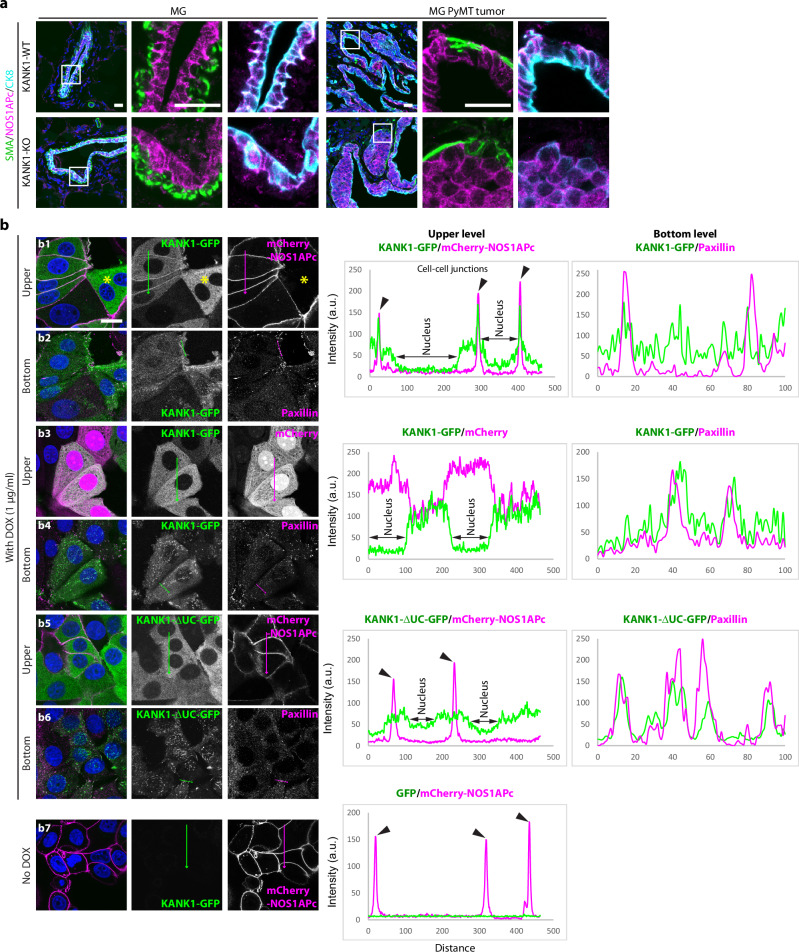
KANK1 is expressed in epithelial cells and connects focal adhesions with the adjacent cortical microtubule stabilizing complex. Although KANK1 was shown to suppress cancer cell growth in vitro, TCGA database points to high KANK1 levels associated with poor prognosis in a wide spectrum of human malignancies. Here, we address this discrepancy and report that KANK1 promotes proliferation and survival of PyMT-transformed mammary tumor cells in vivo. Mechanistically, KANK1 localizes to the basal side of basement membrane (BM)-attached transformed luminal epithelial cells. When these cells lose the contact with the BM and disassemble integrin adhesions, KANK1 is found at cell-cell junctions where it competes with the polarity and tumor suppressor Scribble for NOS1AP binding, which curbs the ability of Scribble to promote Hippo pathway activity. The consequences are stabilization and nuclear accumulation of TAZ, growth and survival of tumor cells and elevated breast cancer development.
KANK1 表达于上皮细胞,将黏着斑与相邻的皮质微管稳定复合物连接起来。尽管 KANK1 已被证明能在体外抑制癌细胞的生长,但 TCGA 数据库指出,在广泛的人类恶性肿瘤中,KANK1 水平较高与预后不良相关。在这里,我们解决了这一差异,并报告 KANK1 促进了 PyMT 转化的乳腺肿瘤细胞在体内的增殖和存活。从机制上讲,KANK1 定位于基底膜(BM)附着的转化腔上皮细胞的基底侧。当这些细胞失去与 BM 的接触并解聚整合素黏附时,KANK1 位于细胞-细胞连接处,与极性和肿瘤抑制因子 Scribble 竞争与 NOS1AP 的结合,从而抑制 Scribble 促进 Hippo 通路活性的能力。其结果是 TAZ 的稳定和核积累,肿瘤细胞的生长和存活,以及乳腺癌的发展增加。