
一氧化碳、温度和硝酸盐限制对海洋蓝藻聚球藻(蓝藻纲)CCMP 1334菌株生长和生理的交互作用。
Interactive effects of CO, temperature, and nitrate limitation on the growth and physiology of strain CCMP 1334 of the marine cyanobacterium Synechococcus (Cyanophyceae).
作者信息
Sharbaugh Alyssa K, Laws Edward A
机构信息
Department of Environmental Sciences, Louisiana State University, Baton Rouge, Louisiana, USA.
出版信息
J Phycol. 2025 Feb;61(1):77-90. doi: 10.1111/jpy.13531. Epub 2024 Nov 30.
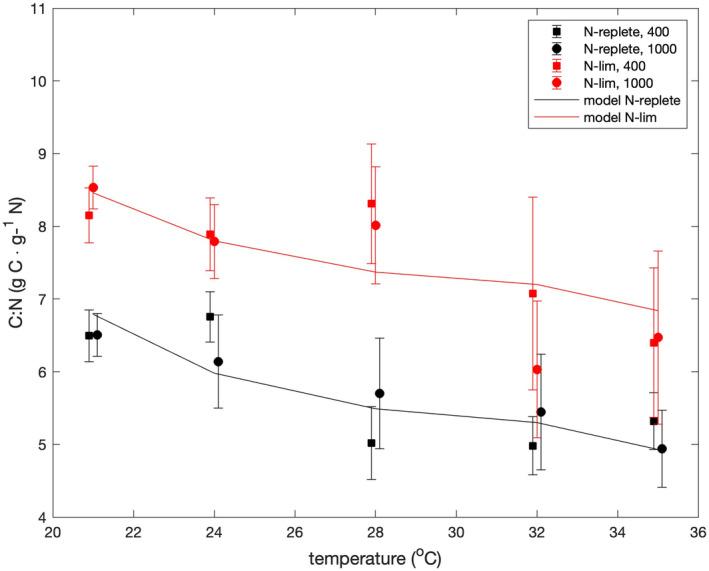
The marine cyanobacterium Synecococcus sp. (CCMP 1334) was grown in a continuous culture system on a 12:12 h light:dark cycle at all combinations of low and high pCO (400 and 1000 ppmv, respectively), nutrient availability (nitrate-limited and nutrient-replete conditions), and temperatures of 21, 24, 28, 32, and 35°C. The maximum nutrient-replete growth rate was ~1.15 day at 32-35°C. Median nutrient-replete growth rates were higher at 1000 ppmv than at 400 ppmv pCO at all temperatures. Carbon:nitrogen ratios were independent of pCO at a fixed relative growth rate (i.e., growth rate ÷ nutrient-replete growth rate) but decreased with increasing temperature. Carbon:chlorophyll a ratios were decreased monotonically with increasing temperature and were higher under nitrate-limited than nutrient-replete conditions. Ratios of phycoerythrin to chlorophyll a were independent of growth conditions. Productivity indices were independent of temperature and nutrient limitation but were consistently higher at 1000 ppmv than 400 ppmv pCO. Both growth rates and dark respiration rates were positively correlated with temperature, and the associated Q values were 2.2 and 2.3, respectively. A model of phytoplankton growth in which cellular carbon is allocated to structure, storage, or the light or dark reactions of photosynthesis accounted for the general patterns of cell composition and growth rate. This strain of Synechococcus appears well suited to changes in environmental conditions that are expected as the climate warms in response to anthropogenic emissions of CO.
海洋蓝藻聚球藻属(Synecococcus sp.,CCMP 1334)在连续培养系统中培养,光暗周期为12:12小时,设置了低高pCO₂(分别为400和1000 ppmv)、营养可利用性(硝酸盐限制和营养充足条件)以及21、24、28、32和35°C温度的所有组合。在32 - 35°C时,营养充足条件下的最大生长速率约为1.15天⁻¹。在所有温度下,1000 ppmv pCO₂时的营养充足条件下的中位生长速率高于400 ppmv pCO₂时。在固定相对生长速率(即生长速率÷营养充足条件下的生长速率)下,碳氮比与pCO₂无关,但随温度升高而降低。碳叶绿素a比随温度升高单调下降,在硝酸盐限制条件下高于营养充足条件。藻红蛋白与叶绿素a的比值与生长条件无关。生产力指数与温度和营养限制无关,但在1000 ppmv pCO₂时始终高于400 ppmv pCO₂。生长速率和暗呼吸速率均与温度呈正相关,相关的Q值分别为2.2和2.3。一个浮游植物生长模型,其中细胞碳分配到结构、储存或光合作用的光反应或暗反应中,解释了细胞组成和生长速率的一般模式。这种聚球藻菌株似乎非常适合因人为排放CO₂导致气候变暖而预期的环境条件变化。




 Zotero 插件