Lim Tae Kang, Choi Yun Sun, Jeong Gu Min, Kim Dong Kyun, Kim Myung-Sun
Department of Orthopedic Surgery, Nowon Eulji Medical Center, Eulji University School of Medicine, Seoul, Korea.
Department of Radiology, Nowon Eulji Medical Center, Eulji University School of Medicine, Seoul, Korea.
Clin Orthop Surg. 2024 Dec;16(6):962-970. doi: 10.4055/cios24071. Epub 2024 Oct 11.
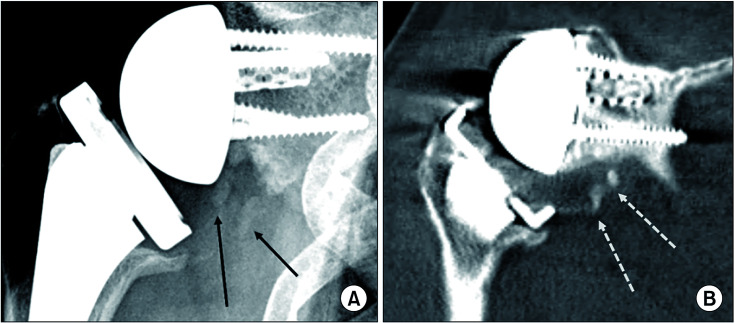
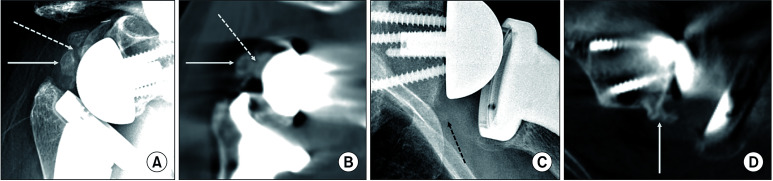
Heterotopic ossification (HO) is difficult to characterize and classify on simple radiographs. Therefore, we attempted to evaluate intraobserver and interobserver reliability of simple radiography and computed tomography (CT) for detecting and classifying HO after reverse shoulder arthroplasty (RSA). It was hypothesized that CT would provide more reliable results than simple radiography.
This retrospective study reviewed 30 patients who underwent RSA performed by a single surgeon. Patients were included if they had both postoperative simple radiographs and CT images taken immediately after surgery and at 1 year after surgery and if they had completed clinical assessment at least 1 year after surgery. We first evaluated the intraobserver and interobserver reliability for the detection of the presence of HO and Modified Brooker's classification both on simple radiographs and CT scans with the use of Kappa statistics. Then, we analyzed the correlation of HO observed in simple radiographs and CT scans with clinical outcomes. All radiographic evaluations were performed by 2 independent reviewers in random orders with 3 weeks of intervals.
The intraobserver reliability outcomes of both reviewers in simple radiography and CT were almost perfect or perfect for the detection of HO and classification. However, CT images improved the interobserver reliability for the detection of HO (kappa value for simple radiographs [K] = 0.6018 and kappa value for CT [K] = 0.8316) and classification (K = 0.5300 and K = 0.6964). At a mean follow-up of 25 months (range, 12-54 months), clinical scores were not significantly different according to the presence of HO based on simple radiographs. However, when CT images were used, the University of California, Los Angeles score and physical component score of short-form 36-item health survey were significantly lower in patients with HO than in patients without HO (27.0 vs. 30.4, = 0.045 and 57.6 vs. 70.7, = 0.034, respectively).
Both simple radiography and CT provided excellent intraobserver reliability for detecting and classifying HO after RSA. Compared to simple radiography, CT tended to improve interobserver reliability and defined the presence and severity of HO more clearly.
在简单的X线片上,异位骨化(HO)难以进行特征描述和分类。因此,我们试图评估在进行反肩关节置换术(RSA)后,简单X线摄影和计算机断层扫描(CT)在检测和分类HO方面的观察者内及观察者间可靠性。我们假设CT能比简单X线摄影提供更可靠的结果。
这项回顾性研究纳入了30例由同一位外科医生实施RSA手术的患者。纳入标准为患者术后既有简单X线片,又有术后即刻及术后1年的CT图像,且术后至少1年完成了临床评估。我们首先使用Kappa统计量评估在简单X线片和CT扫描上检测HO的存在及改良布鲁克分类法的观察者内及观察者间可靠性。然后,我们分析了在简单X线片和CT扫描上观察到的HO与临床结局之间的相关性。所有影像学评估由2名独立的审阅者以随机顺序进行,间隔3周。
两位审阅者在简单X线摄影和CT上关于检测HO及分类的观察者内可靠性结果几乎为完美或完美。然而,CT图像提高了观察者间检测HO的可靠性(简单X线片的kappa值[K]=0.6018,CT的kappa值[K]=0.8316)及分类的可靠性(K=0.5300和K=0.6964)。在平均25个月(范围12 - 54个月)的随访中,基于简单X线片,根据HO的存在情况,临床评分无显著差异。然而,当使用CT图像时,有HO的患者的加利福尼亚大学洛杉矶分校评分和简短36项健康调查的身体成分评分显著低于无HO的患者(分别为27.0对30.4,P = 0.045;57.6对70.7,P = 0.034)。
简单X线摄影和CT在检测和分类RSA术后的HO方面均具有出色的观察者内可靠性。与简单X线摄影相比,CT倾向于提高观察者间可靠性,并更清楚地界定HO的存在和严重程度。