D'haese Sigrid, den Roover Sabine, Verbeke Rein, Aernout Ilke, Meulewater Sofie, Cosyns Joëlle, Meert Jessy, Vanbellingen Sarah, Laeremans Thessa, Lentacker Ine, Aerts Joeri L
Neuro-Aging and Viro-Immunotherapy (NAVI) Research Group, Faculty of Pharmacy and Medicine, Vrije Universiteit Brussel, Brussels, Belgium.
Ghent Research Group on Nanomedicines, Faculty of Pharmacy, Ghent University, Ghent, Belgium.
Mol Ther Nucleic Acids. 2024 Oct 28;35(4):102372. doi: 10.1016/j.omtn.2024.102372. eCollection 2024 Dec 10.
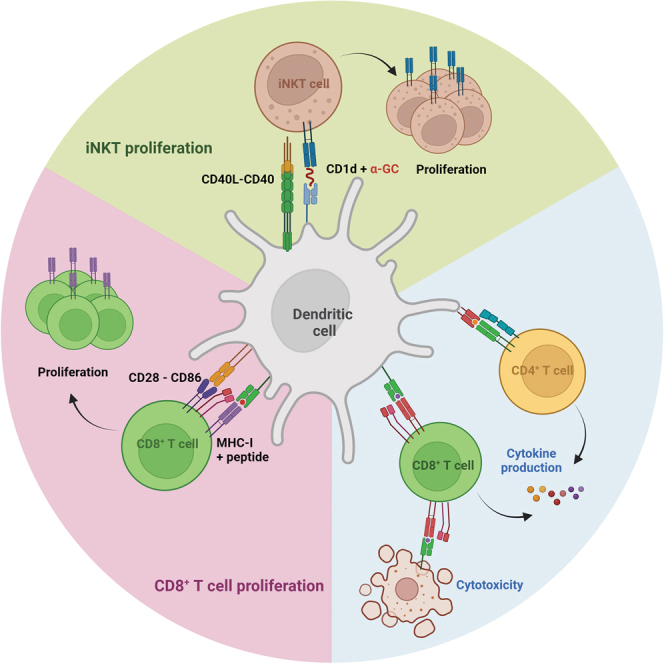
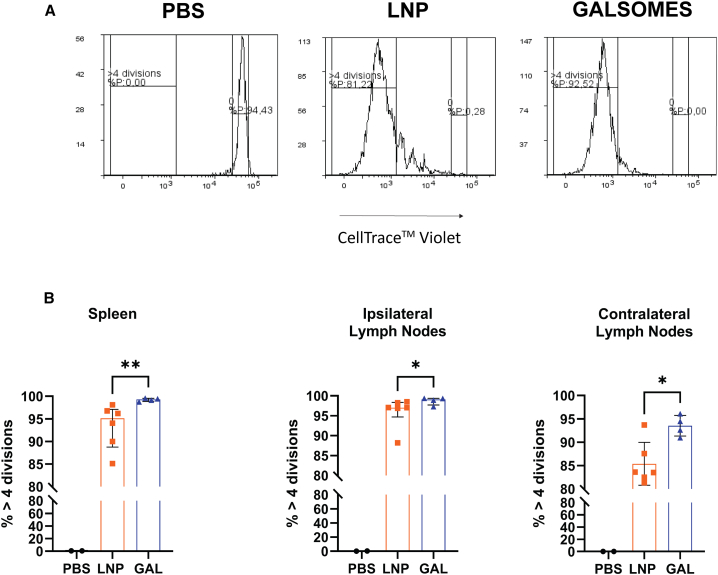
mRNA nanoparticles have been investigated in the context of prophylactic vaccination against HIV, but their effectivity has not been widely investigated in therapeutic vaccination. It has been suggested that a profound CD8 T cell response within lymphoid tissues, a primary site for viral reservoirs, is crucial for achieving optimal viral control, potentially correlating with protection. This study aimed to evaluate the effectiveness of mRNA lipid nanoparticles (LNPs), including a modified variant containing α-galactosylceramide as an adjuvant, termed galsomes. C57BL/6 mice were immunized intramuscularly with nucleoside-modified mRNA encoding ovalbumin (li80tOVA), revealing that mRNA-galsomes induced slightly higher proliferation levels of li80tOVA-specific CD8 T cells in lymphoid tissues across various anatomical sites compared with mRNA-LNPs. In addition, immunization with nucleoside-modified HIV-1 Gag mRNA elicited a notable Gag-specific immune response in both formulations even at low mRNA doses. Remarkably, mRNA-galsomes induced lower polyfunctional responses in CD4 T cells, but similar polyfunctional responses in CD8 T cells in the spleen compared with mRNA-LNPs. Importantly, the Gag-specific CD8 T cells demonstrated cytolytic capacity against target cells in both the spleen and lymphoid tissues, including gut-associated lymph nodes. These findings underscore the potential of both mRNA-galsomes and mRNA-LNPs as tools for therapeutic vaccination against HIV.
信使核糖核酸纳米颗粒已在预防艾滋病毒疫苗接种的背景下进行了研究,但其在治疗性疫苗接种中的有效性尚未得到广泛研究。有人提出,在作为病毒储存库主要部位的淋巴组织内产生强烈的CD8 T细胞反应对于实现最佳病毒控制至关重要,这可能与保护作用相关。本研究旨在评估信使核糖核酸脂质纳米颗粒(LNPs)的有效性,包括一种含有α-半乳糖神经酰胺作为佐剂的改良变体,称为半乳糖体。用编码卵清蛋白的核苷修饰信使核糖核酸(li80tOVA)对C57BL/6小鼠进行肌肉注射免疫,结果显示,与信使核糖核酸-LNPs相比,信使核糖核酸-半乳糖体在各个解剖部位的淋巴组织中诱导的li80tOVA特异性CD8 T细胞增殖水平略高。此外,用核苷修饰的HIV-1 Gag信使核糖核酸进行免疫,即使在低信使核糖核酸剂量下,两种制剂也引发了显著的Gag特异性免疫反应。值得注意的是,与信使核糖核酸-LNPs相比,信使核糖核酸-半乳糖体在CD4 T细胞中诱导的多功能反应较低,但在脾脏的CD8 T细胞中诱导的多功能反应相似。重要的是,Gag特异性CD8 T细胞在脾脏和淋巴组织(包括肠道相关淋巴结)中均表现出对靶细胞的细胞溶解能力。这些发现强调了信使核糖核酸-半乳糖体和信使核糖核酸-LNPs作为抗艾滋病毒治疗性疫苗接种工具的潜力。