Jingjing Yan, Yifang Li, Fei Wang, Junpeng Li, Hongwei Liu, Zhengyu Pei, Haidong Gao
College of Energy Engineering, Shanxi College of Technology, Shuozhou 036000, P.R. China.
College of Safety and Emergency Management Engineering, Taiyuan University of Technology, Taiyuan 030024, P.R. China.
ACS Omega. 2024 Nov 11;9(47):46751-46761. doi: 10.1021/acsomega.4c00881. eCollection 2024 Nov 26.
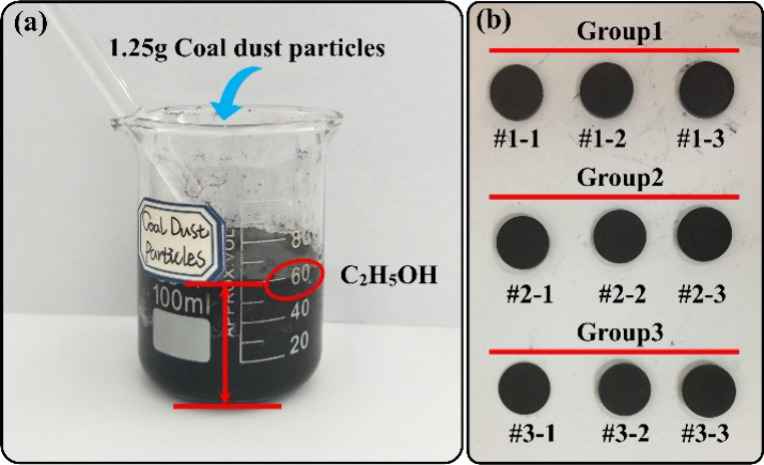
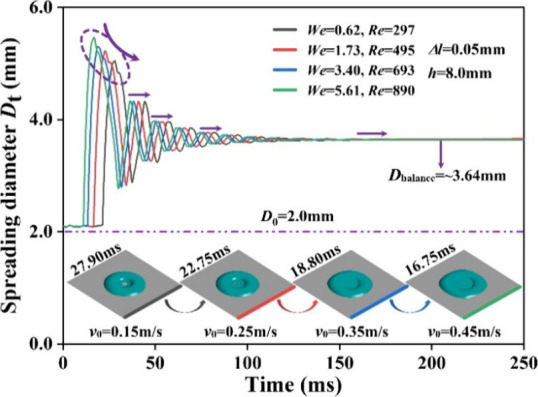
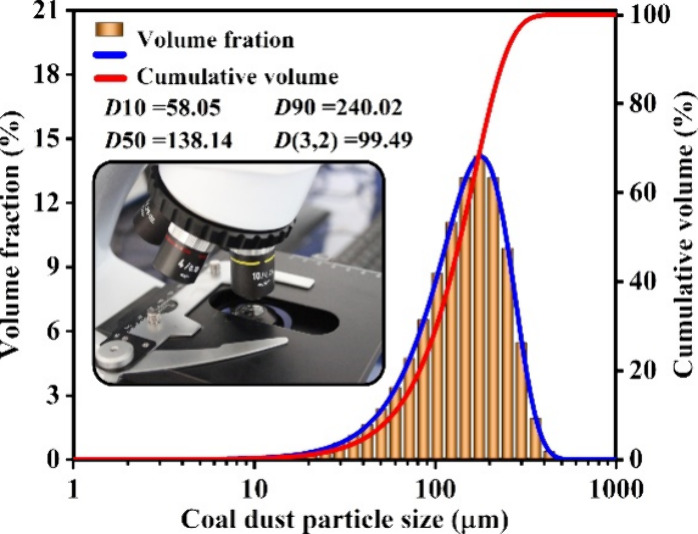
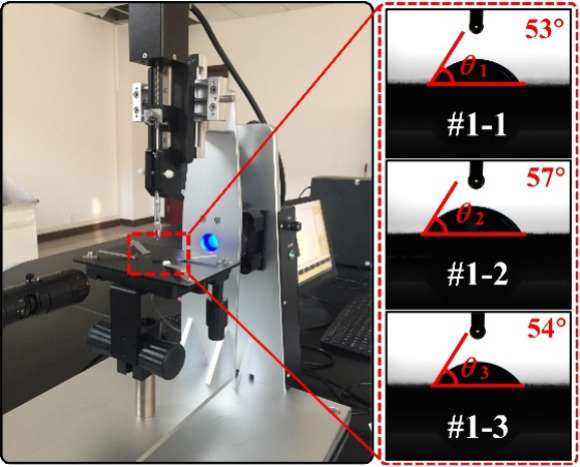
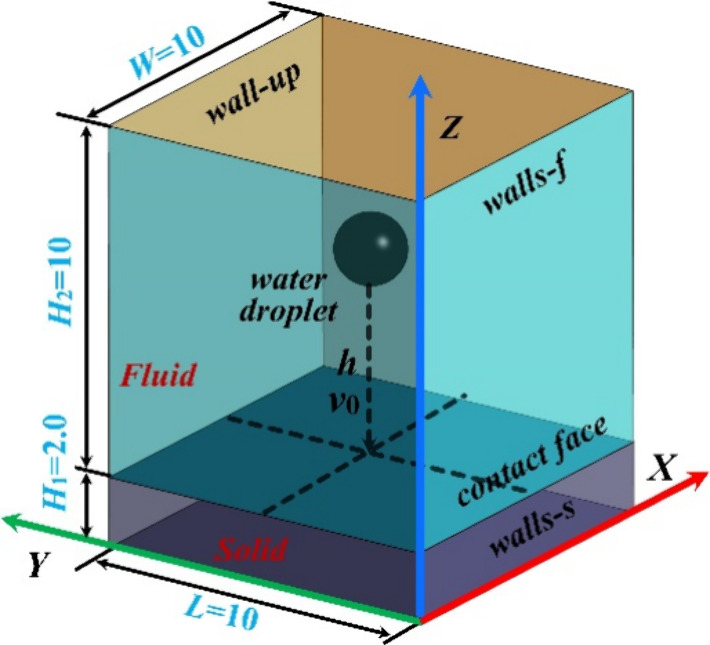
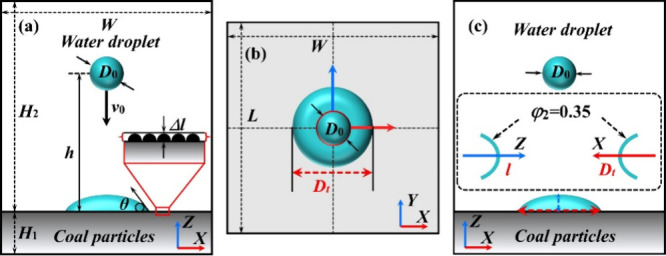
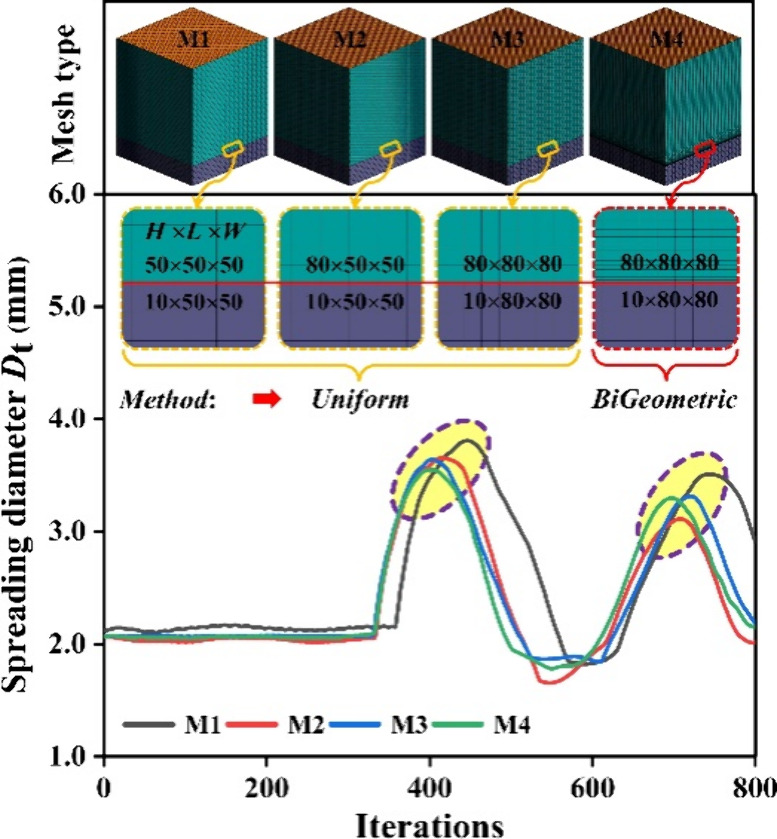
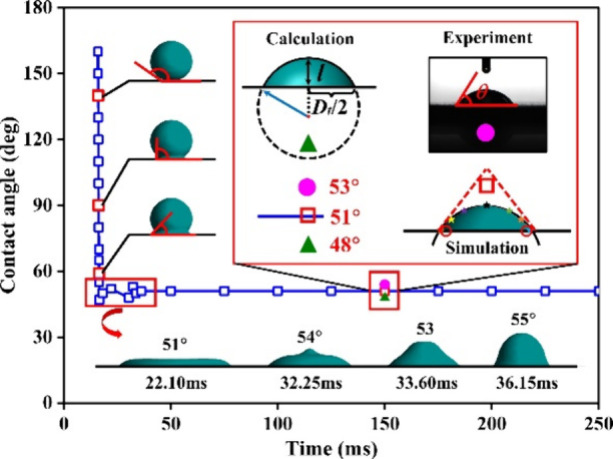
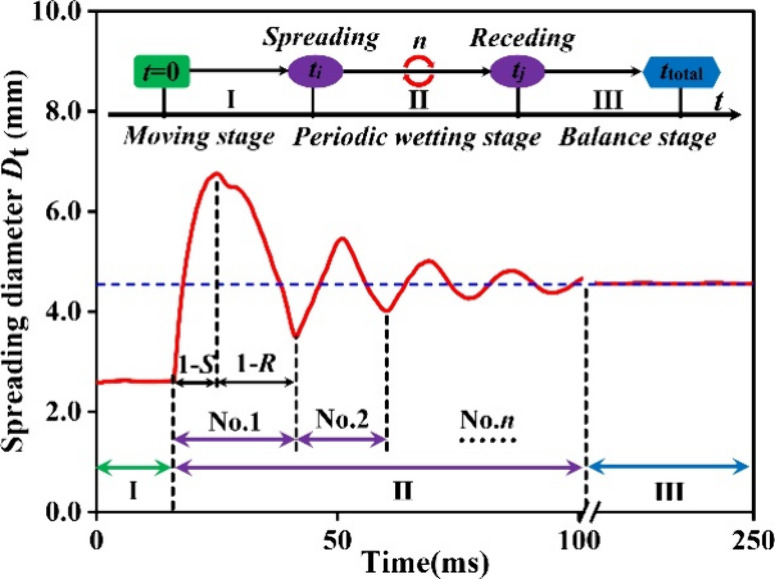
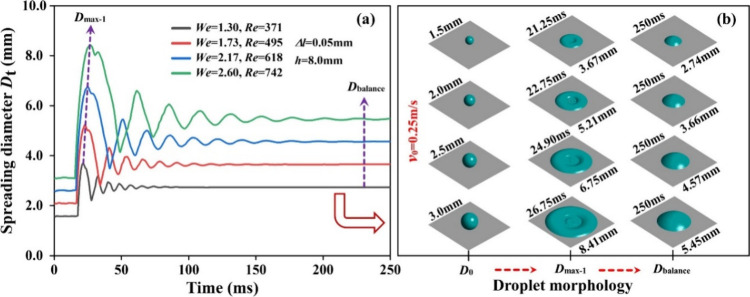
The dynamics of droplets spreading on surfaces have been extensively studied across various influencing factors, necessitating an exploration of their effect on wettability. Herein, the specific composition, size distribution, and contact angle of the coal dust preparation were characterized by a series of experiments to determine the conditions for the simulation. Meanwhile, the multiphase volume of the fluid method was implemented in the simulations, predicated on appropriate boundary conditions, and verified by a mesh independence test. The findings confirmed that the numerical approach for contact angle validation had a minor deviation, making it suitable for multiphase interface tracking. Besides, the typical wetting pattern of droplets was hereby identified into three stages, including the moving stage (stage I), the periodic wetting stage (stage II), and the balancing stage (stage III). The initial diameter could effectively increase the coverage area and spreading time for stage II. Obviously, the first amplitude of first maximum spreading diameter ( ) significantly increased with higher impact velocities, corresponding to an increase in kinetic energy. Despite the significant spreading effect of the falling height mainly on and contact time, the increased trend of wetting efficiency was not obvious. However, the spreading factor and wetting efficiency decreased with increased roughness height. Finally, the difference in spreading wettability was illustrated based on the spreading wetting mechanism. The wetting efficiency of droplets on coal dust was remarkably influenced by the dynamic spreading behaviors of droplets. Overall, the findings from this study offer insights into the extent of spreading wetting that occurs before a droplet reaches an equilibrium state.
液滴在表面上的铺展动力学已经在各种影响因素下得到了广泛研究,因此有必要探究它们对润湿性的影响。在此,通过一系列实验对煤尘制剂的具体成分、粒径分布和接触角进行了表征,以确定模拟条件。同时,在模拟中采用了流体多相体积法,基于适当的边界条件进行计算,并通过网格独立性测试进行了验证。研究结果证实,用于接触角验证的数值方法存在微小偏差,这使其适用于多相界面跟踪。此外,液滴的典型润湿模式在此被确定为三个阶段,包括移动阶段(阶段I)、周期性润湿阶段(阶段II)和平衡阶段(阶段III)。初始直径可以有效增加阶段II的覆盖面积和铺展时间。显然,第一个最大铺展直径( )的第一个振幅随着冲击速度的提高而显著增加,这与动能的增加相对应。尽管下落高度对 和接触时间的铺展效果显著,但润湿效率的增加趋势并不明显。然而,铺展因子和润湿效率随着粗糙度高度的增加而降低。最后,基于铺展润湿机理阐述了铺展润湿性的差异。液滴在煤尘上的润湿效率受到液滴动态铺展行为的显著影响。总体而言,本研究的结果为液滴达到平衡状态之前发生的铺展润湿程度提供了见解。