Crane Paul Daniel, Sillau Stefan, Dreher Renee, Fix Rikki, Winters Phillip, Van Coevering Russell, Engebretson Eric, Valdez Brooke, Matthews Elizabeth, Nair Kavita V, Carlson Aaron M, Piquet Amanda L
From the Department of Neurology (P.D.C., S.S.), and Department of Biostatistics & Informatics (S.S.), University of Colorado Anschutz Medical Campus; University of Colorado School of Medicine Anschutz Medical Campus (R.D., P.W., E.E., B.V., E.M., K.V.N., A.M.C., A.L.P.); University of Colorado School of Medicine (R.F.), Aurora; School of Osteopathic Medicine (R.F.), Kanas City University, MO; University of Colorado School of Medicine Anschutz Medical Campus (R.V.C.); School of Medicine (R.V.C.), Aurora, CO; Renown Health (R.V.C.), Reno, NV; Rocky Mountain MS Center (K.V.N., A.L.P.), University of Colorado School of Medicine; and Skaggs School of Pharmacy and Pharmaceutical Sciences (K.V.N.), University of Colorado Anschutz Medical Campus, Aurora.
Neurology. 2024 Dec 24;103(12):e210078. doi: 10.1212/WNL.0000000000210078. Epub 2024 Dec 2.
Stiff person syndrome spectrum disorder (SPSD) is a rare autoimmune disorder characterized by progressive muscle stiffness and painful spasms with an estimated prevalence of 1-2 cases per million people. Population-based epidemiologic studies are lacking because of both poor patient capture and the lack of standardized diagnostic criteria. Objectives of this study were to describe the incidence and prevalence of SPSD within the University of Colorado Health (UCH) system and apply previously proposed published criteria for SPSD within this population.
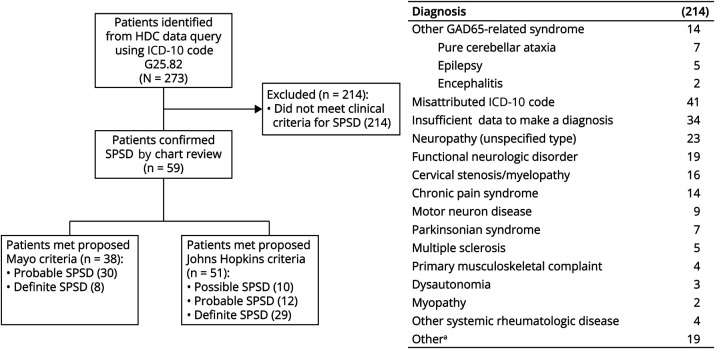
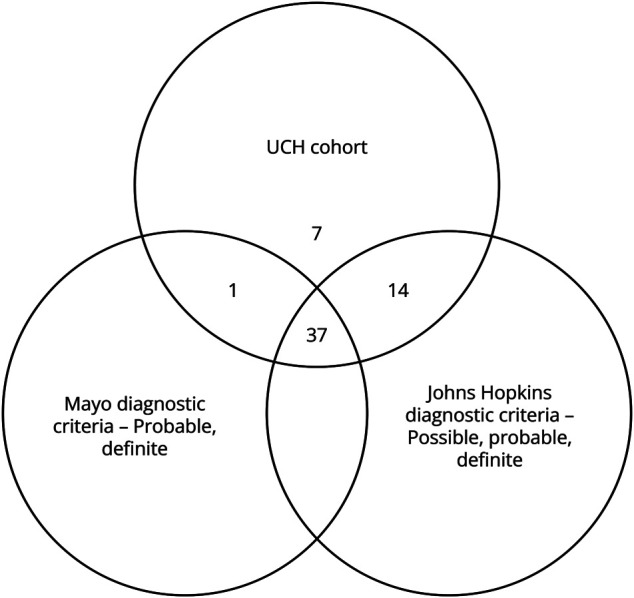
We queried Health Data Compass, an electronic health data repository for a large academic health care system, from 2012 through 2022 for all patients older than 18 years with () codes pertaining to stiff person syndrome. Records were reviewed for diagnostic confirmation. We calculated yearly and period prevalence and incidence rates based on observable person-time exposure of our cohort. We applied previously published Mayo Clinic and Johns Hopkins criteria for SPSD and compared period prevalence based on each criterion and evaluated for agreement.
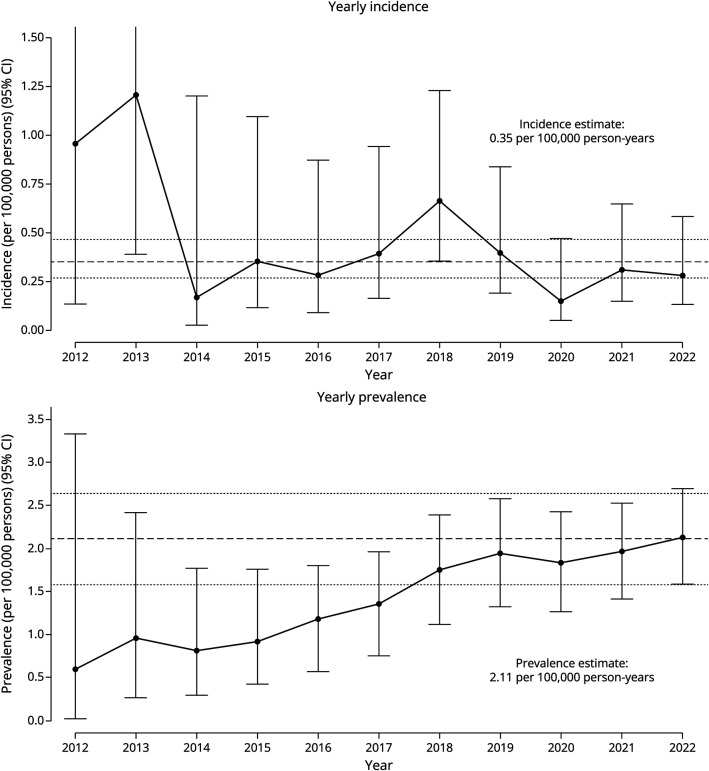
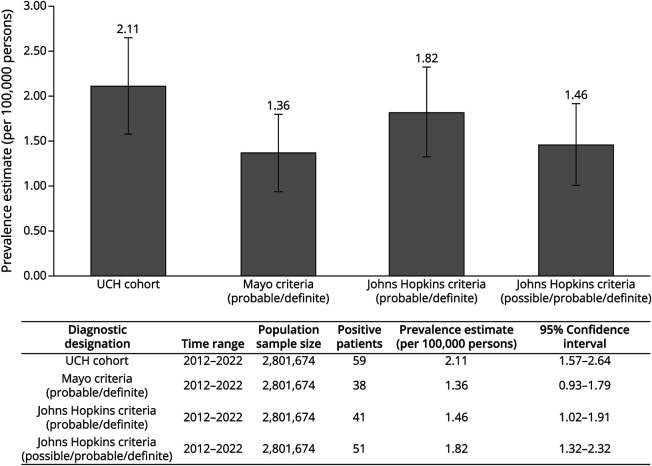
Two hundred and seventy-three patients met the initial inclusion criteria using codes; 59 were confirmed to have SPSD. The mean age was 49.7 years (SD = 12.9), 59.3% were female, 59.3% were considered antibody positive. The total database population over the interval was 2,801,674 persons. The estimated prevalence of SPSD based on our UCH cohort was 2.11 (95% CI 1.57-2.64) per 100,000 persons. The average yearly incidence was 0.35 per 100,000 person-years (95% CI 0.27-0.46). Applying different clinical diagnostic criteria, the estimated prevalence ranged from 1.36 (95% CI 0.93-1.79) to 1.82 (95% CI 1.32-2.32) per 100,000 persons.
We describe a prevalence of SPSD of 2.11 per 100,000 persons in our UCH cohort. Prevalence estimates differed depending on which clinical diagnostic criteria were applied and whether possible SPSD cases were included. Using the most stringent criteria for diagnosis, we report a prevalence of 1.36 per 100,000 persons. While our study uniquely captures many US demographic groups, limitations remain because this is a retrospective review of a single system. Additional studies are needed to determine whether these results are representative of a national or global population.
僵人综合征谱系障碍(SPSD)是一种罕见的自身免疫性疾病,其特征为进行性肌肉僵硬和疼痛性痉挛,估计每百万人中有1 - 2例。由于患者确诊困难以及缺乏标准化诊断标准,基于人群的流行病学研究较为匮乏。本研究的目的是描述科罗拉多大学健康系统(UCH)内SPSD的发病率和患病率,并在该人群中应用先前提出并发表的SPSD诊断标准。
我们查询了Health Data Compass,这是一个大型学术医疗系统的电子健康数据存储库,查询了2012年至2022年所有18岁以上患有与僵人综合征相关编码的患者。对记录进行审查以确认诊断。我们根据队列中可观察到的人时暴露情况计算年度患病率、期间患病率和发病率。我们应用先前发表的梅奥诊所和约翰霍普金斯大学的SPSD诊断标准,并比较基于每个标准的期间患病率并评估一致性。
273名患者使用相关编码符合初始纳入标准;59名被确诊为SPSD。平均年龄为49.7岁(标准差 = 12.9),59.3%为女性,59.3%被认为抗体呈阳性。该时间段内数据库总人数为2,801,674人。基于我们的UCH队列,SPSD的估计患病率为每10万人中2.11例(95%置信区间1.57 - 2.64)。年平均发病率为每10万人年0.35例(95%置信区间0.27 - 0.46)。应用不同的临床诊断标准,估计患病率范围为每10万人中1.36例(95%置信区间0.93 - 1.79)至1.82例(95%置信区间1.32 - 2.32)。
我们描述了UCH队列中SPSD的患病率为每10万人中2.11例。患病率估计因应用的临床诊断标准以及是否纳入可能的SPSD病例而有所不同。使用最严格的诊断标准,我们报告的患病率为每10万人中1.36例。虽然我们的研究独特地涵盖了许多美国人口群体,但仍存在局限性,因为这是对单一系统的回顾性研究。需要进一步的研究来确定这些结果是否代表全国或全球人群。