Cheng Chuhan, Zhang Liyan
School of Clinical Medicine, Fujian Medical University, Fuzhou, China.
Department of Neonatology, Fuzhou Children's Hospital of Fujian Medical University, Fuzhou, China.
Allergy Asthma Immunol Res. 2024 Nov;16(6):640-651. doi: 10.4168/aair.2024.16.6.640.
Metabolic abnormalities, such as insulin resistance (IR) and dyslipidemia, have been linked to an increased risk of asthma. The triglyceride-glucose index (TyG), a metric indicating metabolic dysfunction, exhibits correlations with metabolic syndrome and IR. However, little research has been conducted on the relationship between TyG and asthma in the pediatric population. Therefore, we aimed to investigate the relationship between TyG and asthma among adolescents.
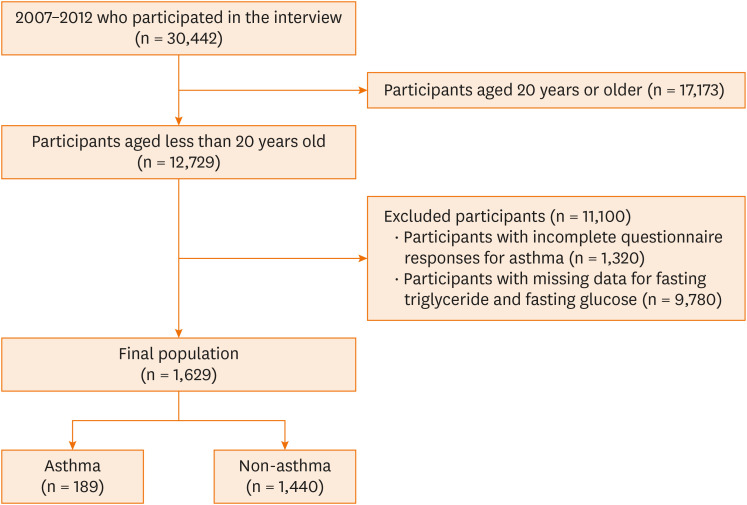
Data from the National Health and Nutrition Examination Survey between 2007 and 2012 was analyzed in this cross-sectional study. The association between TyG and asthma was evaluated using various statistical methods, including multivariate logistic regression analysis, restricted cubic spline (RCS) analysis, threshold effects analysis, and subgroup analysis.
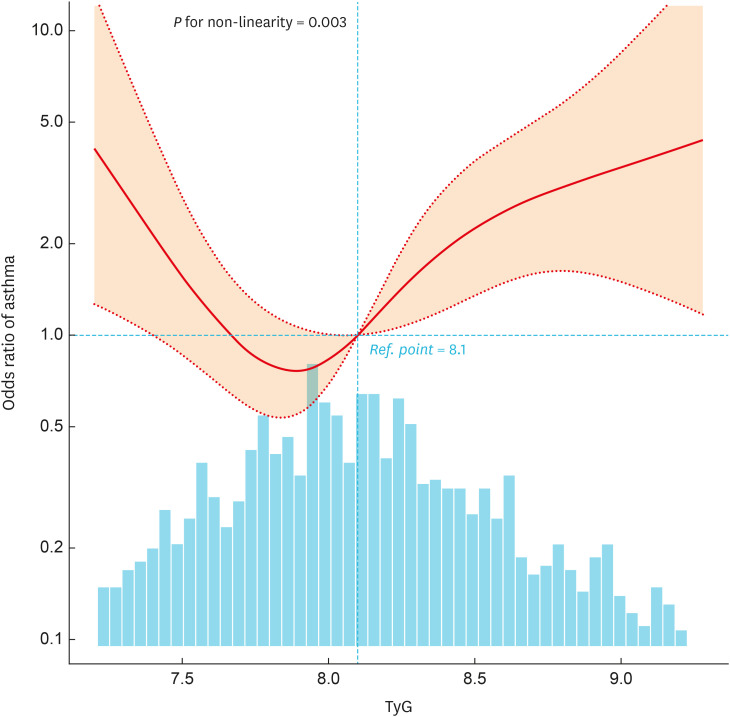
A total of 1,629 adolescent participants were enrolled in the study, consisting of 878 (53.9%) males and 751 females (46.1%), with a mean age of 15.5 years. After adjusting for all covariates in the multivariate logistic regression, the adjusted odds ratio (OR) for TyG and asthma in the highest quintile (Q5, > 8.65) was 4.26 (95% confidence interval [CI], 1.54, 11.81; = 0.005) compared to the TyG in the second quintile (Q2, 7.68-7.96). Additionally, the multivariate RCS analysis revealed a non-linear relationship between TyG and asthma ( = 0.003). In the threshold analysis, the adjusted OR of asthma was 0.001 (95% CI, 0, 0.145; = 0.007) in participants with a TyG < 7.78, and the adjusted OR of asthma was 3.685 (95% CI, 1.499, 9.058; = 0.004) in participants with a TyG ≥ 7.78. Subgroup analysis did not show any interactive role for TyG and asthma.
In US adolescents, a U-shaped association was observed between asthma and the TyG, with a critical turning point identified at around 7.78.
代谢异常,如胰岛素抵抗(IR)和血脂异常,与哮喘风险增加有关。甘油三酯-葡萄糖指数(TyG)是一种指示代谢功能障碍的指标,与代谢综合征和IR相关。然而,关于TyG与儿科人群哮喘之间的关系,研究较少。因此,我们旨在研究青少年中TyG与哮喘之间的关系。
在这项横断面研究中,分析了2007年至2012年期间美国国家健康与营养检查调查的数据。使用多种统计方法评估TyG与哮喘之间的关联,包括多因素逻辑回归分析、受限立方样条(RCS)分析、阈值效应分析和亚组分析。
共有1629名青少年参与了该研究,其中男性878名(53.9%),女性751名(46.1%),平均年龄15.5岁。在多因素逻辑回归中对所有协变量进行调整后,与第二五分位数(Q2,7.68 - 7.96)的TyG相比,最高五分位数(Q5,> 8.65)的TyG与哮喘的调整优势比(OR)为4.26(95%置信区间[CI],1.54,11.81;P = 0.005)。此外,多因素RCS分析显示TyG与哮喘之间存在非线性关系(P = 0.003)。在阈值分析中,TyG < 7.78的参与者中哮喘的调整OR为0.001(95% CI,0,0.145;P = 0.007),TyG≥7.78的参与者中哮喘的调整OR为3.685(95% CI,1.499,9.058;P = 0.004)。亚组分析未显示TyG与哮喘之间存在任何交互作用。
在美国青少年中,观察到哮喘与TyG之间呈U形关联,临界转折点约为7.78。