Kim Wanjin, Kim Su Min, Oh Jongwook, Park HeeUng, Lee Jiwon, Ryu Soorack, Kim Lark Kyun, Cho Han Kyoung, Park Kyung Hee, Lee Jae-Hyun, Park Jung-Won, Park Chang Ook
Department of Dermatology, Severance Hospital, Cutaneous Biology Research Institute, Yonsei University College of Medicine, Seoul, Korea.
Department of Dermatology, Myongji Hospital, Goyang, Korea.
Ann Dermatol. 2024 Dec;36(6):367-375. doi: 10.5021/ad.24.004.
Omalizumab, a monoclonal antibody targeting immunoglobulin E (IgE), is approved for adults and adolescents (12 years or older) with chronic spontaneous urticaria (CSU) that does not respond to high-dose antihistamines. In Korea, there is limited research on predictive biomarkers for omalizumab response in CSU patients.
This retrospective, single-institution study aimed to identify clinical parameters predicting omalizumab response in Korean CSU patients.
We analyzed records of CSU patients aged 19 or older starting omalizumab between January 2017 and October 2019. Omalizumab efficacy was assessed using the Urticaria Activity Score summed over 7 days (UAS7), categorized as well-controlled, mild, moderate, or severe. Ninety CSU patients participated in this study.
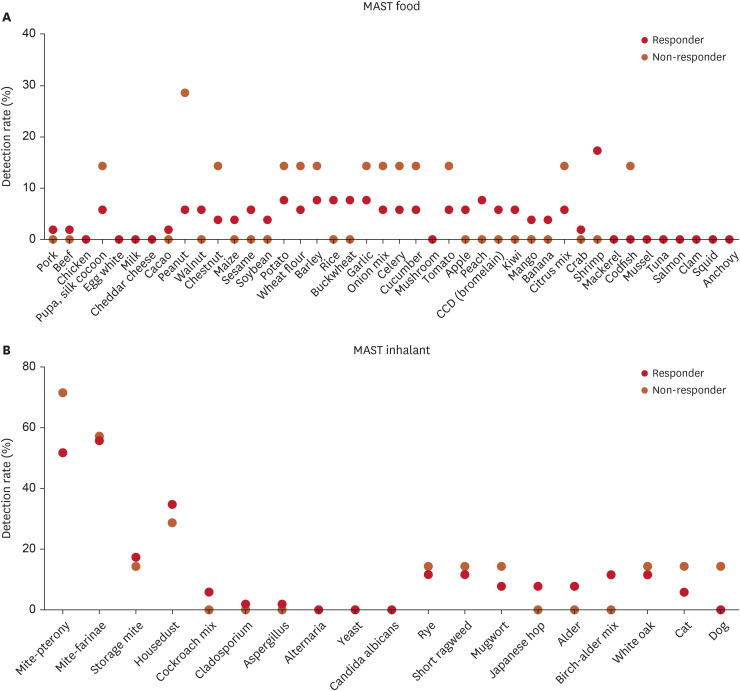
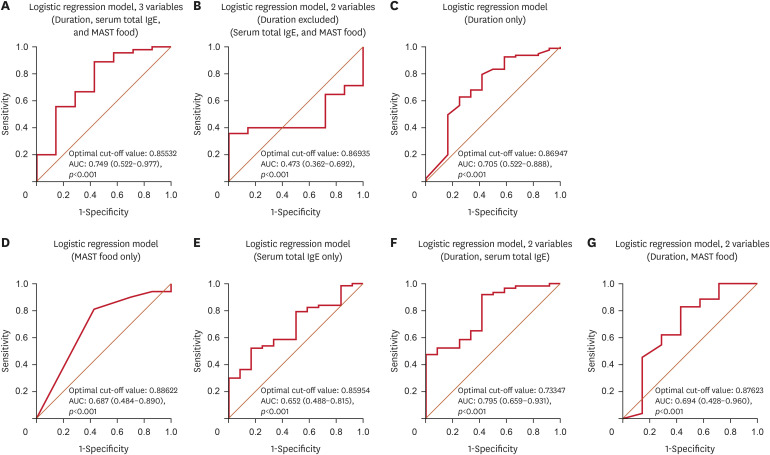
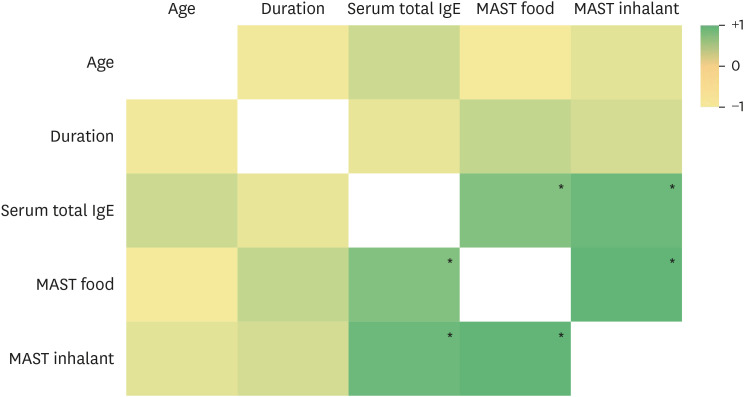
Among these, improvements in UAS7 categories from baseline to 12 weeks of treatment were observed in 78 patients, while 12 patients showed no significant efficacy. The present study identified potential biomarkers that could predict a patient's response to omalizumab, including disease duration and total serum IgE levels (=0.022, =0.046). Notably, a significant correlation was observed between higher detection rates in multiple antigen simultaneous test (MAST) food testing and lower treatment responses (=0.033).
Shorter disease duration of CSU and elevated initial serum total IgE level may serve as potential predictive biomarkers for the responsiveness to omalizumab. Furthermore, a higher MAST food detection rate seemed to correlate with a less favorable treatment response, suggesting patients with a high MAST food detection rate might benefit from a food evaluation in addition to omalizumab treatment.
奥马珠单抗是一种靶向免疫球蛋白E(IgE)的单克隆抗体,已被批准用于对高剂量抗组胺药无反应的成人和青少年(12岁及以上)慢性自发性荨麻疹(CSU)患者。在韩国,关于CSU患者中奥马珠单抗反应的预测生物标志物的研究有限。
这项回顾性单机构研究旨在确定预测韩国CSU患者奥马珠单抗反应的临床参数。
我们分析了2017年1月至2019年10月开始使用奥马珠单抗的19岁及以上CSU患者的记录。使用7天的荨麻疹活动评分总和(UAS7)评估奥马珠单抗疗效,分为控制良好、轻度、中度或重度。90名CSU患者参与了本研究。
其中,78名患者观察到从基线到治疗12周UAS7类别有所改善,而12名患者显示无显著疗效。本研究确定了可以预测患者对奥马珠单抗反应的潜在生物标志物,包括疾病持续时间和血清总IgE水平(=0.022,=0.046)。值得注意的是,在多抗原同步检测(MAST)食物检测中较高的检出率与较低的治疗反应之间观察到显著相关性(=0.033)。
CSU较短的疾病持续时间和升高的初始血清总IgE水平可能是对奥马珠单抗反应性的潜在预测生物标志物。此外,较高的MAST食物检测率似乎与较差的治疗反应相关,表明MAST食物检测率高的患者除奥马珠单抗治疗外可能还会从食物评估中获益。