Kanata Yoshihiro, Uchiyama Yuki, Iwasa Saya, Matsushima Satoko, Tauchi Yuta, Koyama Tetsuo, Domen Kazuhisa
Department of General Medicine and Community Health, Hyogo Medical University Sasayama Medical Center, Tanbasasayama, JPN.
Department of Rehabilitation Medicine, Hyogo Medical University Sasayama Medical Center, Tanbasasayama, JPN.
Cureus. 2024 Oct 29;16(10):e72658. doi: 10.7759/cureus.72658. eCollection 2024 Oct.
Outcome prediction is a crucial component of rehabilitation in post-stroke patients. However, only a few studies have focused on the influence of stroke recurrence on outcomes in these patients. This study aimed to determine the impact of stroke recurrence on functional independence using data from a convalescent rehabilitation hospital.
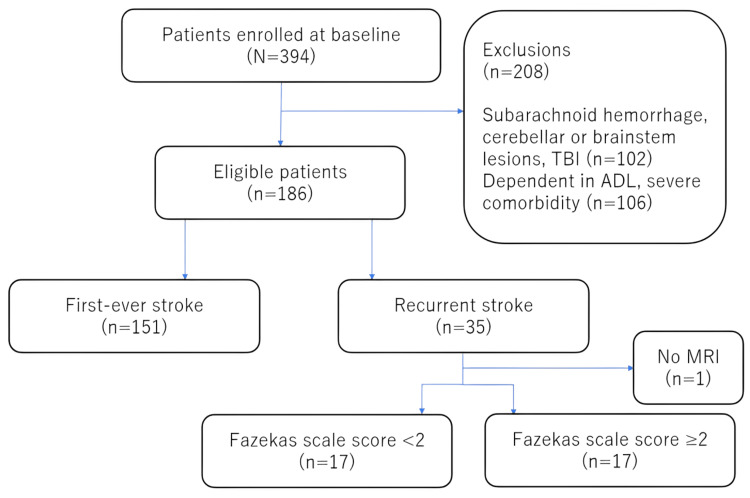
The study included stroke patients who were admitted to our convalescent rehabilitation hospital. Data were collected on age, stroke recurrence, and number of days between stroke onset and transfer to our facility. Scores for the motor component of the functional independence measure (FIM-motor) and stroke impairment assessment set (SIAS-motor) were obtained at admission and discharge. Multivariate regression analysis was performed using the FIM-motor score at discharge as the dependent variable. Stroke recurrence was used as the independent variable, with age, days from onset to transfer, and FIM-motor and total SIAS-motor scores at admission entered as covariates. To explore the impact of the size of deep white matter lesions from prior strokes, we used the Fazekas scale to classify the recurrent cases into subgroups (0-1 or 2-3) and compared the FIM-motor scores at discharge between them.
After adjusting for the above-mentioned covariates, stroke recurrence emerged as a statistically significant predictor of a reduced FIM-motor score at discharge. Furthermore, in patients with recurrent stroke, those with larger deep white matter lesions had a significantly lower FIM-motor score at discharge.
Stroke recurrence was found to be an independent predictor of a reduced FIM-motor score. Moreover, in patients with recurrent stroke, larger deep white matter lesions were associated with further reductions in the FIM-motor score. These findings underscore the negative impact of recurrent stroke on functional independence in stroke patients.
结果预测是中风后患者康复的关键组成部分。然而,只有少数研究关注中风复发对这些患者预后的影响。本研究旨在利用一家康复医院的数据,确定中风复发对功能独立性的影响。
该研究纳入了入住我们康复医院的中风患者。收集了患者的年龄、中风复发情况以及从中风发作到转入我们机构之间的天数等数据。在入院时和出院时获取功能独立性测量(FIM - 运动)和中风损伤评估量表(SIAS - 运动)的运动部分评分。以出院时的FIM - 运动评分为因变量进行多变量回归分析。将中风复发作为自变量,将年龄、发病到转入的天数以及入院时的FIM - 运动和SIAS - 运动总分作为协变量纳入分析。为了探究既往中风引起的深部白质病变大小的影响,我们使用 Fazekas 量表将复发病例分为亚组(0 - 1级或2 - 3级),并比较两组之间出院时的FIM - 运动评分。
在对上述协变量进行调整后,中风复发成为出院时FIM - 运动评分降低的统计学显著预测因素。此外,在中风复发的患者中,深部白质病变较大的患者出院时的FIM - 运动评分显著更低。
发现中风复发是FIM - 运动评分降低的独立预测因素。此外,在中风复发的患者中,较大的深部白质病变与FIM - 运动评分的进一步降低相关。这些发现强调了复发性中风对中风患者功能独立性的负面影响。