Neller Michelle A, Ambalathingal George R, Hamad Nada, Sasadeusz Joe, Pearson Rebecca, Holmes-Liew Chien-Li, Singhal Deepak, Tunbridge Matthew, Ng Wei Yang, Sharplin Kirsty, Moore Andrew, Deambrosis David, Soosay-Raj Trisha, McNaughton Peter, Whyte Morag, Fraser Chris, Grigg Andrew, Kliman David, Bajel Ashish, Cummins Katherine, Dowling Mark, Yeoh Zhi Han, Harrison Simon J, Khot Amit, Tan Sarah, Roos Izanne, Koo Ray Mun, Dohrmann Sara, Ritchie David, Wainstein Brynn, McCleary Karen, Nelson Adam, Gardiner Bradley, Inam Shafqat, Badoux Xavier, Ma Kris, Toro Claudia, Hanna Diane, Hughes David, Conyers Rachel, Cole Theresa, Wang Shiqi Stacie, Chee Lynette, Fleming Jacqueline, Irish Ashley, Purtill Duncan, Cooney Julian, Shaw Peter, Tey Siok-Keen, Hunt Stewart, Subramonia Pillai Elango, John George, Ng Michelle, Ramachandran Shanti, Hopkins Peter, Chambers Daniel, Campbell Scott, Francis Ross, Isbel Nicole, Marlton Paula, Reddiex Hilary, Matthews Katherine K, Voogt Meggie, Panikkar Archana, Beagley Leone, Rehan Sweera, Best Shannon, Raju Jyothy, Le Texier Laetitia, Crooks Pauline, Solomon Matthew, Lekieffre Lea, Srihari Sriganesh, Smith Corey, Khanna Rajiv
Queensland Immunology Research Centre, Infection and Inflammation Program, QIMR Berghofer Medical Research Institute, Herston, Queensland, Australia.
Department of Haematology, St Vincent's Hospital, School of Clinical Medicine, University of New South Wales and School of Medicine, University of Notre Dame, Sydney, New South Wales, Australia.
Nat Commun. 2024 Dec 3;15(1):10339. doi: 10.1038/s41467-024-54595-2.
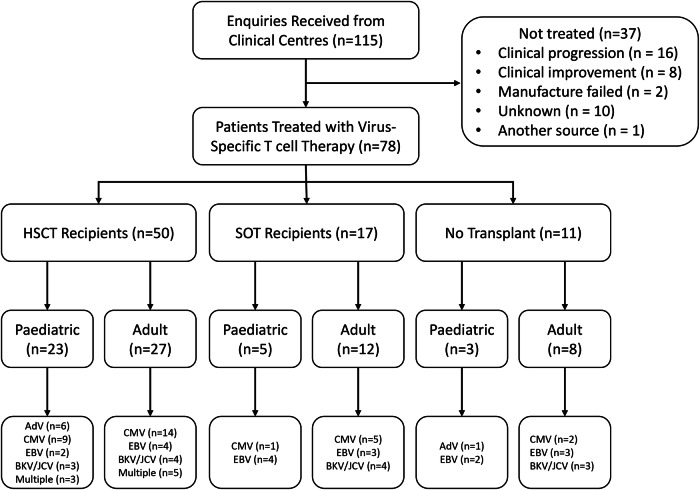
Adoptive T-cell immunotherapy holds great promise for the treatment of viral complications in immunocompromised patients resistant to standard anti-viral strategies. We present a retrospective analysis of 78 patients from 19 hospitals across Australia and New Zealand, treated over the last 15 years with "off-the-shelf" allogeneic T cells directed to a combination of Epstein-Barr virus (EBV), cytomegalovirus (CMV), BK polyomavirus (BKV), John Cunningham virus (JCV) and/or adenovirus (AdV) under the Australian Therapeutic Goods Administration's Special Access Scheme. Most patients had severe post-transplant viral complications, including drug-resistant end-organ CMV disease, BKV-associated haemorrhagic cystitis and EBV-driven post-transplant lymphoproliferative disorder. Adoptive immunotherapy is well tolerated with few adverse effects. Importantly, 46/71 (65%) patients show definitive clinical improvement including reduction in viral load, clinical symptoms and complete resolution of end-organ disease. In addition, seven high-risk patients remain disease free. Based on this long-term encouraging clinical experience, we propose that a dedicated nationally funded centre for anti-viral cellular therapies should be considered to provide T cell therapies for critically ill patients for compassionate use.
过继性T细胞免疫疗法在治疗对标准抗病毒策略耐药的免疫功能低下患者的病毒并发症方面具有巨大潜力。我们对来自澳大利亚和新西兰19家医院的78例患者进行了回顾性分析,这些患者在过去15年中根据澳大利亚治疗用品管理局的特殊准入计划,接受了针对爱泼斯坦-巴尔病毒(EBV)、巨细胞病毒(CMV)、BK多瘤病毒(BKV)、约翰·坎宁安病毒(JCV)和/或腺病毒(AdV)组合的“现成”同种异体T细胞治疗。大多数患者有严重的移植后病毒并发症,包括耐药性终末器官CMV疾病、BKV相关出血性膀胱炎和EBV驱动的移植后淋巴细胞增生性疾病。过继性免疫疗法耐受性良好,不良反应较少。重要的是,46/71(65%)的患者显示出明确的临床改善,包括病毒载量降低、临床症状改善和终末器官疾病完全缓解。此外,7例高危患者仍无疾病。基于这一长期令人鼓舞的临床经验,我们建议应考虑设立一个由国家资助的专门抗病毒细胞治疗中心,为重症患者提供T细胞疗法以供同情使用。