He Zhi, Li Chunxia, Gao Kuo, Zheng Xubin, Wang Xuanyu, Wang Huiling, Chen Qiqi, Tang Ziting, Zhang Mingwang, Yang Deying, Yan Taiming
College of Animal Science and Technology, Sichuan Agricultural University, Chengdu, China.
BMC Genomics. 2024 Dec 3;25(1):1175. doi: 10.1186/s12864-024-11100-9.
Percocypris pingi (Tchang) was classified as Endangered on the Red List of China's Vertebrates in 2015 and is widely distributed in the Upper Yangtze River. Although breeding and release into wild habitats have been performed for this commercially important fish in recent years, low genetic diversity has been found in wild populations. Genomic resources are strongly recommended before formulating and carrying out conservation strategies for P. pingi. Thus, there is an urgent need to conserve germplasm resources and improve the population diversity of P. pingi. To date, the whole genome of P. pingi has not been reported.
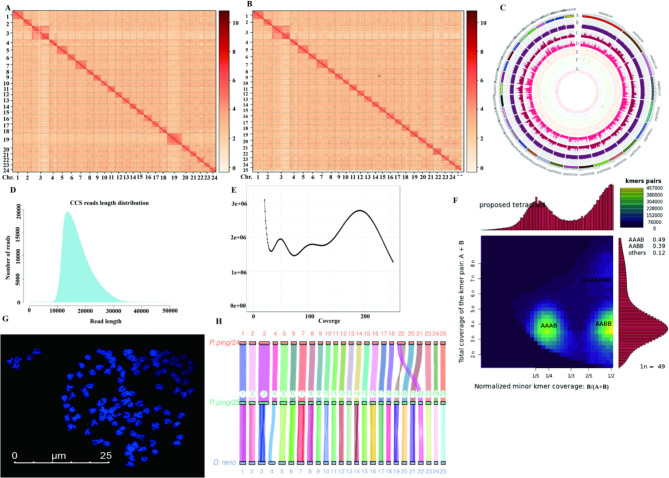
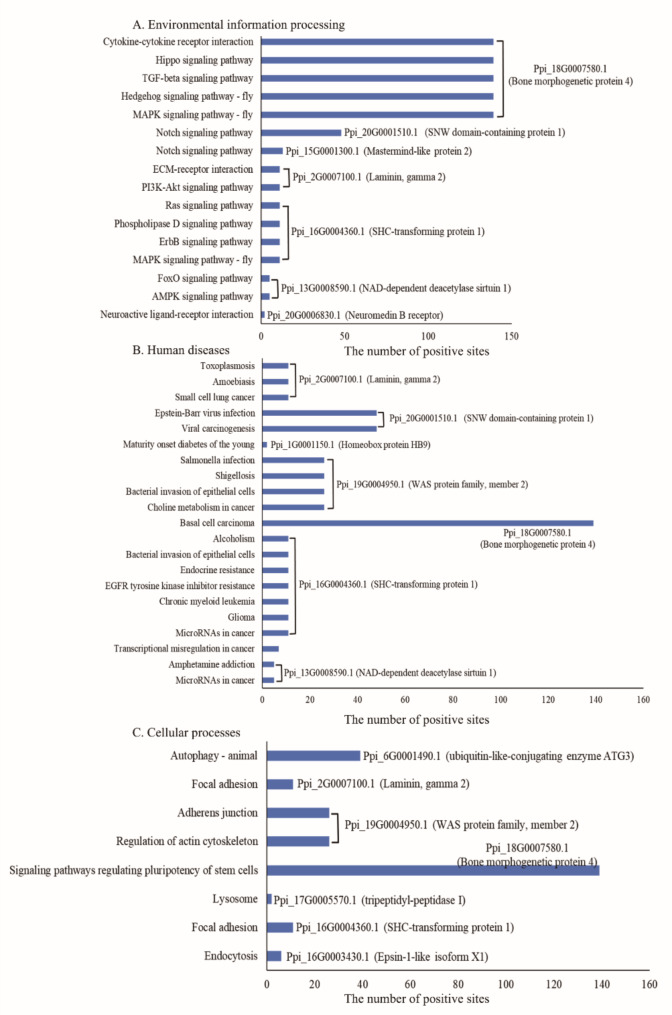
In our study, we constructed the first chromosome-level genome of P. pingi by high-throughput chromosome conformation capture (Hi-C) technology and PacBio long-read sequencing. The assembled genome was 1.7 Gb in size, with an N50 of 17,692 bp and a GC content from circular consensus sequencing of 37.67%. The Hi-C results again demonstrated that P. pingi was tetraploid (n = 98), with the genome consisting of 24-type and 25-type chromosomes. Chr.19 of the 24-type chromosomes in P. pingi resulted from the fusion of chr.19 and chr.22 in zebrafish. The divergence times between 24-type and 25-type chromosomes was around 6.1 million years ago. A total of 25,198 and 25,291 protein-coding genes were obtained from the 24-type and 25-type chromosomes, respectively. The ploidy of P. pingi is an allotetraploid. A total of 8,741 genes of P. pingi were clustered into 4,378 gene families that were shared with 14 other species, and the P. pingi genome had 68 unique gene families. Phylogenetic analyses indicated that P. pingi was most closely related to Schizothorax oconnori, and the genes were clustered on one branch. We identified 166 significantly expanded gene families and 173 significantly contracted gene families in P. pingi. The most enriched positive protein-coding genes, such as Bmp-4, Etfdh, homeobox protein HB9, and ATG3, were screened.
Our study provides a high-quality chromosome-anchored reference genome for P. pingi and provides sufficient information on the chromosomes, which will lead to valuable resources for genetic, genomic, and biological studies of P. pingi and for improving the genetic diversity, population size, and scientific conservation of endangered fish and other key cyprinid species in aquaculture.
长丝裂腹鱼(Percocypris pingi (Tchang))在2015年被列入中国脊椎动物红色名录中的濒危物种,广泛分布于长江上游。尽管近年来针对这种具有重要商业价值的鱼类开展了人工繁殖并放流到野生栖息地,但野生种群中发现遗传多样性较低。在制定和实施长丝裂腹鱼保护策略之前,强烈建议获取基因组资源。因此,迫切需要保护长丝裂腹鱼的种质资源并提高其种群多样性。迄今为止,长丝裂腹鱼的全基因组尚未见报道。
在我们的研究中,我们通过高通量染色体构象捕获(Hi-C)技术和PacBio长读长测序构建了首个染色体水平的长丝裂腹鱼基因组。组装后的基因组大小为1.7 Gb,N50为17,692 bp,通过环形一致序列测序得到的GC含量为37.67%。Hi-C结果再次表明长丝裂腹鱼是四倍体(n = 98),其基因组由24条染色体类型和25条染色体类型组成。长丝裂腹鱼24条染色体类型中的第19号染色体是由斑马鱼的第19号和第22号染色体融合形成的。24条染色体类型和25条染色体类型之间的分歧时间约为610万年前。分别从24条染色体类型和25条染色体类型中获得了25,198个和25,291个蛋白质编码基因。长丝裂腹鱼的倍性为异源四倍体。长丝裂腹鱼共有8,741个基因聚集成4,378个与其他14个物种共有的基因家族,长丝裂腹鱼基因组有68个独特的基因家族。系统发育分析表明长丝裂腹鱼与异齿裂腹鱼(Schizothorax oconnori)关系最为密切,基因聚集在一个分支上。我们在长丝裂腹鱼中鉴定出166个显著扩张的基因家族和173个显著收缩的基因家族。筛选出了最富集的正向蛋白质编码基因,如骨形态发生蛋白4(Bmp-4)、电子传递黄素蛋白脱氢酶(Etfdh)、同源框蛋白HB9和自噬相关蛋白3(ATG3)。
我们的研究为长丝裂腹鱼提供了高质量的染色体锚定参考基因组,并提供了关于染色体的充分信息,这将为长丝裂腹鱼的遗传、基因组和生物学研究以及提高濒危鱼类和水产养殖中其他关键鲤科物种的遗传多样性、种群数量和科学保护提供宝贵资源。