Sonune S P, Saha A, Joshi N G, Pathak S, Bhadra P, Goel G
Department of Physical Medicine and Rehabilitation, All India Institute of Medical Sciences, Bhopal, India.
Can Prosthet Orthot J. 2024 Oct 28;7(1):42879. doi: 10.33137/cpoj.v7i1.42879. eCollection 2024.
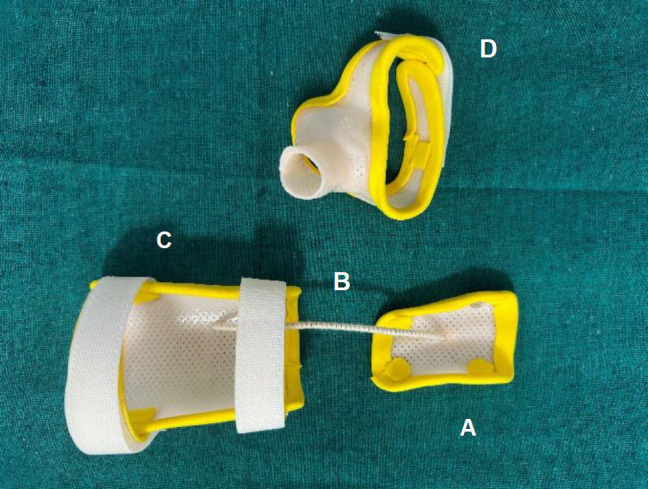
An individual experiencing tetraplegia faces functional limitations due to impaired hand function. The use of an affordable tenodesis wrist-hand orthosis (WHO) can enable finger flexion with active wrist extension, thereby enhancing the three-jaw chuck grasp and overall hand functionality.
To assess hand function and satisfaction in patients with tetraplegia using a modified tenodesis wrist-hand orthosis (WHO), utilizing the Duruöz Hand Index (DHI) and the Orthotics and Prosthetics User Survey (OPUS) satisfaction with device and services subscales.
The study was conducted at a tertiary care center in central India, enrolling patients with tetraplegia admitted to the Department of Physical Medicine and Rehabilitation. A modified tenodesis wrist-hand orthosis (WHO) was designed using low-temperature thermoplastic components. Twenty-two individuals with a minimum wrist extensor power of grade 3/5 were included in the study. These patients were provided with the modified tenodesis WHO and underwent daily training sessions for a period of 2 weeks. Duruöz Hand Index (DHI) scores were assessed at baseline, 6 weeks, and 12 weeks postenrolment. Patient satisfaction was evaluated using the Orthotics and Prosthetics User's Survey (OPUS) satisfaction with device and services subscales.
The analysis of the DHI scores indicated a significant enhancement in functional abilities at both 6-week and 12-week follow-ups compared to the baseline assessment. Notably, the most substantial progress at 6 weeks follow-up was observed in tasks such as buttoning a shirt, while significant improvement at the 12-week mark was noted in activities like turning a key in a lock. The median OPUS device satisfaction score was 50, corresponding to a Rasch score of 68.8. Additionally, the median OPUS satisfaction score for services stood at 46, with a Rasch score of 72.7. Patients expressed the highest satisfaction levels with the courteous demeanor of the staff, prompt scheduling of appointments, and accurate fitting of the orthosis.
The study findings indicate that the modified tenodesis WHO is an effective and satisfactory therapeutic device for improving hand function in patients with tetraplegia. The findings encourage further investigation and application of the modified tenodesis WHO in clinical practice.
因手部功能受损,四肢瘫痪患者面临功能限制。使用价格实惠的动力腱式手腕-手部矫形器(WHO)可在主动伸腕时实现手指屈曲,从而增强三指捏握及整体手部功能。
使用改良动力腱式手腕-手部矫形器(WHO),通过杜鲁奥兹手部指数(DHI)以及矫形器与假肢使用者对装置及服务满意度量表,评估四肢瘫痪患者的手部功能及满意度。
该研究在印度中部的一家三级护理中心开展,纳入物理医学与康复科收治的四肢瘫痪患者。采用低温热塑性部件设计了一种改良动力腱式手腕-手部矫形器(WHO)。研究纳入了22名腕伸肌力量至少为3/5级的个体。为这些患者提供改良动力腱式WHO,并进行为期2周的每日训练课程。在入组时、入组后6周和12周评估杜鲁奥兹手部指数(DHI)得分。使用矫形器与假肢使用者对装置及服务满意度量表评估患者满意度。
DHI得分分析表明,与基线评估相比,在6周和12周随访时功能能力均有显著提高。值得注意的是,在6周随访时,扣衬衫纽扣等任务取得了最大进展,而在12周时,开锁等活动有显著改善。OPUS装置满意度中位数得分为50,对应拉施得分68.8。此外,服务的OPUS满意度中位数得分为46,拉施得分为72.7。患者对工作人员的礼貌态度、预约安排迅速以及矫形器适配准确满意度最高。
研究结果表明,改良动力腱式WHO是改善四肢瘫痪患者手部功能的有效且令人满意的治疗装置。这些发现鼓励在临床实践中对改良动力腱式WHO进行进一步研究和应用。