Spencer Jennifer C, Whitaker Rebecca G, Pignone Michael P
Department of Population Health, Dell Medical School, The University of Texas at Austin, Austin, Texas.
Department of Internal Medicine, Dell Medical School, The University of Texas at Austin, Austin, Texas.
AJPM Focus. 2024 Oct 18;4(1):100289. doi: 10.1016/j.focus.2024.100289. eCollection 2025 Feb.
Effective December 2023, North Carolina expanded Medicaid eligibility to cover individuals up to 138% of the Federal Poverty Level. The authors sought to understand the preventive care needs of the newly Medicaid-eligible population.
The authors conducted a repeat cross-sectional analysis using the 2016, 2018, 2020, and 2022 North Carolina Behavioral Risk Factor Surveillance Survey. The authors defined the Medicaid expansion population as those aged 18-64 years with household incomes below 138% Federal Poverty Level and reporting no current source of insurance. The authors compared with those enrolled in traditional Medicaid and all nonelderly adult North Carolinians, evaluating up-to-date use of preventive care services. Survey weights were used to estimate total unmet need.
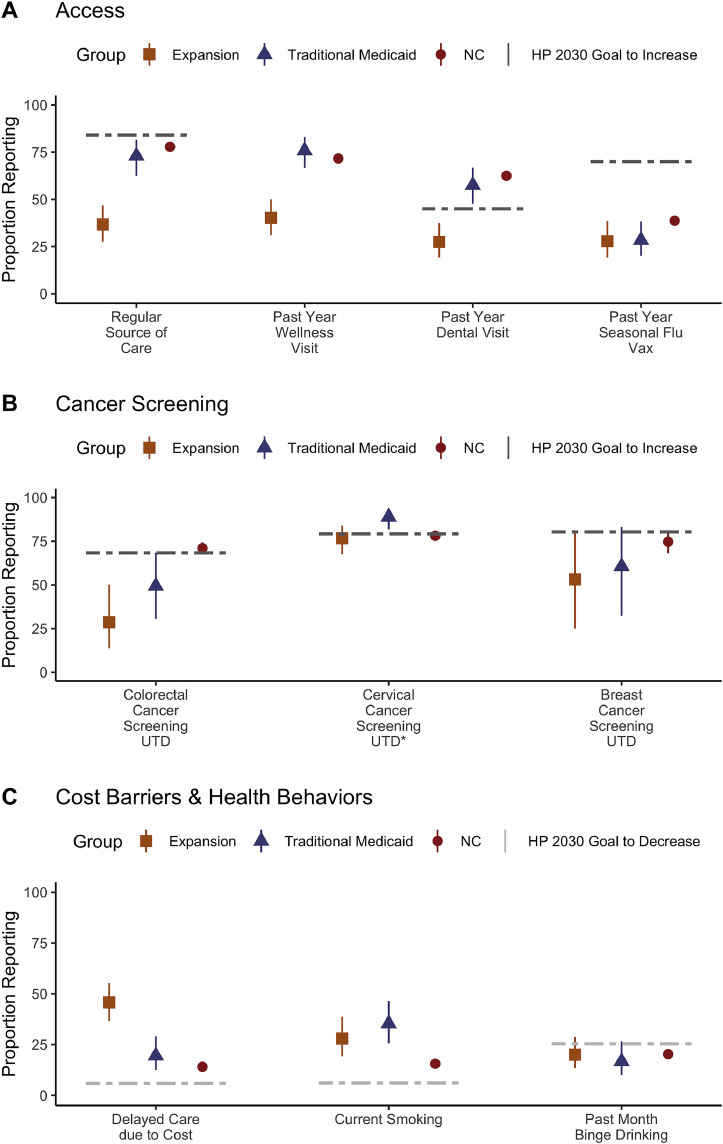
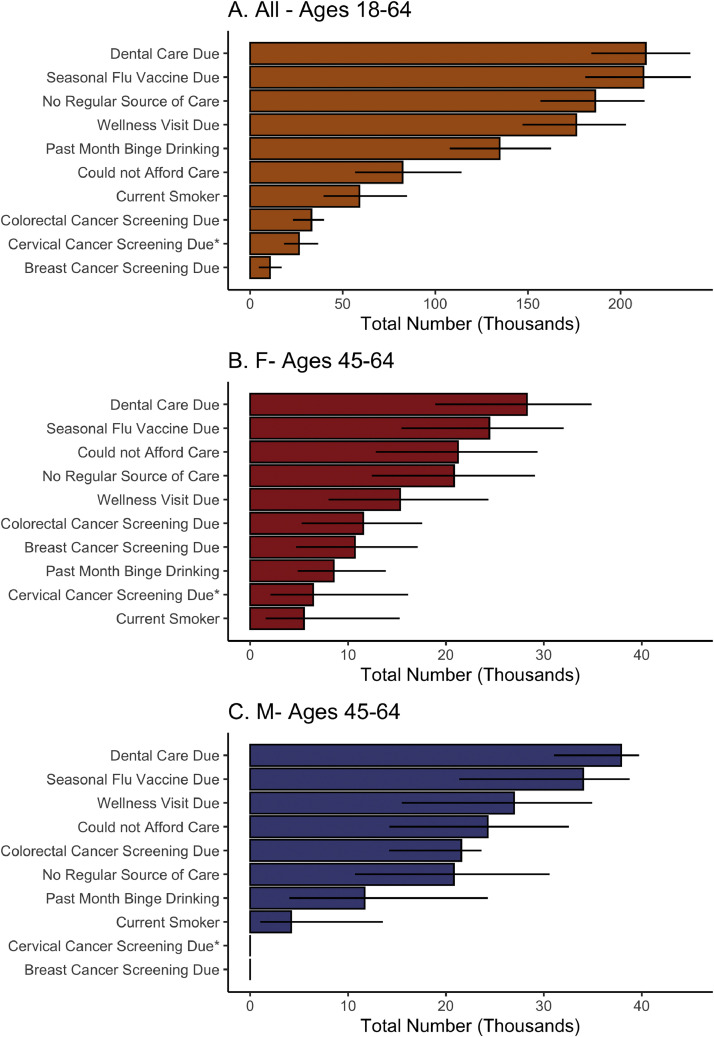
The authors estimated 294,000 individuals in the Medicaid expansion population in 2022. Preventive care use was low for the expansion population in all years. In 2022, 36.7% (27.7%-46.8%) reported having a regular source of care, 40.2% (31.1%-50%) reported a past-year wellness visit, and 45.7% (36.6%-55.2%) reported delaying needed care owing to cost. Among eligible respondents, 28.6% (13.8%-50.2%) were up to date with colorectal cancer screening (vs 49.4% [30.5%-68.4%] for traditional Medicaid and 71% [67.3%-74.4%] for all North Carolina population). It was estimated that 176,000 in the expansion population needed a wellness visit; 186,000 needed a regular care provider; and 66,000 needed 1 or more cancer screening.
The North Carolina Medicaid expansion population has a high number of unmet preventive care needs. North Carolina should consider approaches to improve provider capacity for those in Medicaid and promote preventive care and risk reduction for the newly enrolled expansion population.
自2023年12月起,北卡罗来纳州扩大了医疗补助资格范围,将联邦贫困线138%以下的个人纳入其中。作者试图了解新符合医疗补助资格人群的预防性保健需求。
作者使用2016年、2018年、2020年和2022年北卡罗来纳州行为风险因素监测调查进行重复横断面分析。作者将医疗补助扩大人群定义为年龄在18至64岁之间、家庭收入低于联邦贫困线138%且报告目前没有保险来源的人群。作者将其与参加传统医疗补助的人群以及所有北卡罗来纳州非老年成年人进行比较,评估预防性保健服务的最新使用情况。调查权重用于估计总的未满足需求。
作者估计2022年医疗补助扩大人群中有294,000人。在所有年份中,扩大人群的预防性保健使用率都很低。2022年,36.7%(27.7%-46.8%)报告有固定的医疗服务来源,40.2%(31.1%-50%)报告过去一年进行过健康检查,45.7%(36.6%-55.2%)报告因费用问题推迟了所需的医疗服务。在符合条件的受访者中,28.6%(13.8%-50.2%)进行了最新的结直肠癌筛查(传统医疗补助人群为49.4%[30.5%-68.4%],北卡罗来纳州所有人群为71%[67.3%-74.4%])。据估计,扩大人群中有176,000人需要进行健康检查;186,000人需要有固定的医疗服务提供者;66,000人需要进行1次或更多次癌症筛查。
北卡罗来纳州医疗补助扩大人群有大量未满足的预防性保健需求。北卡罗来纳州应考虑采取措施,提高医疗补助人群的医疗服务提供者能力,并为新纳入的扩大人群促进预防性保健和降低风险。